
A runway weight limit that moves from 45,000 pounds to at least 65,000 pounds is, among other things, a paving specification. That change appears in a plan Greeley published for its airport, and it shows why concrete paving is chosen where wheels are heavy and loads repeat: the pavement has to behave like a structure, not like a surface.
We place concrete pavement for truck routes, intersections, bus pads, aircraft aprons, industrial yards and other heavy-traffic areas on the northern Front Range. The work looks simple from the street, a gray ribbon going down in a straight line, but it depends on a long list of details: a stable subbase, correct thickness, dowelled joints, mix durability for freeze-thaw, and curing that protects the surface in the first days.
Concrete costs more to place than asphalt, but it lasts longer under heavy loads and needs less maintenance. We help owners and designers compare the two on lifecycle terms, not just first cost.
Airports are the clearest example. Northern Colorado Regional Airport has an 8,500 by 100 foot main runway and sits on just over 1,000 acres northeast of Loveland. Greeley-Weld County Airport has a 10,000 foot runway and has been pursuing FAA Part 139 certification, with plans for a new hangar and taxiway. Aprons, taxiways and hangar pads are concrete or asphalt depending on aircraft loads, and the work needs careful coordination with airfield operations.
Roads and interchanges are another. The CDOT interchange project at I-25 and Mulberry covers I-25 mileposts 269 to 271 and CO 14 frontage road connections, and cites flooding concerns and aging infrastructure. Construction funding had not been identified as of the last published update, so schedule is uncertain, but projects like it call for pavement designed for heavy traffic and drainage challenges. Private owners of truck terminals and logistics yards follow the same logic.
Concrete pavement is designed by a civil or pavement engineer from traffic, soil strength and climate. The design sets slab thickness, subbase type and depth, joint spacing, dowel size and spacing, and concrete strength, usually in flexural terms. Air entrainment is required for Colorado freeze-thaw exposure. Public agencies publish standard specifications that define each of these, and airport work follows aviation requirements on top.
Testing accompanies placement. Slump, air content, temperature and strength samples are taken from the truck, and thickness is verified by probing or coring. Ride quality may be measured on larger roads. We coordinate with the testing agency, share results with the engineer and fix any issue immediately. Subbase density and proof-rolling are tested before paving to confirm support is uniform.
Pavement performance starts below the slab. We trim the subbase to tight tolerances, compact it to the required density, and proof-roll to find soft areas. Uniform support matters more than high support: slabs on soft spots crack. We set forms or a stringline for slipform paving, place dowel baskets or use dowel bar inserters, and tie longitudinal joints with bars where the design calls for it.
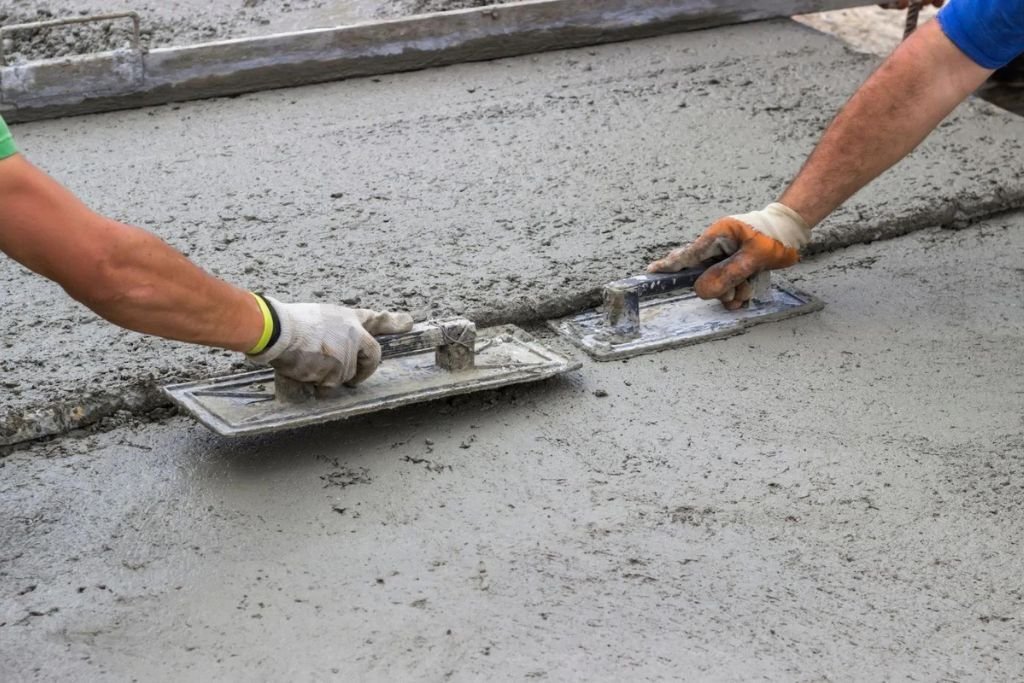
Placement is continuous. We keep the paver or the screed moving, coordinate truck arrivals so the concrete does not stack up, and finish the surface with a texture appropriate for the traffic. Curing compound goes on right behind the finishing. Joints are sawed as soon as the concrete can take it without raveling, which can be only a few hours after placement, and we schedule saw crews so the timing is not missed.
Pavement thickness and subbase depth drive volume and cost, followed by dowels, tie bars and joint sealing. Slipform paving is economical for long, uniform runs; fixed-form paving suits intersections, small lots and irregular shapes. Haul distance from the batch plant and the pace of placement affect delivered price, and so do traffic control and phasing requirements in live areas.
The tradeoff against asphalt is cost now versus cost later. Concrete pavement has higher initial cost but lower maintenance and longer service life, particularly under standing trucks, turning movements and fuel spills. Owners of logistics yards and municipal streets often prefer it for those reasons. Where concrete is used only at high-stress zones such as intersections and truck waiting areas, a hybrid design can control budget.
Concrete pavement can be opened to traffic when it reaches the strength the engineer specifies, which may take a few days with normal mix or less with high-early mixes. We plan placement around that date, and we set staging so work zones can be handed back to the public or the tenant on time. In cold weather, blankets and heat extend curing; in hot weather, fogging and retarders buy working time.
Seasonal limits matter. Late fall and early spring windows are narrow, and a pavement placed too late may be exposed to freeze before it matures. We recommend placing early in the season or accepting winter protection costs. Coordinate with the utility crews so that trenching across new pavement is complete before we begin. Cutting into new concrete for a forgotten service line is expensive.
Concrete paving is one of a set of scopes that fit together. Parking lot concrete and truck courts and dock aprons use the same principles at different thicknesses, and curb and gutter defines the edges. Underneath, road subgrade preparation determines how long the pavement lasts. Paving is often priced with the building concrete that surrounds it, which our commercial concrete contractor page covers.
Owners of an aircraft hangar need apron and taxi paving, and municipal and public works departments need roads and intersections. We price each scope separately and together, and we coordinate with the airport managers at Northern Colorado Regional Airport and elsewhere on operating restrictions.
Share the pavement section, the traffic and your target opening date. We will return a paving plan and price with subbase, joints and curing laid out.
It depends on traffic, subgrade and design life. Industrial yards and truck aprons often run six to nine inches or more, and airport pavement can be thicker. The pavement engineer sets the number and we build to it with the specified subbase and joints.
Dowels transfer load across joints so slabs share traffic and do not fault. Without them, repeated truck wheels can create steps at the joints. They are placed in baskets or inserted mechanically at the specified spacing and must be aligned carefully.
Only with protection. We avoid frozen subbase, place warm mix, and use blankets or heat for curing. Late-season paving is risky, and sometimes it is better to wait until spring.
Many designs call for several days of curing and a minimum strength, verified by cylinders or beams. High-early mixes can shorten this. We schedule opening dates with the owner and the engineer and keep barricades up until the numbers are met.
After curing, we clean the saw cuts and install backer rod and sealant, or a preformed seal, to keep water and debris out. Sealing prevents pumping and spalling and is done to a set depth and width.