
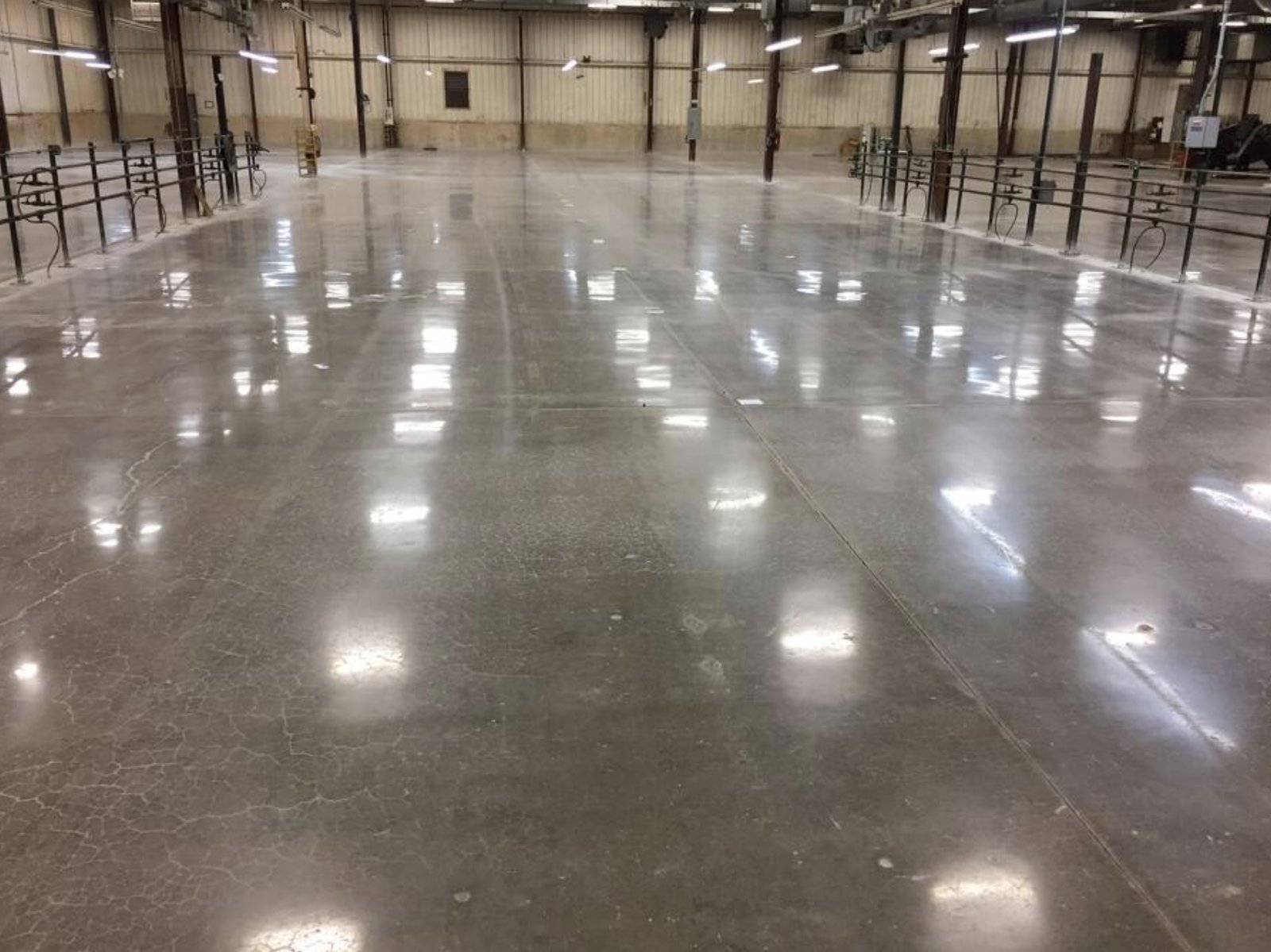
Polished concrete is a grinding job before it is a finishing job, and the best results are decided when the slab is poured, not when the polisher arrives. The concrete has to be placed, finished and cured with polishing in mind, because the grinder will expose whatever the slab contains: the mix, the aggregate, the troweling pattern and every blemish that happened in the first two days.
We build and polish floors for retail tenants, office users and flex buildings that want a durable, light-reflective floor without a separate flooring material. A properly polished slab resists abrasion, cleans quickly, and does not need waxing. It also asks the owner to accept that concrete is a natural material, with variations in color and fine hairline cracking that become part of its look.
Our approach is to align the slab work and the polishing work early, so the floor you see at opening is the one both of us planned.
The scope starts with a mix and finishing plan. For floors that will be polished, we typically use a hard-troweled finish, avoid curing compounds that interfere with densifier, and cure with water or a compatible cure. Joint layout is set early, with control joints arranged to respect the building grid and avoid awkward cuts across the polished field.
Polishing proceeds through a sequence of diamond abrasives, starting with coarse metal-bond tools that remove the surface paste and open the desired aggregate exposure, then finer resin-bond tools that refine the sheen. A chemical densifier is applied to harden the surface, and a guard coat or burnish can follow. Joints and cracks are filled with a semi-rigid material, flush with the surface, so that wheels and heels do not chip the edges. We describe each step and its tolerance in the proposal.
A polished floor should be one of the last trades in the building, but the slab is one of the first. That gap is the schedule problem. A slab that sits exposed for months collects stains, scratches, paint, drywall mud and rust marks that polishing may not remove. We protect it with sheet protection or a temporary coating where the schedule calls for it, and we set a protection plan with the general contractor.
Polishing needs a dry, enclosed building, clean power and a dust-control setup, and it usually follows painting and heavy equipment moves. We plan access with the construction manager, pick days when other trades are not tracking in, and keep the polish crew from standing idle. In winter, heat in the building matters because temperature affects densifier performance and cure.
Slab moisture affects polishing as it affects any floor finish. We check relative humidity or moisture emission where the specification asks for it and discuss a vapor retarder under the slab at the design stage. Cracks will occur in most slabs even with good practice, and a polished floor shows them. Owners who choose polish should expect hairline cracks to be filled rather than eliminated.
Color and aggregate exposure vary with mix and with how deep the grinding goes. A cream finish removes little surface paste, a salt-and-pepper finish exposes fine aggregate, and a full-aggregate finish goes deeper and costs more. We prepare sample panels where it matters so the owner can approve appearance in the real light of the space. Dyes and stains add color but also add a step and a maintenance consideration.
Retail buildings favor polished concrete for its reflectivity and low maintenance, and the northern Front Range has plenty of retail activity. Centerra, a commercial hub at the I-25 and US 34 interchange shared by Loveland and Johnstown, includes shopping centers, a mall and a medical center, and a 39,000 square foot commercial condo project in Timnath near Harmony Road shows the smaller format. For a retail shopping center, polished floors cut maintenance costs for tenants.
Offices and technology space also use the finish. The Harmony Road corridor, where a three-story 179,688 square foot office building changed hands in 2019, is the kind of office stock where tenant improvements can include exposed, polished slabs. Flex buildings combine showroom and shop, where flex and light industrial space benefits from a durable floor that looks finished. Office buildings may use polish in lobbies and common areas.
Cost scales with the level of finish. A basic grind and seal is the lowest cost; a mid-level polish with densifier is more; a full-aggregate high-gloss polish is the most. Floor area, slab condition, joint count, color treatments and the number of grinding steps all matter. Existing slabs that were not placed with polishing in mind may need more passes, patching and filler.
Compared with other floor coverings, polished concrete can be economical over time because there is no replacement of tile or carpet and little wax or stripping. Initial cost depends on how much the slab can do the work. We outline options, including a more decorative path through decorative concrete and tougher industrial treatments through industrial concrete floors, and commercial developers can compare lifecycle cost to the budget for tenant improvements.
Send the plan and the finish schedule. We will propose slab, joint and polish steps with a protection plan and a price for the sheen you want.
Most can, but results vary. Slabs placed and finished with polishing in mind give better, more uniform results. Older or poorly finished slabs may show patches, stains or soft spots. We evaluate the slab and set expectations before quoting.
Concrete cracks as it shrinks, and polishing does not prevent that. Control joints guide most cracks, and we fill joints and visible cracks with a semi-rigid filler. Hairline cracks are normal and are part of the character of the floor.
A polished floor can be slippery when wet. For entries and wet areas, we recommend a lower sheen or a slip-resistant sealer. The specification should state the required coefficient of friction, and we test it when asked.
Dust-mop and damp-mop with a neutral cleaner, avoid acidic or harsh products, and use walk-off mats at entries. Periodic burnishing or reapplication of guard coat restores shine in heavy traffic areas. Spills should be wiped promptly.
Yes, if the building is enclosed and heated, because densifier and guard coats need adequate temperatures. We schedule around heat and keep the floor protected from deicing salts tracked in on boots and equipment.