Duct banks are specified in inches and inspected in minutes, which is why a utility or energy company wants a contractor who treats trench geometry as seriously as a lineman treats clearance. A bank that wanders four inches off line at a bend becomes a pulling problem months later, when a crew is trying to feed cable through it. We build the trenches, the encasement, the vaults and the equipment pads that electrical, gas, water and communications owners put underground, and we build them to be pulled, tested and maintained.
The northern Front Range supplies a steady mix of energy-adjacent work. Colorado State University's Powerhouse Energy Campus north of Old Town is a 100,000 sq ft facility that hosts 26 labs and research groups, among them a methane emissions test center, an engines laboratory and a grid modernization initiative working on microgrid components and solar photovoltaic testing. In Windsor, wind turbine blade production was announced in 2021 to move to the town, with about 150 added jobs expected. Research, manufacturing and generation each pull new service into the ground.
Our work for utility owners ranges from a single electrical duct bank serving a new building to long runs of conduit and fiber trenching along a collector road. We are not the electrician and we do not energize anything; we deliver the civil work that lets the owner's crews do their part safely.
The scope begins with the locate. We pothole the existing lines to confirm depth and location, mark them for the owner's crew, and then trench with the width and depth the standard detail requires. For a concrete-encased duct bank we set spacers on a regular interval, tie the conduits to hold alignment, place the encasement in a continuous pour where the design allows, and add warning tape at the specified depth. Backfill goes in lifts with density tests, and the surface is restored to match what we cut.
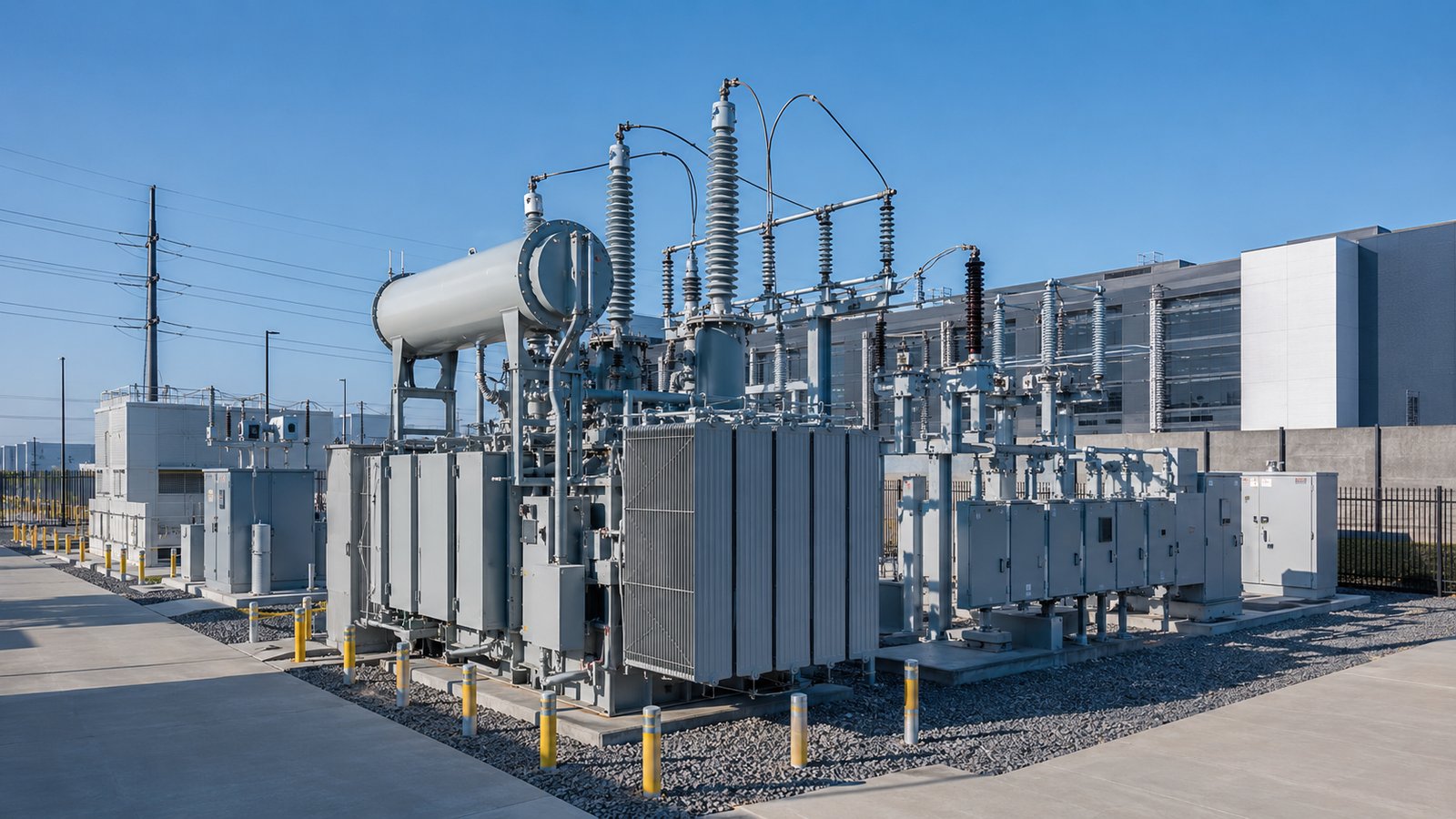
Related structures are part of the same package. We pour pads for transformers and switchgear to the manufacturer's template, build manholes and vaults with precast or cast-in-place walls as the owner specifies, and set bollards where vehicles could strike an above-grade cabinet. When an existing line has to be moved to make room for a new road or building, the utility relocation trade crews stage the new route first and cut over in a planned outage.
We build for the pull. Conduit sweeps are laid to the radius in the standard, joints are cleaned and cemented, and each run is proved with a mandrel and a pull line before it is backfilled. When a section fails the mandrel, we find the problem while the trench is open, not after the concrete has cured over it. The owner's inspector witnesses the proof, and the result goes into a log.
As-builts follow the same discipline. We survey invert elevations, bend locations and vault corners, record them against the owner's coordinate system and hand over a package that matches the ground. An owner who has to plan the next expansion, or who has to dig in the same street in ten years, benefits from records that match what is buried. We keep photos of every open trench with a tape in frame for the same reason.
Utility routes on the northern Front Range cross agricultural land, and the irrigation network that serves it is part of the design. Much of the farmland around Eaton depends on irrigation systems, and ditch companies set their own crossing conditions: casing or encasement depth, work only outside the irrigation season, and restoration of the bank to the original grade. We schedule crossings into the dry window, bore or trench as the ditch owner requires, and plan the dewatering that a shallow water table may demand.
River corridors bring other constraints. The Cache la Poudre River drops about 6,155 feet over its course, and flooding is a periodic reality near it. We design trench plugs, anti-seep collars and restoration with the flood path in mind, and we keep stockpiles out of the active channel. Our dewatering systems keep discharge water clean, with sediment controls checked daily.
An energy owner's calendar is set by the load and the weather as much as by the contractor. Planned outages are scarce, so our work is staged to put as much as possible in service before the cutover window, and we hold the crew and the materials ready for the day the outage is approved. If the window moves, the sequence moves with it and we tell the owner the effect in hours.
Winter changes the work. Frozen ground slows trenching, backfill cannot be placed on frozen subgrade without thaw work, and concrete encasement needs cold-weather protection. For long linear projects we put the crossings and the poured work in the shoulder seasons and use the cold months for non-concrete work such as clearing, grading and pulling. Union Pacific's line running north-south through Ault parallel to US 85 is an example of an existing corridor that crosses most of our routes, and crossings under or beside a railroad require their own permit and schedule, which we build into the plan.
Energized lines and pressurized pipe set the safety rules. We follow the owner's rules for approach distance, hold a pre-job briefing at each location and keep a spotter on any equipment working near an overhead line. When we dig near a marked gas or electric line, we expose it by hand or by vacuum excavation and protect it before machine digging resumes. Excavations deeper than five feet get a protective system and a competent person, and ventilation and monitoring are planned where a confined space is entered.
We coordinate on the same corridor with municipal and public works owners, who often control the street we are trenching in, and with oil, gas and midstream operators whose pipelines and facilities cross the same land. Shared-corridor work is mostly a matter of knowing who is down there and talking to them before the bucket moves.
Send the plan and profile, the permit conditions and the outage calendar. We will return a trench-by-trench scope with crossings priced separately and a sequence built around your cutover.
Trenching to the design width and depth, setting conduit spacers on the specified interval, tying the conduits, placing encasement in a continuous pour and marking the top with warning tape. The conduits are proved with a mandrel before and after the pour. We coordinate the concrete mix, usually with a colored dye if the owner specifies it, so any later excavation sees a visual warning.
We test for groundwater in the pothole stage, and if the trench will be below the water table, we plan well points or sump pumping, with discharge treated through sediment controls and routed according to the permit. Dewatering is carried as its own line item in our bid because its cost depends on the soils and the season.
Yes. On a developer job, we reserve trench windows for the dry utilities in the joint trench plan, set sleeves under paving ahead of the pavement work and coordinate inspection with each utility. The goal is that no one cuts new pavement to place a line that should have been in the ground a month earlier.
Plan and profile drawings, the standard details, the permit conditions for each crossing and whether the owner supplies conduit. We price by linear foot in categories for open trench, bore, rock or hard ground and restoration, and we separate the crossings from the straight run.
No. We build the civil work: trenches, encasement, pads, vaults and restoration. The owner's electricians or specialty contractors pull cable, terminate and energize. We coordinate our turnover with them so conduits are clean, pull lines are in place and pads are cured to the manufacturer's schedule.