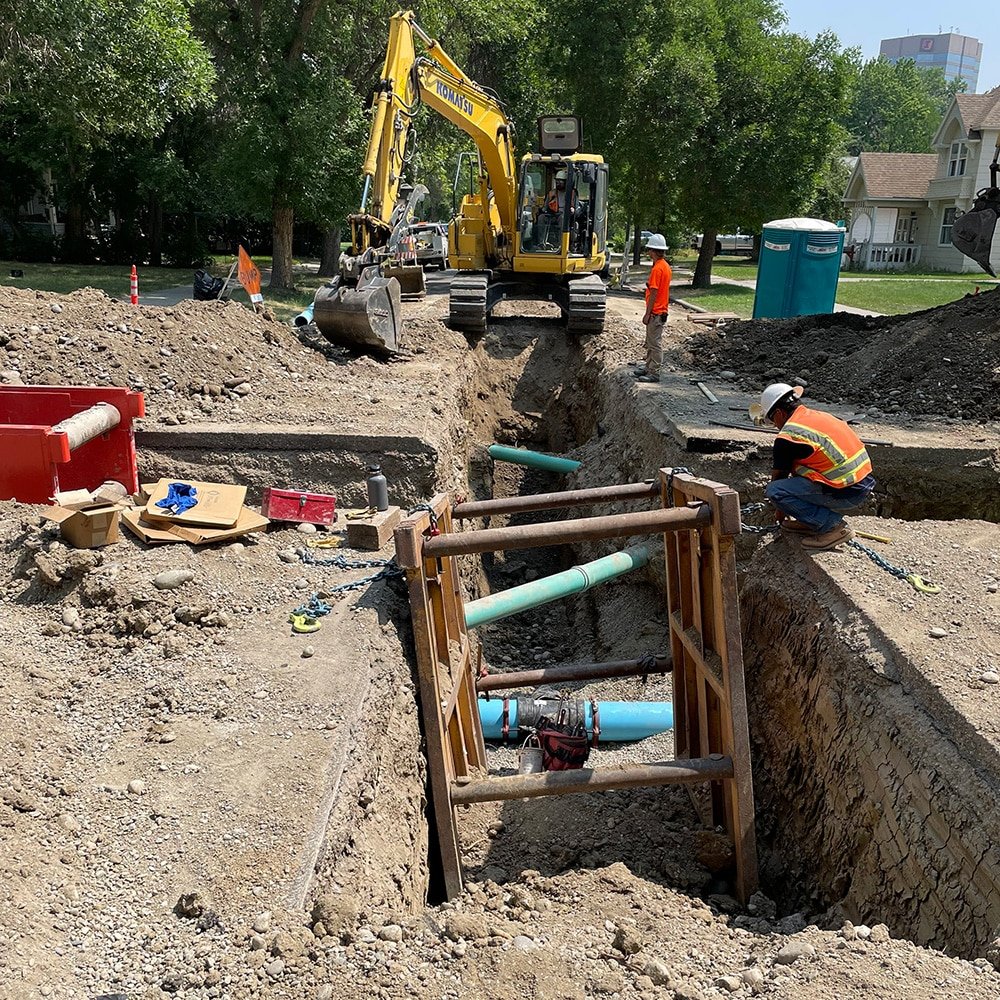
Frost reaches 30 inches into the ground in Fort Collins according to the city's design criteria, and that single number shapes how a water main is built here. The pipe has to sit below the freezing line with margin to spare, which means deeper trenches, more spoil, more shoring and a longer day for every segment than a map of the pipe size would suggest. A main that is laid shallow and survives its first winter can still fail in the third, when a cold snap meets a dry spell and the ground freezes deeper than usual.
We install domestic water mains and service lines for commercial campuses, industrial parks and subdivisions, working from the utility owner's standard details. The work runs from the tap or tie-in at the existing system through the new pipe, valves, hydrants and services, and ends with pressure testing, disinfection and the clearance sample that lets the line go into service. Each step has a hold point where a failed test costs days, so the crew is organized around getting the first test right.
Mains on commercial sites are most often ductile iron or PVC in the larger pressure classes, with polyethylene pipe chosen for directional drilling and trenchless crossings. Each material has its own handling rules. Ductile iron is heavy and requires bedding that supports the barrel evenly, PVC is sensitive to impact and sunlight and needs careful bell and spigot assembly, and polyethylene needs fusion equipment and an operator who can document each joint.
Beyond the pipe itself, the scope covers gate valves, tapping sleeves, air release valves, meter vaults, blow-offs, thrust blocks and restrained joints, and tracer wire laid with the pipe. Concrete thrust blocks are poured against undisturbed soil at every bend, tee and dead end, and we check the bearing area against the plan before pouring. Detectable marker tape goes in the trench above the pipe so the next contractor to dig will know it is there.
Farming built much of this region, and the water systems that served it are still in the ground. Berthoud's early economy was farming, including alfalfa, sugar beets and wheat, and in the surrounding country a new main often has to cross an irrigation ditch or lateral that belongs to a ditch company with its own rules about when and how it can be disturbed. Crossings are scheduled for the off-season when the ditch is dry or arranged with a temporary flume, and the owner of the ditch signs off on cover, bedding and the restoration of the bank.
Reservoirs shape the landscape too. Horsetooth Reservoir holds 156,735 acre-feet behind four earthen dams just west of Fort Collins, and the water that moves out of it is part of a network of pipes, tunnels and canals that the region depends on. A contractor who works near these facilities learns to treat them as owned and monitored infrastructure and to ask who must be notified before an excavator breaks ground.
Most of our water main work is open trench, because it is fast and gives the inspector a full view of bedding and joints. We keep the open length short, usually a day's production, and backfill with controlled lifts so settlement does not telegraph into the pavement above. Where the line must cross a road, a railroad, a major ditch or a utility corridor that cannot be opened, we use a steel-cased bore or directional drilling and size the work pit with the carrier pipe in mind.
Tie-ins to live mains are the most delicate step. They require a shutdown window agreed with the owner, isolation valves proven to hold, a dry trench (groundwater control pumps run before the cut is opened) and every fitting laid out beforehand. We rehearse the tie-in on paper, stage the repair couplings and dewatering pumps and confirm the customers who will lose service have been notified. The goal is to restore pressure inside the window with no surprises.
A main is not finished until it passes a hydrostatic test, usually at a pressure and duration defined by the owner's standards, with allowable leakage measured against the pumped volume. We fill and vent the line slowly, let the pipe settle, and test in segments that include the valves and hydrants. If a joint leaks, the section is isolated, uncovered and repaired before the test is repeated.
Disinfection follows with chlorine, flushing and bacteriological sampling. Sample results take a day or two, so this stage belongs on the critical path of any building that needs water for occupancy. We schedule it ahead of the planned turnover date and coordinate with the fire inspector so that the hydrants are flow-tested at the same time. Winter adds the extra task of insulating or draining temporary connections.
A water main rarely arrives alone. It runs beside fire lines and hydrants, shares a corridor with sewer and storm lines that dictate its crossings, and depends on good trenching and backfill for long-term performance.
Our customers include municipal and public works departments extending service and developers of multifamily and mixed-use projects who need new lots served. Berthoud, for one, grew from 10,332 residents in 2020 to an estimated 14,080 in 2025, and growth like that is carried by mains laid ahead of the houses.
Send the utility plans and the connection point, and we will price the trench, the structures and the testing window together.
The utility owner sets the minimum cover in its standards, and the main must sit below the frost line with margin. Fort Collins design criteria list a 30 inch frost depth, so cover is typically set well beyond that. We confirm the required depth on the approved plan and survey the trench bottom as we go.
The utility owner closes isolation valves, drains the section and issues the work window. We tie in with the pipe, fittings and repair couplings staged, dewater the trench, make the connection and flush it before the owner reopens the valves. Customers affected are notified in advance.
After installation, a main has to pass pressure testing, disinfection and a bacteriological sample before it is accepted. Allow several working days after the last fitting is in place, longer if the first sample fails. We plan the date backward from the building's turnover.
Yes. We coordinate with the ditch company, schedule the crossing for a dry period if possible, protect the banks and restore the section to the owner's standard. Crossing agreements and notice periods are slower than most people expect, so we start them early.