
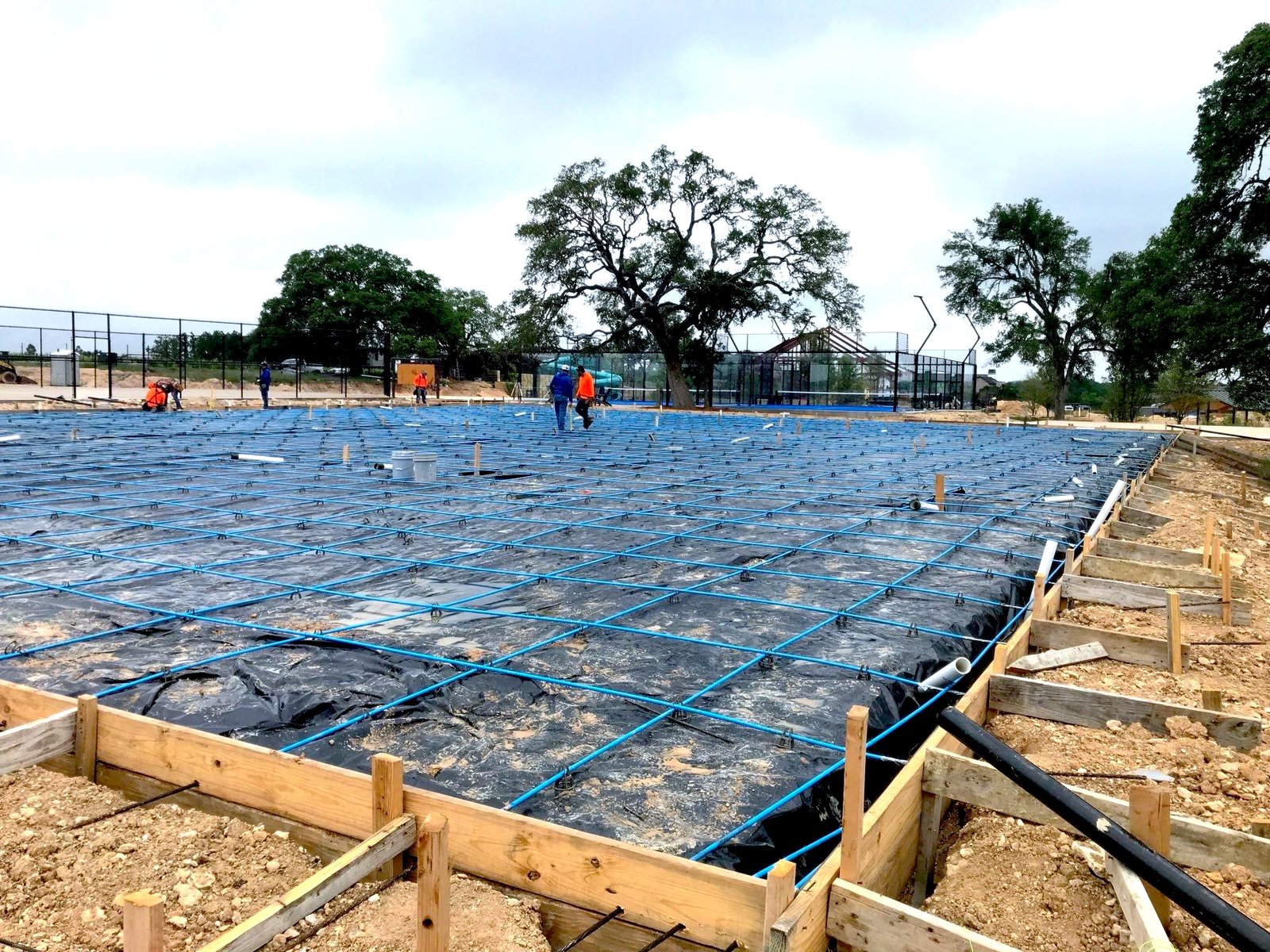
Steel cables running through a slab change the way a crew works, the way an owner plans future penetrations, and the way a building behaves under load. In a post-tensioned slab, greased and sheathed strands are laid out in a pattern, the concrete is placed around them, and once the concrete has gained enough strength the strands are stretched with hydraulic jacks and locked off. The slab ends up under permanent compression, which closes cracks, reduces joints and often allows a thinner section.
We place post-tensioned slabs for buildings where those advantages matter: large floors that benefit from fewer joints, elevated decks that need long spans, and sites where soil movement is a concern. The method needs close coordination between the engineer, the tendon supplier and the crew, because a mistake in layout or sequence is hard to correct once concrete covers the strands.
We approach each project with a clear division of work: the engineer designs the tendon pattern and stressing sequence, the supplier detailing and delivery, and we handle the placement, protection and coordination that keep the plan intact.
Post-tensioned slabs are designed by an engineer who specifies tendon type, spacing, profile, stressing force and concrete strength at stressing. Shop drawings from the supplier translate that design into a layout. Fort Collins permits are reviewed under the 2024 International Building Code with local amendments for submissions on or after April 1, 2026, and Seismic Design Category B appears in the city's design criteria, which the engineer uses when detailing tendon anchorage and reinforcement around openings. Owners planning work near the CSU Foothills Campus or similar campuses can expect the same documentation from us. Weld County's engineered foundation requirement for most new structures, effective June 15, 2026 under its adoption of the 2024 code, often leads to post-tensioned or ribbed foundations as the engineered answer on difficult soils.
Inspectors typically check tendon layout before the pour and stressing records after it. We keep placement logs, field-cured cylinder results and elongation records so that the engineer can confirm each tendon reached its design force. Documentation is not paperwork for its own sake; it is the only way to prove what is inside the slab.
Post-tensioning changes how other trades work. Penetrations through the slab must be planned before the pour, because cutting or coring into a stressed tendon is dangerous and can compromise the structure. Sleeves, embeds and chases are located on the tendon drawings and placed with the reinforcement. Later changes, such as adding a floor drain or a column, need an engineer's review and often a scan of the slab to locate tendons.
Owners should keep the tendon layout in the building record. We provide marked-up drawings and, when requested, mark the tendon paths on the slab surface so that future tenants and contractors can find them. Ground conditions matter too: the slab edge may be thickened, and the subgrade preparation should limit differential movement. A university the size of Colorado State University, which reported 34,412 students in fall 2025, keeps demand steady for parking, labs and housing, and school and healthcare owners who build long-span decks for education buildings keep strict records for them, as they should.
Stressing is the highest-risk moment in post-tensioned work. A tendon under load stores a great deal of energy, and a failure at an end fitting or a wedge can launch parts with force. We establish an exclusion zone behind and in line with the jacks, keep everyone not directly involved out of it, and require that the stressing crew follows the supplier's procedure. Only trained personnel operate the jacks and pumps.
Before and after stressing we protect exposed end fittings and strands from damage and moisture. We never cut, drill or burn near a tendon without the engineer's direction and a location scan. Anyone who works on a post-tensioned building in later years should know the same rules, so we leave clear information with the owner.
We start with a pre-pour meeting with the engineer and the tendon supplier to review the shop drawings, the sequence and the locations of openings. The subgrade is prepared and a slip sheet or bond breaker is placed where the design requires it. Tendons are laid out, supported on chairs at their drape profile, and tied so they do not move during the pour. Stressing-end fittings and pocket formers are set at the slab edges.
Concrete placement requires care. Vibration around the end fittings must be thorough but must not displace the strands. Finishing proceeds as in any other slab, with curing as soon as the surface allows. When field-cured cylinders confirm the stressing strength, usually within a few days, we stress tendons in the specified order, measure elongation, and record results. Afterward the pockets are filled with a non-shrink grout and sealed to protect the strand ends.
Post-tensioning adds material, supplier and stressing costs, plus a more careful placement schedule. It can recover those costs by reducing slab thickness, eliminating many control joints, limiting cracking and shortening the construction schedule on elevated decks. For a parking structure, where long spans and watertight surfaces are valued, the economics are usually favorable. For a multifamily or mixed-use podium, thin flat slabs can reduce floor-to-floor height.
On a slab on grade, the equation is less clear. A conventionally reinforced slab may be cheaper for a small building, while a large floor with demanding flatness can justify the tendons. We help owners compare options with realistic quantities and schedule, drawing on our work on super-flat slabs and elevated slabs and decks.
Send us the structural drawings and soils report. We will review the layout, coordinate with the tendon supplier and give you a placement plan and price.
Compressing the slab with steel strands reduces cracking, allows longer spans and thinner sections, and cuts the number of joints. Owners of parking structures, podiums and some large floors choose it for durability and a better riding surface, and sometimes for lower total cost.
Only with extreme care. You must locate the tendons first with scanning or by the recorded layout, and have the engineer approve the location. Cutting a stressed tendon can be dangerous and can damage the slab. Never core or saw a post-tensioned slab without that review.
Usually when the concrete reaches the strength shown on the drawings, which may be a few days after placement. We confirm with field-cured cylinders. Cold weather can extend the time, so the schedule includes cure protection.
It can be, since the compressive force helps the slab bridge small soil movements. The engineer decides based on the geotechnical report. Subgrade preparation still matters, and the design may include thickened edges or ribs.
Keep the tendon layout drawings, stressing records and any scan results. These are what a future contractor needs to modify the building safely. We deliver them at closeout along with marked-up as-built drawings.