On a 265-acre mixed-use site with 90 acres of interstate frontage, the first thing anyone builds is a balanced earthwork plan, because every cubic yard that has to be trucked on or off the property is a cost that grading was supposed to avoid. Mass grading is the stage that turns a farm field or a rolling parcel into a set of pads, streets, ponds and slopes at the elevations the civil drawings call for, and it is judged on two things: whether the finished surface matches the plan, and whether the dirt came from the right places to get there.
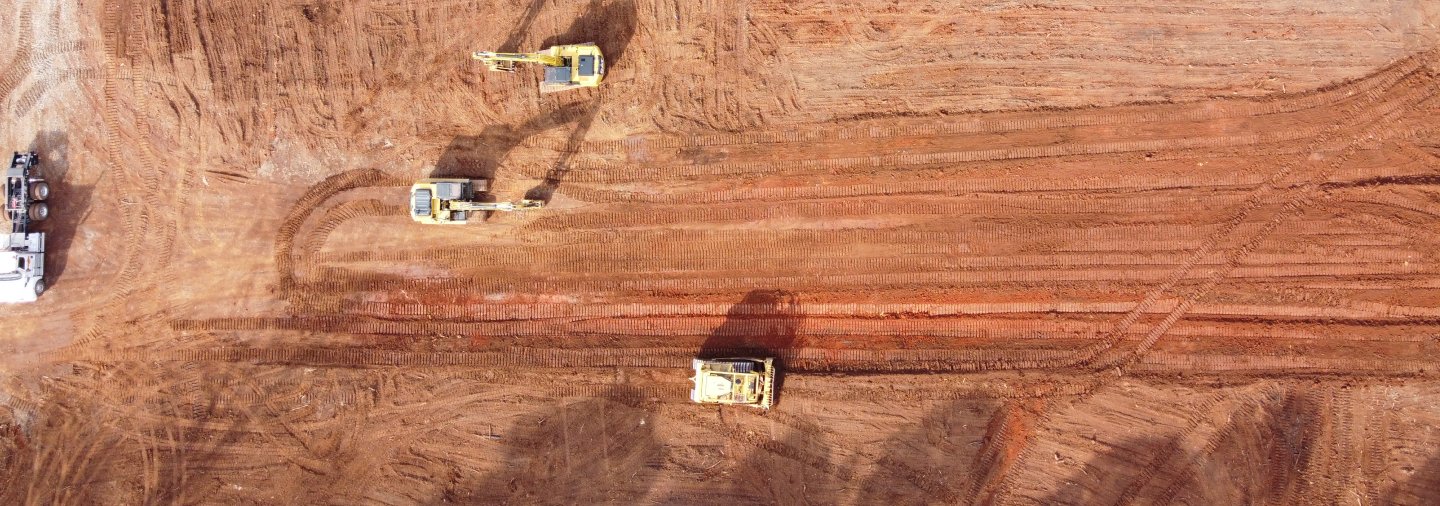
We perform mass grading for commercial parks, industrial pads, roadway corridors and subdivisions, with scrapers, dozers, excavators, graders, compactors and water trucks sized to the quantities. The work follows clearing and precedes utilities and paving, so it controls the schedule of everyone behind it. Our aim is to hand the site over to the utility crew at the right subgrade, compacted, tested and drained, with the haul roads, stockpiles and erosion controls managed along the way.
The earthwork quantities on the plan are net numbers, and the real balance depends on shrink and swell, on topsoil that has to be set aside, on unsuitable material and on the spoil from utility trenches and ponds. Before we start, we review the quantity takeoff, mark the sources and destinations on a mass haul diagram, and estimate the shrink or swell from the geotechnical report. The goal is to move dirt the shortest distance, usually from high ground to nearby low ground, with as little hauling on public roads as possible.
Machine control makes the plan workable. Dozers and graders fitted with GPS and a digital terrain model cut and fill to the design surface without a stake at every pass, and a survey crew checks the results at grid points. Where imported or exported material cannot be avoided, we plan import, export and haul-off with truck cycles, haul routes and disposal sites set ahead of time.
The scope covers stripping and stockpiling topsoil, cutting high areas, placing fill in lifts, building embankments for roads and ponds, shaping swales and slopes and fine-trimming the pads to the elevation the building contractor expects. Cut and fill follow the principles in cut and fill earthwork: thin lifts, moisture conditioning to the range in the geotechnical report, and compaction with the right roller for the material.
Different soils behave differently. Sandy material compacts quickly but dries and blows, silty soil is sensitive to moisture and clay can be too wet or too dry to hit density without conditioning. Where the geotechnical report flags expansive clay or collapsible soil under a building, the contract may call for over-excavation and replacement, and we plan the grading to leave the work area accessible. Proof-rolling before fill is placed catches soft zones, and each lift is tested by the testing agency before the next one covers it.
Earthwork is the most weather-sensitive part of a site schedule. A week of rain closes the haul roads and leaves clay too wet to compact, while a dry, windy summer demands water trucks and dust control. Winter brings frozen ground that cannot be compacted, and fill placed on frozen subgrade can settle in the spring. We plan the schedule with the wet and dry seasons in mind, put the heaviest cuts in the best months and leave interior fine grading for when the ground allows.
Interfaces with other trades control the production rate. Utility crews need finished subgrade ahead of them, the paving contractor needs trimmed base, and the building contractor needs a certified pad. We divide the site into zones, finish each in turn and release it with a survey and a density report. That staging keeps the utility and building crews working while grading continues elsewhere.
A 2022 report described a Highway 60 and I-25 project in Johnstown planned for more than 1,000 housing units and more than 1 million sq ft of retail, at an interchange passing more than 99,000 vehicles daily. Sites like that are graded in pieces, with the retail pads graded ahead of the residential blocks and the roads built first, so construction access and the public roads stay open. Roadside visibility is part of the product, so slopes and screening berms are shaped with that in mind.
Industrial campuses grade differently. Centerra covers about 3,000 acres, and its industrial buildings use concrete construction with dock-high loading, which needs flat, well-compacted pads and truck courts. In Evans, three new industrial buildings were built in 2025 near Highways 85 and 34 and I-25. A building pad for a distribution center must be uniform in bearing, because a slab with several acres of floor tolerates little differential settlement.
The main cost drivers are net and gross quantities, average haul distance, the number of handles each cubic yard gets and the quality of the material. Moving dirt once, from a cut to a fill, is economical. Stockpiling and rehandling it doubles the cost. Importing structural fill, treating wet or poor soils with lime or cement, and exporting unsuitable material can be the largest variables, and they are usually unknown until the geotechnical work is complete.
Owners such as logistics and warehouse developers can control the number by deciding pad elevations with the earthwork in mind. A pad raised or lowered by a foot across a large site can balance the job entirely. We offer a value review with the civil engineer to look for these adjustments before the bid, and we price alternates when the geotechnical report suggests more than one approach.
Mass grading requires a grading permit or land disturbance permit and coverage under the stormwater program, with a plan showing perimeter controls, sediment basins, stabilized construction entrances and phased stabilization. Dust control is a separate requirement in many areas, and large disturbed acreage may trigger air quality permitting. We hold the paperwork, carry out the inspections and keep the logs current.
The plan is also a schedule. Ground that will be disturbed but not built for months is stabilized with seed and mulch or with a tackifier, and the sediment basins are kept clean. When grading finishes, the pad is handed to the building contractor with the density tests, the survey and a clear statement of what is complete. Finished pads then go to building pad preparation, with the final subgrade and base work, after site clearing and grubbing has already removed the organic material.
Send the civil sheets, the earthwork quantities and the geotechnical report and we will review balance, haul and phasing for you.
The geotechnical report sets the target, commonly a percentage of the maximum dry density from a Proctor test and a moisture range around the optimum. The testing agency verifies each lift. Structural fill under footings and slabs has tighter requirements than general site fill.
Sometimes, but it is difficult. Frozen soil cannot be compacted, and fill placed on frozen ground can settle later. We grade in winter where conditions allow, such as on dry sandy soils, and save critical building pads for warmer months.
It shows how earth moves across the site, where cuts feed fills and how far each haul is. It helps pick the right equipment and find the cheapest balance. Changes in pad elevations shift the diagram, which is why design and earthwork should be reviewed together.
Water trucks control dust on haul roads and disturbed ground, and stabilized entrances with rock and tracking pads keep mud off public streets. We sweep when needed and track the weather, since a wet week requires different measures than a dry one.
The contract sets the allocation. Usually unforeseen conditions are covered by a differing-site-conditions clause, and the contractor documents the condition and notifies the owner promptly. Early test pits, as part of the geotechnical program, are the best way to reduce the chance of surprise.