
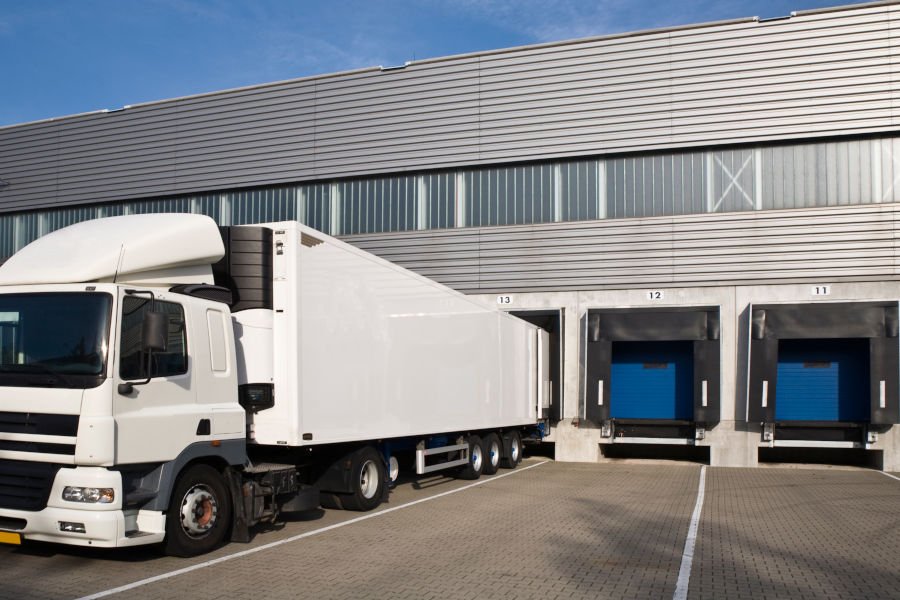
A tractor-trailer parked at a dock puts most of a loaded trailer's weight on two small steel feet, and the pavement under those feet decides whether the dock stays level for the life of the building. Truck courts take a beating that parking lots never see: landing gear loads, constant turning under full axle weights, fuel and hydraulic drips, and snowplows scraping the same lanes every winter.
We build concrete truck courts and dock aprons for warehouses, distribution centers, flex buildings and truck terminals on the northern Front Range. The work is concentrated at the building's most expensive operating edge. If the apron settles, doors do not seal; if the court holds water, ice forms at the dock; if joints fail, the maintenance cost never stops.
Our approach is to treat the court as heavy-duty pavement with building-grade grading, not as a parking lot with a bigger footprint.
Court geometry comes from the trucks. A 53 foot trailer with a tractor needs a long approach and a wide swing to back into a dock, so truck courts are commonly 130 feet deep or more, with a separate apron next to the building. The apron area where trailers sit takes the landing gear loads and typically gets a thicker slab, extra reinforcement or a higher-strength mix. The drive lane beyond takes the moving loads.
Turning is the hidden stress. Tractor drive tires turning at low speed scrub the surface and push on joints, which is why dowels and proper joint layout matter. We review the design for where trucks will actually stop, queue and turn, not only where they are supposed to. On a newly built 24,000 square foot industrial building at the southeast corner of I-25 and Prospect Road, with 12 by 12 and 14 by 14 foot overhead doors and about 0.6 acres of fenced yard, the yard is as much a part of the operation as the building.
We prepare and test the subgrade, place and compact the base, set forms, install dowels and tie bars, place reinforcement as required, and pour, finish, cure and saw the pavement. Aprons are poured with a slight slope away from the building, usually in the range of one to two percent, with dock leveler pits and trash compactor pads coordinated with the building contractor. Edge details are set so that the apron meets the building slab and door thresholds without a trip hazard or a water path.
Other pieces belong to the scope. Trailer storage stalls may be a thicker section than the drive lane. Dumpster and compactor pads need heavy slabs. Bollards, wheel stops and guard posts protect dock doors and building corners. We coordinate each with loading dock pits and ramps and tie into the concrete paving that serves the rest of the site.
Industrial space is spreading along I-25. The Centerra Industrial buildings in Loveland are described as concrete construction with 24 foot clear heights and dock-high loading, half a mile from the interstate. In Windsor, the Great Western Industrial Park has dual rail interchanges to two railroads and building sizes from 60,000 to 1,000,000 square feet, which implies truck courts of every size, many with trailer storage.
Both examples are the kind of site where the court is a major portion of the project cost. Truck terminals and cross-dock buildings have the heaviest traffic, with doors on both sides and constant movement. A distribution center has fewer but longer stays at the dock. We design for the actual duty cycle.
Pavement thickness and area are the biggest line items. A truck court of several acres at eight or nine inches of reinforced concrete is a very large pour. Dowel baskets, reinforcement and sealed joints add cost but protect it. Subgrade improvement may be needed to support loads, and that can include geogrid, cement or lime treatment, or a thicker base.
Drainage and utilities add their own costs. Inlets, trench drains and detention systems must be installed at the right elevation and often before paving. Concrete in the apron zone costs more than in the drive lane, and owners can save money by tailoring thickness to the loads, using thicker sections only where trailers park. Logistics and warehouse developers who build on speculation often choose the heavier section anyway to avoid restricting tenants.
We build truck courts and dock aprons from the Timberline and Prospect industrial area in southeast Fort Collins to Centerra in Loveland, and out through Windsor and the rest of Weld County. The haul from the batch plant to the site is a factor in cost and schedule, and we plan deliveries to match the pour rate.
Each site has its own conditions. Some are near rail lines, which means track crossings, and some are near irrigation ditches that must be crossed or relocated. Others sit near the airport and have height or lighting limits. We walk the site, review the civil plans and call out unusual items before pricing. If you are planning a site we have not mentioned, ask.
Send the site plan, truck types and dock layout. We will price the court, apron and pits with thickness zoned to your loads and joint details spelled out.
Truck lanes and aprons commonly run eight to ten inches for heavy use, with the landing gear zone sometimes thicker, while light-duty areas can be thinner. The pavement engineer sets thickness from traffic and soil. We build to that design and can suggest zoning to control cost.
Common causes are poor subgrade support, trailer landing gear on thin pavement, water getting under the slab and missing dowels at joints. Good base, adequate thickness, drainage and load transfer reduce these problems.
Yes, that is a common hybrid. Concrete handles the landing gear and turning zones, and asphalt serves lighter lanes. The transition requires care so the edge does not break up, and we detail it with a keyed joint or dowels.
Grade is the first defense: slope the apron away from the dock and carry water to inlets. Trench drains at the dock edge catch runoff, and joint sealant keeps meltwater from refreezing below the surface. Deicers should be used carefully on young concrete.
A court of a few acres can be paved in a few weeks of good weather after the subgrade is complete, with joint sawing and sealing following. The calendar is more sensitive to subgrade, utilities and weather than to concrete production.