
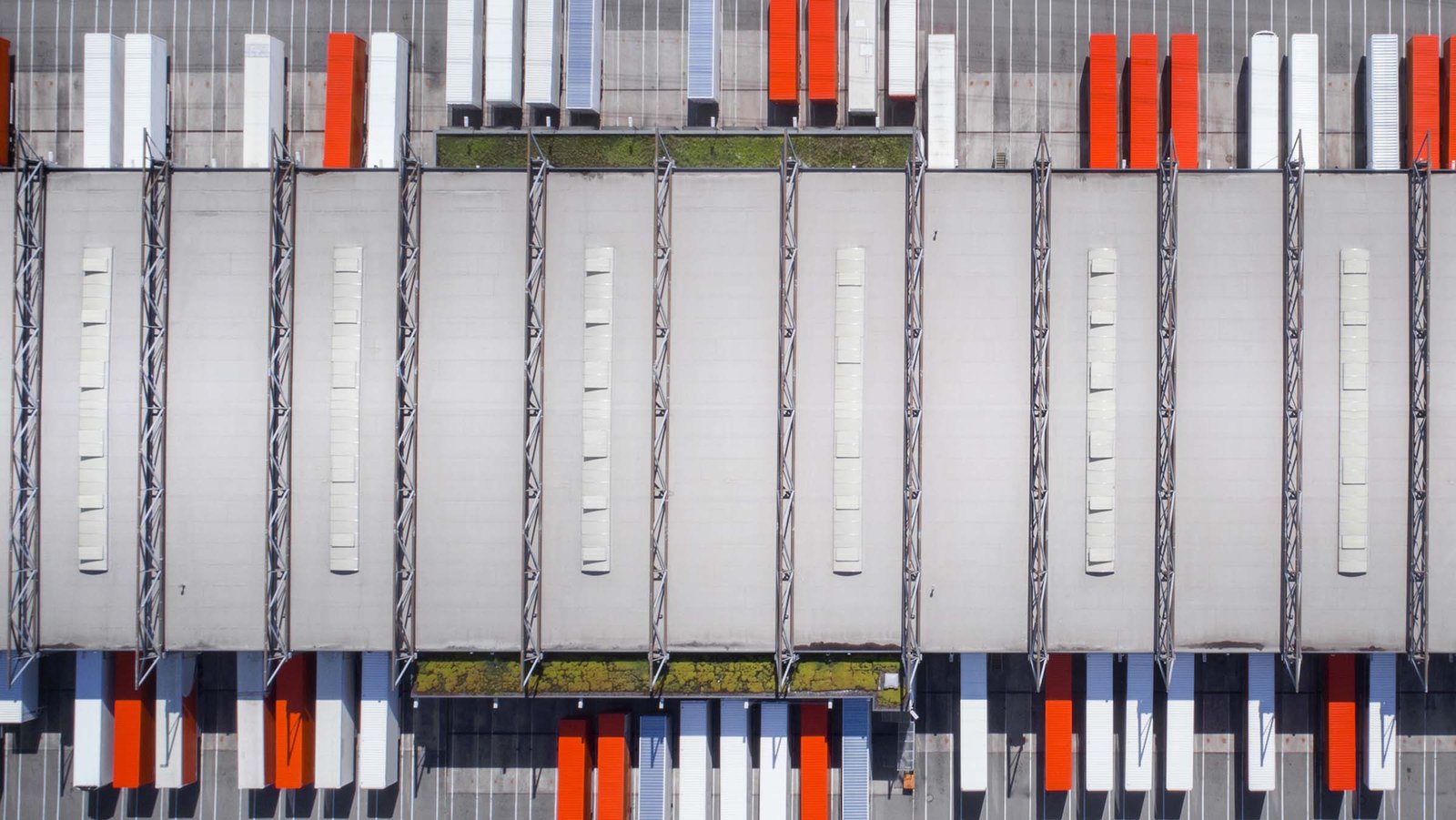
Most of a truck terminal is pavement. The building is a long, narrow strip of dock doors, a shop and a small office, and everything around it is a court where tractors back, brake, turn and park under load day after day. Pavement that is thick enough for a distribution yard can still fail in a terminal if the subgrade is soft or the joints are poorly detailed, because the loads are repeated, slow and concentrated at the same turning paths.
Location matters more here than almost anywhere else. Interstate 25 runs along the east side of Fort Collins, with US 287 becoming College Avenue through the city, and State Highway 14 leaves on Mulberry Street after an I-25 interchange. Terminal operators look at those routes, and at the rail lines north and east of town, when they choose a parcel. We look at them too, because the haul route that brings fill and concrete to the site is the same one the trucks will use for decades.
We build the earthwork, the paving, the underground utilities and the building concrete for cross-dock and truck terminal sites, and we think of them as one pavement structure that happens to include a building. The logistics and warehouse developers we work with often ask us to test two or three site layouts before the plan is frozen.
A terminal wants fast access to the interstate and a short trip to the customers it serves. US 85 meets US 34 at Evans in a large interchange with left exits and loop ramps, and Evans has added new industrial buildings at Brantner Road close to that junction. Further north, Ault sits where US 85 and State Highway 14 meet, with a Union Pacific line running through it parallel to the highway between Denver and the state line.
The Mulberry interchange is another reference. CDOT's I-25 and Mulberry (CO 14) project covers I-25 mileposts 269 to 271 and cites flooding concerns and aging infrastructure among the reasons for replacement. Design funds were secured in September 2022, with final design estimated for early 2028, so interchange construction is some distance off. Owners near the Mulberry and I-25 interchange should expect the roadway work to change access in the future and plan their driveways accordingly.
The pavement design begins with the truck movements. We ask for the turning templates of the design vehicle and overlay them on the court, because the stress is greatest where a tractor swings through a corner or spins on its tandems. Those zones get extra thickness, closer joint spacing and dowels, and the corners are rounded so that slab corners do not break under wheel loads.
Drainage is the other half. A yard that holds a skin of water softens the subgrade and ices over in January. We slope the court to inlets and trench drains, set the inlets with concrete aprons so they do not sink under traffic, and route the storm lines to detention before they leave the site. The distribution center version of this problem has more doors, but the principle is the same.
Besides the court itself, a terminal needs a number of smaller concrete items: a fueling island and canopy footings, a truck wash pad with a sump, a scale pad, trailer landing pads in the drop lot, light pole bases, fence posts, and a perimeter curb. Fuel and wash areas must be contained, and our containment pad work covers the sloped floors, sumps and sealed joints that regulators expect.
Then there is the building. The dock wall is a heavy, accurately formed element that has to align with a precise door spacing, and the floor behind it needs to carry forklifts and pallet jacks. Because terminals often use cross-dock layouts, the foundation for the interior is a simple slab (a fulfillment center has far more floor to carry, and far less pavement), but the docks, pits and levelers are not simple, and we check the dimensions against the equipment shop drawings before the forms are closed.
On a typical terminal, concrete paving represents more cost than the building. Each additional inch of slab thickness over a 10-acre court is a large quantity of concrete, so it is important to base the thickness on the real design loads and not on a conservative default. We provide alternates for different thicknesses and show how they affect the yardage, the haul and the schedule.
The second driver is the subgrade. Soft ground that needs to be over-excavated or stabilized adds time and expense, and a few test pits before bidding are cheaper than finding out during the work. Imported base material is costly when the nearest pit is far, so we plan haul distances early and look for balance on site. For owners comparing asphalt and concrete, our parking lot concrete pricing includes a lifecycle view, not only the first cost.
Terminal projects come from carriers, shippers who build their own cross-dock space, developers building to suit, and municipal or public agencies expanding fleet yards. Our public-sector clients in municipal and public works have similar needs for a fleet yard: heavy pavement, fueling, wash facilities and secure fencing.
Eaton's Union Pacific industrial rail parks total 160 acres zoned I-2, with parcels divisible to a 1 acre minimum and unit train and manifest service available. A site like that supports intermodal transfer as well as truck operations, which changes the paving design near the track and the crossing details.
Terminal expansions often happen while the yard is operating, and the first rule is to separate people from trucks. We use phased paving so that one half of the court is closed while the other half remains in service, and we place barriers and signage along the construction zone. Concrete trucks and operating tractors share a gate, so we arrange delivery windows with the dispatcher.
Traffic control also affects public roads: when a new driveway meets a county or state highway, a permit and a traffic control plan are required. The trade crews work to the plan, flag when required and keep dust and mud off the public road with a stabilized construction entrance.
Share the design vehicle, the door count and the site boundaries, and we will return pavement, drainage and building concrete quantities with alternates for thickness and material.
Concrete resists the rutting and shoving that come from standing and turning heavy trailers, and it holds up to fuel and hydraulic fluid spills. Asphalt costs less to place and is easier to repair, so many terminals use concrete in the dock apron and turning zones and asphalt elsewhere. We price both.
The engineer sets joint spacing from the slab thickness and the base type. We lay out the joints before the pour so they line up with inlets, building corners and the traffic path. Dowel baskets or inserted bars are placed accurately to keep the slabs aligned under load.
A large court can be placed in strips with a slipform or a fixed-form paver over many pour days. The curing period and sawing follow each pour, and the court must reach strength before heavy trucks run on it. We give the owner a pour map with dates.
Yes, if the drainage, utilities and the base are designed for it. Phase one usually includes the building, the dock court and the detention basin, with the trailer lot and fuel area following. Stub-outs and thickened edges let the next phase tie in cleanly.