Two calendars decide most concrete work in Fort Collins before a form is set: the permit calendar and the weather calendar. We pour foundations, slabs and flatwork, lay site utilities and move dirt across the city, from the Interstate 25 side to the campus districts and the grid of Old Town, and we build each schedule around both calendars instead of around a start date someone hopes for.
The permit calendar has a hard edge right now. The city treats the 2024 International Building Code with local amendments as the current code for permits submitted on or after April 1, 2026, and keeps the 2021 codes available for reference until October 1, 2026. If your drawings were produced under the older set, the submission date decides which rules govern, and we read that date before we put numbers on footings, slab thickness or reinforcing, since a code change can reach all three.
The weather calendar is the one nobody negotiates. Winter nights on the northern Front Range stop pours that would have been routine in September, and a summer afternoon can take the slump out of a truck before the finishers reach it. Our quotes state the pour window, the protection we have priced and the yardage per placement, so you see the sequence as well as the number.
On a Fort Collins site the scope usually starts with clearing, stripping and rough grade, then moves to site utilities, building pads, footings and stem walls, slabs on grade and the flatwork around them. We schedule those operations back to back so a prepared pad does not sit open to rain or a freeze between the proof-roll and the pour. Compaction is tested lift by lift, and the subgrade is proof-rolled again just before forms or reinforcing go in.
Concrete only leaves a site as a finished product if curing is treated as part of the work. We choose the curing method by season, wet cure or compound in summer and blankets with heat in winter, and we record placement temperatures so the lab strengths can be read against what the weather did to the slab. That record is part of our concrete testing and quality control routine, written into the sequence instead of added when an inspector asks for it.
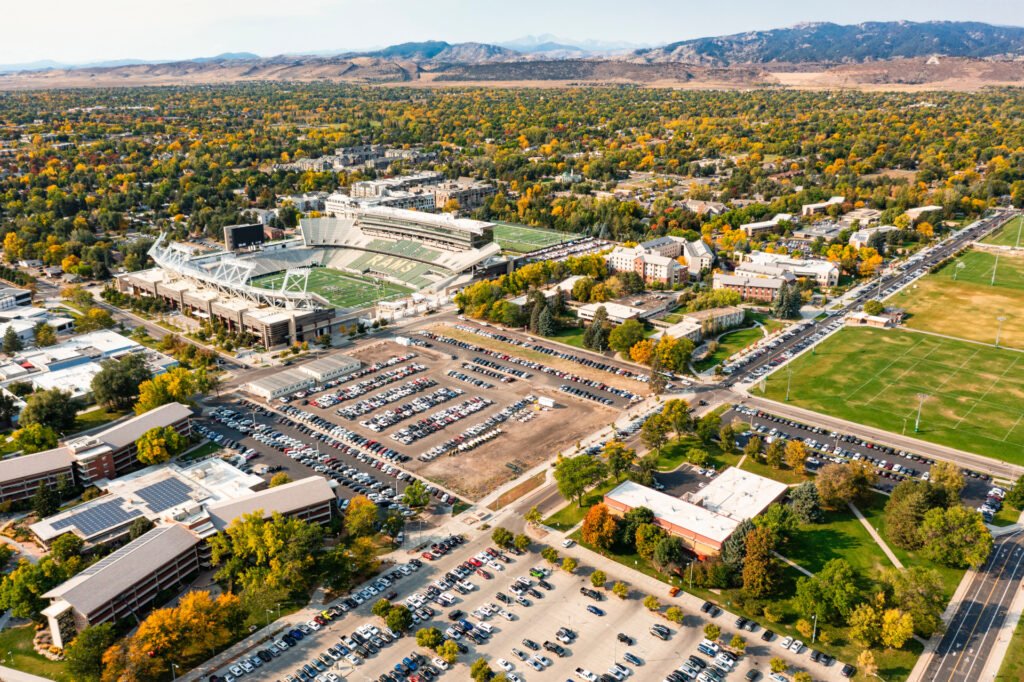
Colorado State University reported an all-time high fall 2025 enrollment of 34,412 students, including a first-year class of 5,376. That population drives lecture halls, housing, parking and research space, and every one of those begins with site work and a structural slab. For general contractors bidding that kind of work we coordinate the concrete and site work package, and our page on the CSU Foothills campus describes the large-site side of it.
The city's industrial side shows in its bigger campuses too. One manufacturing campus here sits on 101 acres, was planned to reach 660,000 square feet, and had its first two phases total 363,320 square feet at about $134 million. Work at that scale is phased, and phasing is a concrete problem: cold joints, slab sequencing and shared utilities have to be decided before the first phase is poured, not when the second phase is bid.
Interstate 25 runs along the east side of Fort Collins, US 287 becomes College Avenue through the city, and State Highway 14 leaves on Mulberry Street after an I-25 interchange. Those routes set how mixer trucks, dump trucks and lowboys reach a site and what time of day we schedule heavy deliveries. We map the haul route during estimating, including where a loaded truck has to cross a signalized corridor, because a truck that arrives late becomes a cold joint at the site.
Freight rail in Fort Collins is provided by Union Pacific and BNSF, which matters to industrial owners who want a loading slab or transload pad near track. Rail-side concrete needs a different subgrade conversation than a parking lot, and the railroad's own requirements come first. We raise those items at the pre-bid stage, and we pay particular attention to sites that depend on the Mulberry and I-25 interchange for trucking.
From late fall through early spring we plan cold-weather concrete protection into the price: warmed mix, blankets or heated enclosures, and a curing period long enough for the slab to reach strength before it sees load or a hard freeze. In summer the risk reverses, so we move placements to early morning, control mix temperature and keep the finishers ahead of the evaporation rate.
A realistic schedule here leaves float at both ends of the year. We would rather tell you in the bid that a January pour may slip a week than promise a date the weather will not honor, and then watch the trades behind us stack up on a frozen slab. When the forecast turns, we hold or shift the placement and say so the same day.
Most of our Fort Collins work reaches us through general contractors and construction managers who need one concrete and site subcontractor able to carry earthwork, utilities and slabs on a single schedule. Developers bring pad sites that need rough grading and utility stubs, and owners bring tenant improvements that need a saw-cut and patched slab.
Coordinated trade partners take on school and education buildings, where the pour windows are set by the academic calendar and the access routes by pedestrian traffic. Wherever the project sits in the city, we ask for the drawings, the permit submission date and the geotechnical report first, because those three documents shape every number we give you.
Tell us the site, the scope and the months you want concrete in the ground. We will come back with yardage, sequence and the weather allowances written into the price.
The city's current code applies to permits submitted on or after April 1, 2026, and the 2021 codes remain available for reference until October 1, 2026. The submission date, not the design date, is the point to settle with the building department. We price from the drawings you give us and flag structural or energy items that look tied to the older edition, so the engineer can confirm them before concrete is ordered.
We can place concrete in cold weather when protection is part of the plan. Warmed mix water, blankets or enclosures, and temperature monitoring during cure are priced into the job. The limiting factor is the subgrade, which has to be thawed, free of snow and ice and not saturated. In a hard freeze we hold the placement rather than pour on frozen ground that will settle when it thaws.
Yes, with planning. We schedule heavy deliveries and noisy operations away from class changes, agree on haul routes with the owner's facilities staff and keep walkways open with temporary routing. Large pours move to early morning or to breaks in the term. Staging space is usually the tightest constraint, so we ask early where mixer trucks can queue.
On most sites we do. Trenching, bedding, backfill compaction and the slab above them share a subgrade, and a trench that settles under a finished floor is a failure no one wants to assign. Water, sewer and storm inspections run on their own schedules, so we build those holds into the calendar before we commit to a pour date.
Send the drawings, the geotechnical report if there is one, the date you expect to submit for permit and the months you want concrete placed. With those we state yardage, reinforcing, placement method and weather protection, and we write the assumptions beside the price so changes can be discussed against a clear baseline.