
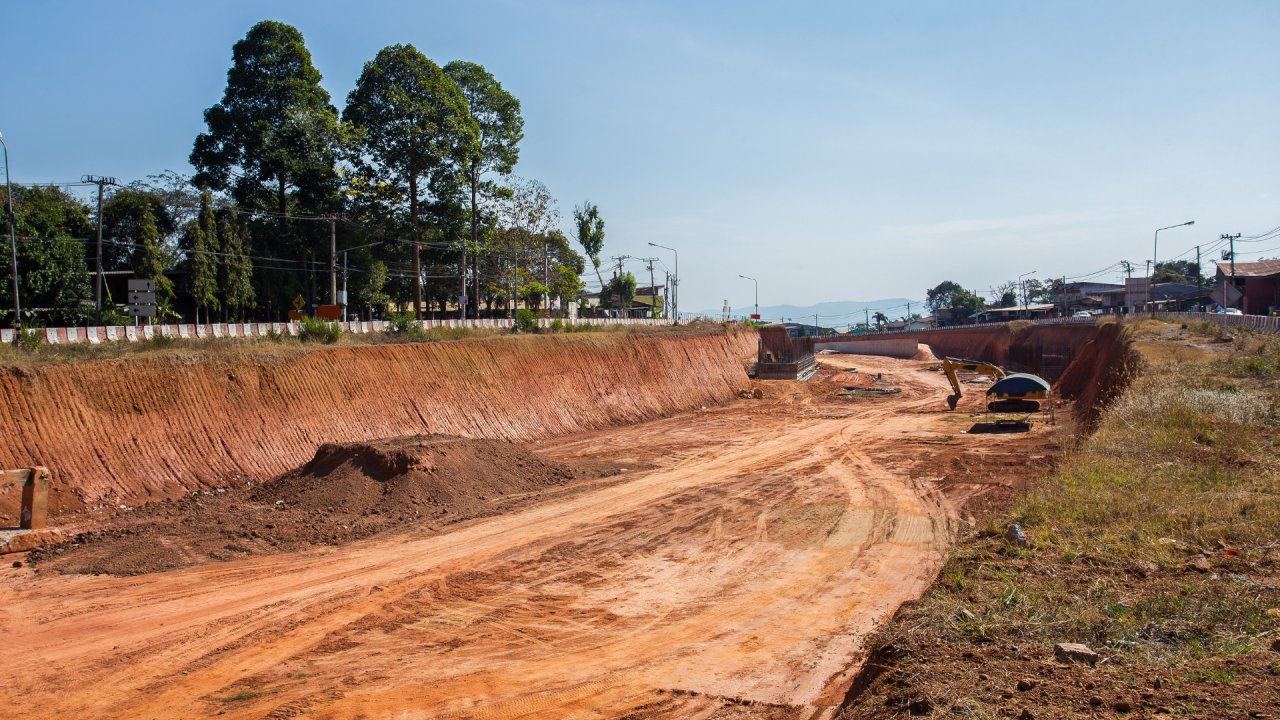
Hundredths of a foot are the unit of measure on a finished subgrade, and they are easier to lose than to find. A building pad that sits a half inch high at one corner and a half inch low at another is poured to a single slab thickness on the drawings and to two different thicknesses in the field, which is where yardage overruns and curling complaints begin. Fine grading is the last pass of earthwork before concrete or asphalt takes over, and everything placed above it inherits whatever it got wrong.
We fine grade slab subgrades, aggregate base for pavement, curb and gutter lines, sidewalk corridors and the swales and pans that carry water off a site in Fort Collins and the towns around it. The work comes after the bulk earthwork and after the underground utilities are in and backfilled, and it ends with a surface that a pour crew or a paving crew can accept without trimming it again.
The buyers who call us are usually general contractors and developers who already have a grading plan and need someone to hold it to the finish tolerance the next trade expects, not just to the rough elevation a mass-grading pass delivers.
Fine grading starts from a rough surface that is already close, usually within a tenth of a foot or so, and brings it to design elevation with the control the following trade needs. On a slab pad that means trimming the subgrade, placing and shaping the granular base, and checking it against stakes or a machine-control model before the vapor barrier goes down, which is the stage that precedes slab on grade placement. For pavement it means finishing the aggregate base to a surface that will let asphalt be placed at a uniform thickness, or concrete paving at a uniform depth.
It also covers the small shapes that decide whether a site drains: gutter pans, inlet aprons, swales, the dish at the back of a loading apron. The gutter lines we set ahead of curb and gutter crews are a good example. These are low-volume items that take a surprising share of the survey effort because a quarter inch of error in a short run of flowline holds water for years. We build them from the same control as the larger surfaces so the two never disagree.
We check the underlying work before we trim over it. Utility trenches that have settled, soft areas that showed up after a rain and cut sections that were left wetter than the fill beside them are all easier to correct before base is placed than after. A proof-roll with a loaded truck or heavy roller tells us where the subgrade is pumping, and those spots are corrected and recompacted rather than covered.
Trimming then runs from grade stakes or a machine-control model, whichever the project provides, with a second check by rod or rover on a regular grid. Base is placed in even passes, moisture conditioned and compacted, and tested by the owner's testing firm before we release the area. Where the base will carry asphalt, the handoff follows the same steps we describe for asphalt paving base preparation. Our rule is to have the surveyor or the engineer see the final surface before the next crew arrives, so that nobody is arguing about elevations after concrete is in the forms.
Tilt-up and metal-building projects put the heaviest demand on a flat, even pad, because racking and forklift traffic show every inch of grade error in the finished floor. Our work for warehouse buildings and flex and light industrial buildings centers on the pad itself, the apron around it and the truck court beyond, each finished to its own tolerance.
Corridor work is different. The 2013 city study of Harmony Road looked at roughly $53 million in improvements, including widened four-lane sections, raised landscaped medians, buffered bike lanes and continuous sidewalks, and every one of those elements depends on finish grading that meets accessible-route slopes. We bring the same discipline to shopping-center pads and parking fields along the Harmony Road corridor.
Fine grading is a schedule hinge. It cannot start until utilities under the pad are inspected and backfilled, and it should not finish until the pour or paving crew is ready, because an exposed finished subgrade is vulnerable to rain, traffic and frost. Fort Collins building design criteria list a 30 inch frost depth, so winter fine grading means keeping frozen material out of the base and protecting a finished surface from freezing before concrete is placed on it.
We plan the last trim as close to the pour as the site allows, with a day or two of float for weather. If a storm arrives after trimming, the area is re-proofed and re-checked, not simply poured over. On phased projects we release pads in the order the concrete crew will place them, so that no section sits finished and unprotected longer than necessary.
The price follows area, tolerance and access more than volume. A broad open pad can be trimmed quickly by machine-control equipment, while a congested site with footings, pipe stubs and embeds needs hand work around every obstruction. Tighter tolerance means more passes and more survey checks, and a base thickness specified in several layers adds testing hold points between them.
Rework is the cost owners rarely budget for. If the rough grade arrives high or low, base quantities change, and if utilities settle after backfill the trim has to be redone. We flag these early in preconstruction, and we work with general contractors and construction managers to agree on who owns the tolerance of the rough surface before the unit price for finishing is set. Related work such as building pad preparation is usually priced alongside it.
Send us the grading plan, the slab or paving specification and your target start. We will review the rough surface, price the finish pass and tell you what we need from the utility and testing schedules to hand the area over on time.
It depends on the specification and the control method. With machine control and a rover check on a grid, a half inch of the design elevation is routine for a slab subgrade, and tighter is possible where the floor demands it. We read the flatness and thickness requirements in the slab specification first, because the subgrade tolerance should be set to protect them, not copied from a generic note.
We measure it on arrival and report the difference before we trim. If the surface is within the range the contract assumed, finish grading proceeds as priced. If it is far out, base quantities and trimming time change, and we would rather settle that in writing before the first pass than after the concrete crew is waiting.
It can, with limits. Frozen material cannot be compacted to specification, so we protect the subgrade with blankets or insulated covers where needed and keep frost out of the base. A finished surface that freezes is re-checked and often re-proofed before concrete goes on it.
Yes. The owner's testing firm checks base density and thickness, and we schedule our releases around its visits. We would rather hold an area for a test than have it covered by the next trade without a recorded result.
Normally the project provides the control and the model, and we verify it against known points before we start. We coordinate rover and rod checks for the final pass so we can document each area as we hand it over.