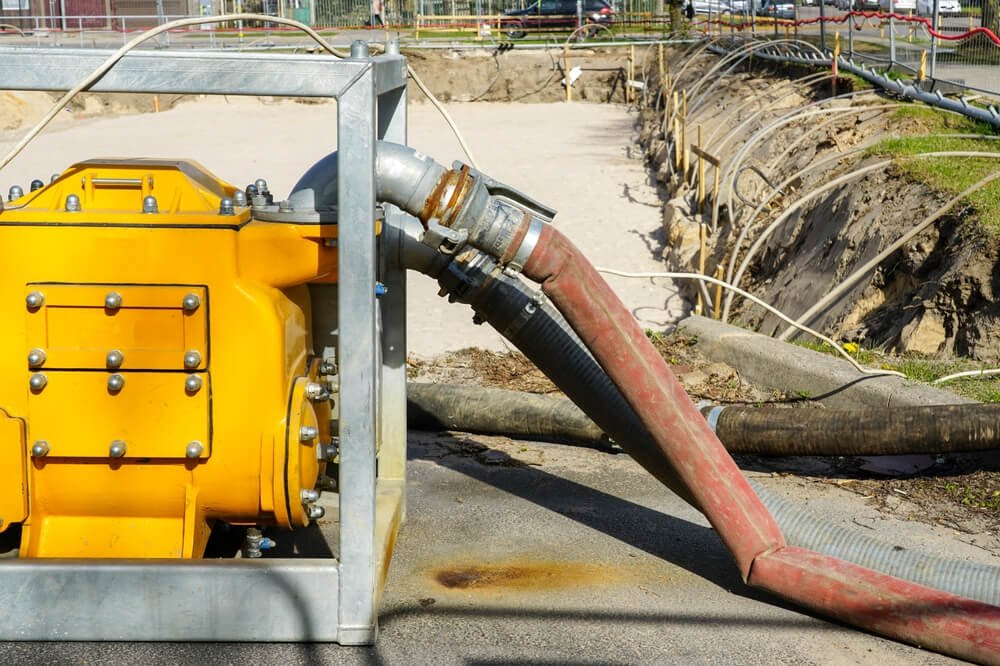
Ground that looks dry in March can be wet at ten feet in June, and a trench or a footing excavation that was planned in the dry season can fill with water before the pipe or the formwork is in. Groundwater in the lowlands of the northern Front Range moves with the rivers, the irrigation season and the weather upstream, and a contractor who opens a deep cut without a plan for water will spend the schedule pumping it, not building.
We design and operate dewatering for utility trenches, pump pits, foundation excavations, vault installations and pond construction. The objective is narrow and practical: keep the excavation dry enough that the work can be done properly, keep the soil from being pulled out with the water, and discharge the water in a way that does not create a problem for the site, the neighbors or the receiving stream. Each of those goals has its own constraints, and the plan has to meet all three.
The South Platte River runs along the south side of Evans, a home rule city at 4,682 ft elevation in the Greeley metropolitan area, and the Cache la Poudre River is 126 miles long, passes through Fort Collins and joins the South Platte about 5 miles east of Greeley, so a site at Laporte and a site at Evans share a river system without sharing a water table. Sites near either river often hit groundwater within a few feet, and the level rises and falls with river stage and with the ditches that run through the same floodplain.
In the foothills west of town, Bellvue sits in a narrow valley at the mouth of Rist Canyon, where the southern portion of the valley is now inundated by Horsetooth Reservoir. Sites there and around other reservoirs see seepage and spring flows that do not follow the river pattern. We start every dewatering plan with the geotechnical borings and any monitoring wells, and we add test pits or a pump test when the information is thin.
The simplest method, used in shallow excavation work, is a sump: a pit at the low corner of the excavation with a submersible pump, suitable for clean granular soils and modest inflow. Where the soil is finer or the flow is higher, wellpoints are driven in a line along the trench and connected by a header to a vacuum pump, lowering the water table ahead of the excavation. Deep wells with submersible pumps are used for large foundations, such as a deep slab pit under a cold storage facility, or deep structures where wellpoints cannot reach.
The choice depends on soil permeability, the depth below the water table and the duration of the work. We size pumps and headers from the expected flow, provide standby pumps for critical operations, and fuel or power them so the system can run around the clock. A system that stops overnight can let a trench flood and undo a day's work.
Discharge is the part of dewatering that draws attention from regulators and neighbors. Water pumped from an excavation may carry sediment, and in some soils it may carry contaminants, so most jurisdictions require sediment control and, in some cases, discharge authorization before the water leaves the site. We pump to a settling tank, a filter bag or a vegetated area, depending on the volume and the quality, and we test the water when the site history calls for it.
Dewatering also affects the ground around the excavation. Lowering the water table can settle nearby structures, pavements and utilities, so we monitor the drawdown and, where it matters, survey points on adjacent buildings. Wells that are installed for dewatering are abandoned and sealed to the owner's and the state's requirements when the work is done.
The best dewatering is done ahead of the excavator. We install the wellpoints or wells first, let the water table drop, and then open the cut, so the soil is stable and the pipe or the footing can be placed in the dry. In a trench, the pumps run ahead of the trench box and are moved as the work advances.
When we cannot drop the water table in advance, we work the excavation in short sections and place a stable bedding of crushed rock over a fabric wrap. The bedding gives the pipe or the foundation a base and a path for water to reach the sumps. We protect the subgrade from traffic and do not drive over saturated soil that will pump and lose its strength, which matters most under a floor, where building pad preparation depends on a dry, proof-rolled surface. The trade partners for trenching and backfill and excavation work with the dewatering operator daily to match the pace of the pumps to the cut.
Dewatering cost has three parts: installation, operation and removal. Installation depends on the number and depth of wells or wellpoints and on the soil. Operation is a matter of pump hours, fuel or power, and monitoring. Removal includes pulling the equipment and sealing wells. A job that needs one pump for a week costs a small fraction of a job that needs a header system for a month.
Owners such as industrial and manufacturing owners can keep cost down by arranging the work so that the deepest parts are excavated in one season, by providing geotechnical data in the bid package and by allowing time for the water table to drop. We also recommend that the contract identify who pays for unexpected water, since that is a frequent source of disputes on sewer and pad work alike.
Dewatering adds hazards: electrical equipment in wet locations, fuel storage, hoses across work areas and an excavation that may have a different water level than the surrounding ground. Pumps and cords are grounded and protected, hoses are routed away from walkways, and fuel is kept in containment. A competent person inspects the excavation daily and after rain, since drawing water from the soil changes its strength.
We keep a log of pump rates, water levels and discharge quality. The record helps the engineer judge whether the system is performing, and it shows the regulator that the discharge was controlled. When the work is finished, we remove the equipment and stabilize the discharge area.
Send the borings and the cut depths and we will propose a dewatering method, a pump plan and a discharge route before the bid.
Look at the geotechnical borings for groundwater depth and at the proposed depth of cut. If the excavation will extend within a couple of feet of the water table, or if the soil is silty or sandy and water-bearing, plan for it. Test pits dug at the time of the bid are the most direct evidence.
It can, if the water table is lowered enough to consolidate soft soils. The engineer evaluates the risk and the contractor monitors drawdown and settlement points when it matters. Recharge wells or a cutoff wall are sometimes used in sensitive locations.
It goes to a settling tank, a filter bag or a vegetated area on site, and, where the volume and the permit allow, to a storm inlet or channel. Sediment and, if required, contaminants are controlled before discharge. The owner or the engineer defines the allowed outlet.
A simple sump takes minutes. A wellpoint system of a few hundred feet can be installed in a day or two, and deep wells may take longer because drilling, development and pump installation are involved. The water table needs time to drop after pumping begins, often a day or more.