Glass fiber will not forgive a crushed duct, a kinked sweep or a handhole set at the wrong depth. The cable itself is light and the pull is easy when the path is clean, but a path that was trenched carelessly can mean a failed pull, a splice where none was planned and a return trip to open pavement that was just restored. Trenching for conduit and fiber is simple work that rewards care, and it punishes shortcuts for years afterward.
We trench, bore and install conduit for fiber, communications, security and low-voltage lines on commercial campuses, in business parks and along public rights-of-way. The scope can be a single lateral to a building, a multi-way backbone across a campus or a long route along a corridor. In each case the goal is to deliver a clean, proven, documented path that the cable crew can use without surprises.
Open trench is the standard method because it allows bedding, warning tape and tracer wire to be placed with care. Where pavement, landscaping or an existing structure stands in the way, horizontal directional drilling or jack-and-bore keeps the surface intact. Narrow micro-trenches cut by saw are used in pavement when the owner wants minimum disruption, and plowing is occasionally used in open ground for smaller ducts.
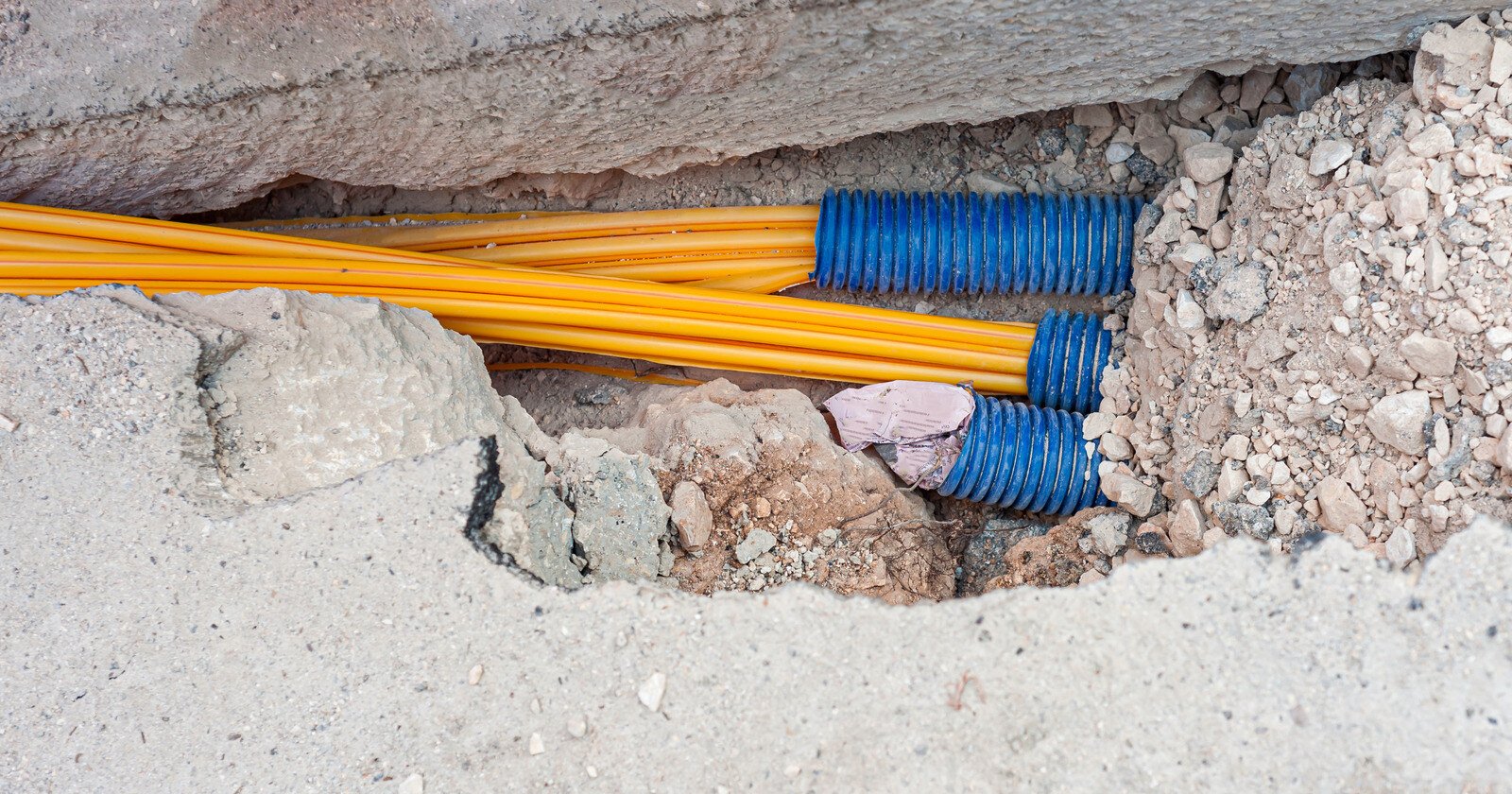
The conduit is usually HDPE, schedule 40 or 80 PVC, or rigid steel in exposed locations, and the ways are sized for the cable plus spare capacity. Handholes, pull boxes and splice vaults are set at the spacing the design calls for, with their lids at final grade and their bases on compacted gravel to prevent settling. Each duct is proved with a mandrel, blown clear and left with a pull string or a tape.
Fort Collins is laid out with Interstate 25 along its east side, US 287 as College Avenue through the city and State Highway 14 leaving on Mulberry Street, and trenches along these corridors are subject to the road owner's right-of-way rules. CDOT's I-25 and Mulberry interchange improvements project covers I-25 mileposts 269 to 271 and cites aging infrastructure and flooding concerns, which is a reminder that buried lines near state facilities may be moved, extended or built around as projects advance.
Within the city, a 2013 study of the Harmony Road corridor, home to office buildings and a tech corridor, involved about $53 million in potential improvements, including widened sections, raised landscaped medians and continuous sidewalks. Conduit routes built along corridors like this one should be placed with those future changes in mind, with extra spare ways where future conflicts are likely and with careful documentation of depth and location.
Work in the public right-of-way normally requires a permit from the road owner, traffic control plans and restoration to the owner's standard. Depth of cover for communications conduit is set by the owner and the serving carrier, and separation from power, gas and water lines is set by code and utility standards. We lay out the route on the plans, mark the crossings and review the cover requirements before we mobilize.
We also confirm who owns the conduit, who is allowed to place cable in it and where the demarcation sits. These questions affect the size of the handholes, the number of ducts, and the labeling system. Settling them before the trench is cut avoids having to retrofit a handhole or add a duct after the surface has been restored.
Fiber bend radius is the technical limit that matters most. Sweeps are chosen to give the cable crew a gentle path, long runs include pull boxes to limit tension, and no 90 degree fitting goes into a run that will carry large cable. Bedding is clean sand or fine gravel free of stones that could damage the duct, and the trench is backfilled in lifts to avoid settlement under pavement.
Before backfill, a surveyor records the horizontal and vertical location of every handhole and bend. Tracer wire is connected and tested at the handholes, and warning tape goes in 12 inches above the duct. A duct that is proven on the day it is installed will be there when the cable arrives, which is the point of the whole exercise.
Conduit trenches usually run before paving and landscaping, and they cross the paths of other contractors. We coordinate with the site utility crew to share trenches where the separation allows and to avoid cutting each other's work. The conduit installation is scheduled before the base course is placed, so that no one has to saw cut new pavement.
On campus work for schools and healthcare owners, the trench is often limited to hours when classes are out or when access to buildings can be maintained. We phase work in short sections, plate or backfill at the end of each shift, and communicate with facilities staff on closures. Deliveries of conduit, vaults and handholes are scheduled to arrive just ahead of the crew to avoid blocking access.
Larger power-and-communications projects combine this scope with electrical duct banks and rely on utility potholing to verify crossings before the trench is cut.
Our customers also include utilities and energy companies extending communication lines. Where the route cuts through an existing street, we cross with trenching and backfill methods that restore the structure of the road.
Send the route plan and the right-of-way requirements and we will propose the method for each crossing, with a schedule and a restoration plan.
The required depth comes from the right-of-way owner and the carrier, and it varies by location and by traffic loading. We confirm the figure on the plan before trenching, and we verify depth with a measuring rod or survey before backfill. Where depth cannot be achieved because of a conflict, we ask the owner for approval of a revised detail.
A handhole is a small box used for pulling and splicing smaller cable, while a vault is a larger structure that can hold splice cases and coiled slack. Vaults are usually precast concrete and set on gravel with a traffic-rated lid. The design sets the type and location.
Often yes. Directional drilling and boring can go under roads, walks and landscaping, and micro-trenching limits the cut to a narrow slot. Open trench is still the cheapest for long clear runs, so we compare the options for each crossing.
Plastic conduit cannot be found with a locator. A tracer wire laid with the conduit carries a signal the locating crew can follow, so the line is not struck by a later excavator. We test the wire at each handhole and record the results.