
Poured once and buried for the life of the building, a duct bank is the part of an electrical system that nobody wants to touch again. The conduits are spaced, tied, encased in red-dyed concrete and backfilled, and the cables that will run through them may not be pulled for months. If a conduit is crushed, offset or left with a burr at a joint, the damage will not show until the electrician is on site with a reel of expensive cable and no way to get it through.
We build concrete-encased and direct-buried duct banks for service entrances, transformer pads, campus feeders, switchgear rooms and utility interconnections. The work belongs to the underground contractor because it sits in the trench, but it is governed by the electrical drawings and by the serving utility. We coordinate the two, check separations and cover, and stage the pour so the electrical contractor can pull on a predictable date.
Colorado State University's Powerhouse Energy Campus is a 100,000 sq ft facility north of Old Town Fort Collins, and its 26 labs and research groups include a Grid Modernization Initiative and work on microgrid components, solar photovoltaic testing and large-scale engine testing. Buildings that host that kind of research need feeders with redundancy, spare conduits and room for sensors and controls that will change over time.
Poudre Valley Hospital in Fort Collins has 270 beds, 11 surgical suites and 12 intensive care beds, and healthcare campuses of that type depend on duplicated power paths and carefully separated conduit routes. When we build duct banks on such sites, the spare ways, the labeled pull boxes and the exact elevation records are as important as the encasement itself.
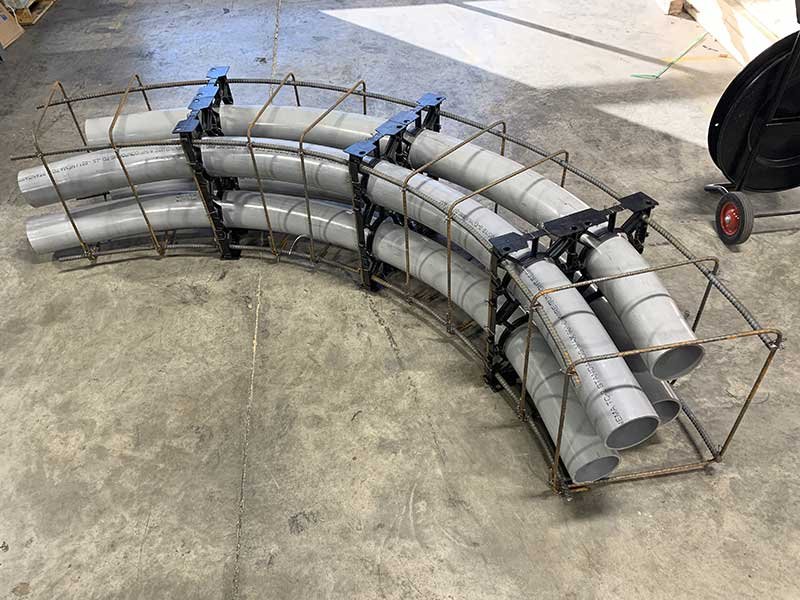
The bank is assembled in the trench with plastic spacers set at intervals that hold the conduits at the specified separation, both horizontally and vertically. The conduits are tied down so that they do not float when the concrete is placed, and joints are solvent-welded with the manufacturer's cement and checked for continuity. Sweeps and bends are made with factory elbows or rigid steel sweeps when the radius is critical for large cable.
Reinforcing steel is placed as the drawings show, typically above and below the bank and at transitions where the conduit enters a building or a vault. The concrete is red-dyed so a later excavator will see the encasement and stop. We place it in lifts and vibrate carefully, working around the bundle so every void is filled without displacing the spacers. Before the concrete goes in, each duct is proved with a mandrel and left with a pull string.
The package includes trenching to the depth the drawings require, the conduit and fittings, concrete encasement or direct-buried backfill with warning tape, pull boxes, handholes and vaults, transformer pads and equipment bases, and the stubs into buildings and switchgear. We also install the grounding conductor when it is included in the trench scope and the tracer wire that makes the bank findable.
Utility service is a separate coordination. The serving utility defines its own requirements for conduit size, number of bends, pull box spacing and the point of connection, and it often supplies or specifies the transformer pad. We confirm those requirements before pouring because a bank built to the wrong template must be broken out and rebuilt.
Excavating near existing power is one of the highest-risk activities in site work. We confirm the location of every energized line by locate tickets and potholing, mark the tolerance zone on the surface and hand-dig or vacuum within it. Equipment operators know the minimum clearance from overhead lines, and a spotter is assigned wherever the boom or the dump bed might rise toward them.
Trench safety follows the same rules as any deep excavation, and the pour is planned so that concrete is not placed against an unsupported wall. When the work must tie into a live system, the serving utility controls the outage, locks out the circuit and confirms the line is de-energized before the trade team approaches the cable.
The electrical schedule usually has a hard date for the pull, and the duct bank has to be inspected, poured and cured by then. We sequence inspections before the pour, cast in segments that match the available concrete, and protect the bank from loads until it reaches the strength the engineer requires. In cold weather the encasement is covered and kept above freezing, because concrete that freezes while it is young can lose strength.
Once the bank is poured, we leave the ends capped, mark them on the survey and take photographs for the as-built record before backfilling. The pull string, the mandrel record and the survey are handed to the electrical contractor so the pull can start without a second site visit.
The number of conduits, their diameter, the depth, the length of the run and the amount of reinforcement are the main variables. Concrete encasement adds cost but protects the cables against future excavation and heavy loads, so it is often specified under roads and in congested corridors. Unexpected conflicts add the most cost, which is why we ask for a utility survey and use potholing before pricing.
Where the route continues as a smaller conduit and fiber trench, the bank usually ends at a handhole or vault. Long banks with many bends are more expensive to pull, so we advise designers to minimize bends and to add pull boxes rather than force a tight radius. The other cost driver is access. A bank that crosses an existing road or a parking lot needs pavement cutting and restoration, and sometimes a phased closure.
We build duct banks for utilities and energy companies and for owners of data centers and other facilities where an outage is expensive, and the same coordination applies whether the bank serves a single transformer or a whole campus.
Send the one-line and the underground plan and we will confirm separations, encasement and the pull date with your electrical contractor.
Encasement protects the conduits from crushing by future excavation and heavy surface loads, and it fixes their spacing so they do not move during backfill. Red dye warns the next excavator. It is most often required under roadways, in congested corridors and wherever the cables are critical.
Spares cost little compared with reopening a bank, so many owners add one or two ways per bank or a spare for each critical circuit. We recommend discussing growth with the electrical engineer and the owner before the drawing is final.
Yes, with protection. The trench must be free of frost and water, the concrete is delivered warm, and the finished bank is blanketed. We also keep the temperature records, because the engineer may ask for them.
Separation between ducts, vertical and horizontal alignment, bend radius, smooth joints and clean ends are the critical items. A mandrel passed through each duct before the pour and again after backfill confirms that nothing has moved or collapsed.
We do, along with the electrical contractor. The utility often has its own detail for pad size, conduit count and bend limits, and we confirm those before forming the bank. Meeting with the utility's inspector before the pour avoids rework.