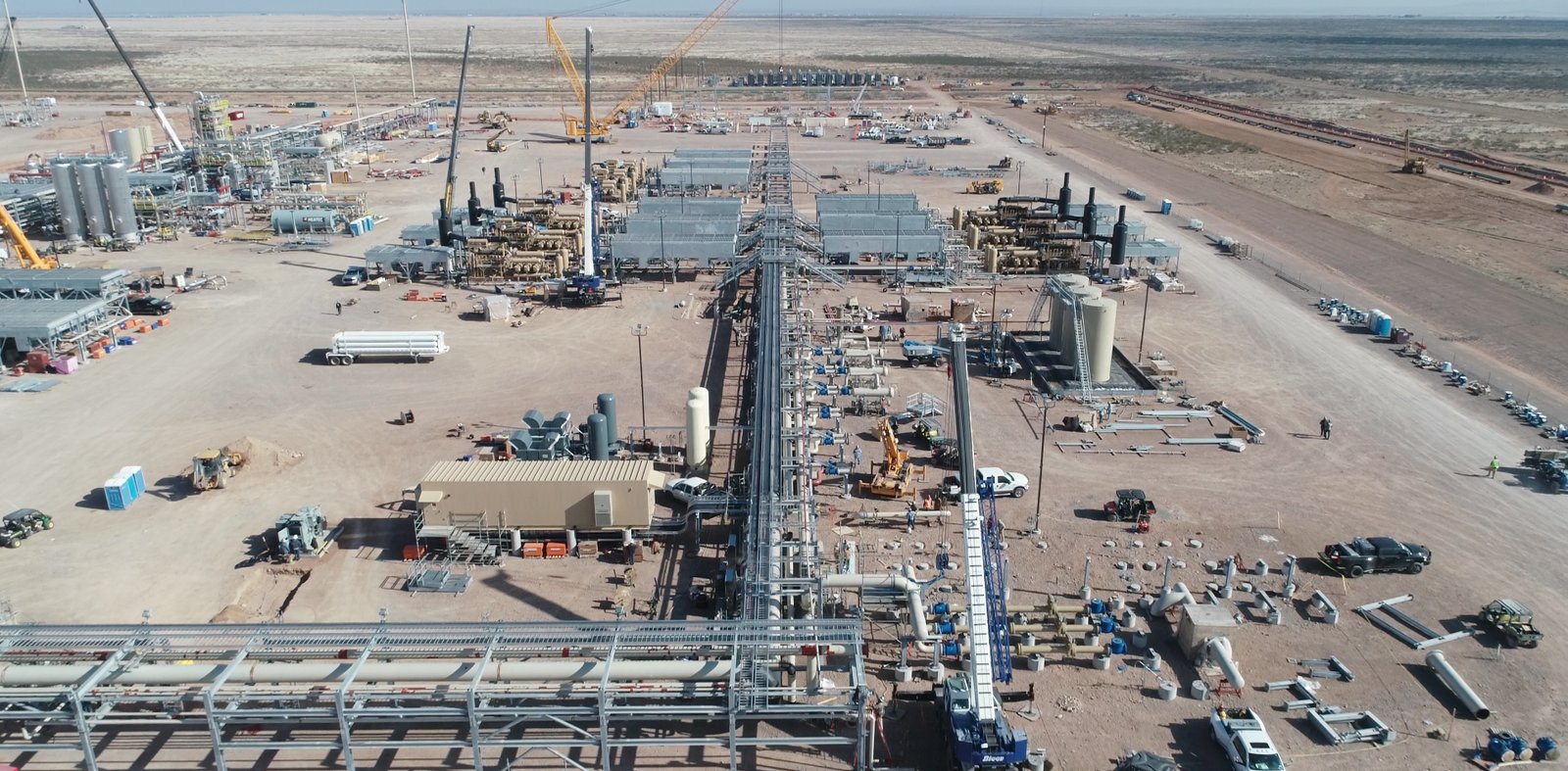
Compressor skids and tank batteries sit on concrete that has to hold fluid as well as weight, and the owner who understands that tends to ask the right first question: what happens to the pad when the liquid is not where it is supposed to be. We build the pads, the containment, the access and the trenches that oil, gas and midstream operators need on the Weld and Larimer County side of the northern Front Range, and we build them with the spill in mind.
Weld County sets the ground rules for much of this work. Unincorporated Weld County adopted the 2024 International Building Code effective June 15, 2026, with engineered foundation designs required for most new structures, which means a facility building or a skid foundation outside a town is likely to arrive with stamped drawings rather than a standard detail. Inside the towns the editions differ, and the Home Builders Association tracker shows that commercial codes in Colorado are adopted city by city and county by county, so we confirm which jurisdiction a site sits in before we price.
The industrial base here is wide. Colorado State University's Powerhouse Energy Campus hosts a methane emissions technology evaluation center and large-scale engine testing, which tells operators that emissions and equipment performance are studied locally. The Great Western Industrial Park in Windsor lists oilfield service firms among its tenants, and Union Pacific's Eaton rail park offers unit train and manifest service. Operators who need pads, roads and pipelines do not work in isolation from those neighbors, and we build with them in mind.
The geography matters to anyone moving equipment and fluids. Greeley is served by US 34 and US 85, and the South Platte River bounds Greeley and Evans on the south while the Cache la Poudre runs through north Greeley. At Kersey, US 34 crosses the South Platte and meets County Road 53, which gives a haul route for rigs and loads moving between farm roads and the highway. Eaton sits on US 85 about 7 miles north of Greeley and on Union Pacific's mainline, with a 160-acre rail park zoned I-2 and parcels divisible to a 1 acre minimum.
For an operator, those details translate to three questions about every site: how heavy loads reach it, how stormwater leaves it and how close it is to a river or ditch. Our site work starts with those questions, because a pad is only as good as the road to it and the drainage around it. We build lease roads and entrance aprons in aggregate or concrete, as the operator's maintenance plan prefers.
The core of our oil and gas scope is containment pads and secondary containment: reinforced slabs with integral curbs, sloped to a sump, jointed with waterstops and sealed so that a release stays inside the wall until a vacuum truck arrives. The curb height and volume come from the operator's engineer, and we build to those numbers and test the containment where the design requires.
Equipment foundations come next. Equipment pads and machine foundations for compressors, separators and pumps carry anchor bolts or rods set with templates, and the grout and base plate details follow the manufacturer's drawings. Around them we place truck loading aprons, small bridging slabs over pipe racks and bollards, and we trench for gathering lines, power and communications with the compaction and bedding the pipeline owner's inspector requires. The pipe itself is typically installed by specialists, and we coordinate the trench so their crews work without delay.
Operators carry their own engineering standards, and the best submittal is one that answers them: concrete mix designs with the air content and water-cement ratio stated, reinforcing placement drawings, and test reports for every pour. Because Weld County requires engineered foundation designs for most new structures in the unincorporated area, we work from the engineer's stamped drawings and submit RFIs when field conditions differ, rather than substituting details on our own.
Stormwater is part of the permit conversation on any disturbed site. We install the sediment controls, track inspection frequency and maintain the stormwater plan documents with our erosion control and SWPPP support. Sites near the South Platte or the Cache la Poudre need particular care with perimeter controls, since a single heavy storm can move a lot of silt toward the river. We also work with the operator's environmental staff on any wetland or floodplain boundary in the plans.
An active facility has hazards that a building site does not: hydrocarbon vapor, pressurized lines, hot work permits and exclusion zones around live equipment. We follow the operator's safety program, complete the required orientation and, where required, gas monitoring, and we do not start a trench or a pour without a signed work authorization. Locating existing lines with utility potholing and locating before we dig is not a courtesy on a facility like this; it is how we avoid cutting a line.
Excavations are protected with shoring or sloping, spoil is staged away from the edge, and equipment operators work with spotters near live piping. We keep a clean site, because loose rebar, wire and concrete debris are hazards for the operator's own operators too. On sites shared with utilities and energy companies, we coordinate access and outage windows with each owner's field lead.
Pad price is driven by containment volume, slab thickness, reinforcing density and the number of penetrations and embedded items. A containment slab with a high curb and many sumps costs more than a plain skid pad, and the extra labor for waterstops and sealants is what separates them. Geotechnical conditions are the other variable: a pad on poor soil needs over-excavation and engineered fill, which we price as separate items.
Remoteness changes price too. A site far from a ready-mix plant adds haul time, which affects the mix and the placement window, and a site in winter needs protection. We price those factors openly, and we tell operators when it makes sense to batch several pads into one mobilization. Where the same owner also runs agricultural or processing operations, as agriculture and dairy owners in the Greeley area do, we can often combine concrete scopes into one program.
Send the facility layout, the equipment list and the engineer of record. We will return a priced scope with containment, foundations, roads and trenches described separately.
Integral curbs or walls, a floor sloped to a sump, waterstops in construction joints, sealed joints and sometimes a coating or liner depending on the fluid stored. The structure must hold the volume the operator's engineer specifies, so curb height and floor area are checked against that number. We also test or inspect the containment before the equipment is set.
Yes. We set anchor bolts and rods with steel templates from the equipment manufacturer's drawings, check elevation and projection with a survey instrument before the pour and photograph the layout. A bolt that is off by an inch is a rework problem for the owner, so we check twice.
We build from the engineer's stamped foundation drawings, and our submittals include the mix design, reinforcing shop drawings and inspection schedule. If something in the field differs from the drawing, such as soft subgrade or an unmarked line, we stop and send a request for information rather than guess.
Often yes, with an approved work plan, designated access, exclusion zones around live equipment and a plan for hot work and vehicle traffic. We stage our work in areas the operator can isolate, and we coordinate daily with the field lead.