A utility that sits in the way of a road, a building or a new interchange does not move by itself, and its move almost always takes longer than the work that forces it. Water, sewer, gas, power and communications lines each belong to a different owner with its own design review, its own crews and its own outage rules. The contractor in the middle has to turn those independent calendars into a single sequence so the new facility can be built without a utility strike or a month of waiting.
We relocate and replace buried and overhead-adjacent utilities for developers, public agencies and utility owners. The work is built around a simple discipline: find out what is there, agree on where it should go, build the new route before the old one is taken out of service, and then cut over in a window that does not strand a customer. Most problems in relocation work come from one of those steps being skipped, usually the first.
Each relocation begins with a utility inventory. We compile the locate tickets, the as-builts and the records that owners will share, and we verify the critical crossings by potholing to establish depth and size. The result is a conflict list that the design team uses to decide whether to shift the new construction, lower the new pipe under the old one or move the old line.
The conflict list also tells us who needs to be at the table. Private lines, abandoned services and ditch company facilities are often not shown on the owner's maps, and their owners need to be contacted before work starts. A relocation agreement or a notice of intent is often required, and the lead time for these documents is typically longer than the construction itself.
CDOT's I-25 and Mulberry (CO 14) Interchange Improvements project covers I-25 mileposts 269 to 271 and CO 14 frontage road connections from milepost 138.7 to 139.25, and it cites flooding concerns and aging infrastructure among its reasons. The agency secured design funds in September 2022, and its page estimates 30 percent design in early 2026, 60 percent in early 2027 and final design in early 2028, subject to change. Utility conflicts typically surface and are resolved between those design milestones, so relocation planning for such a project begins long before the dirt moves.
The region has done this before. US 287 was rerouted in 2007 onto a bypass north and west of downtown Berthoud, moving through traffic off Mountain Avenue, and a change like that reaches into the utility corridors on both sides of the old and new alignments. Owners of government and municipal facilities planning work near such roads should expect a long runway.
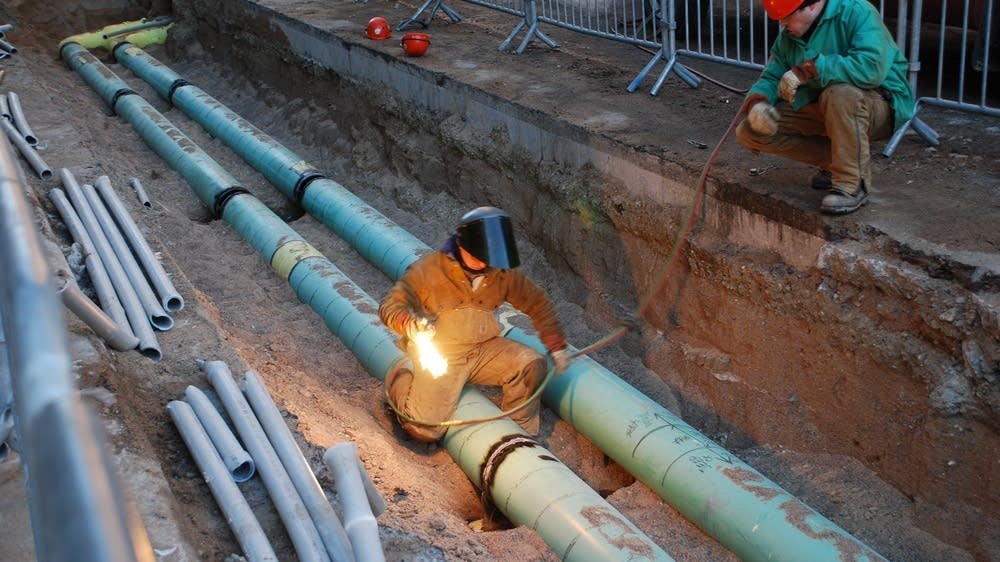
The central rule of relocation is that the new route is built, tested and energized before the old one is shut down. For a water line, that means installing and testing the new main, then making a quick cutover during a planned shutdown. For electric, it can mean building a new duct bank and pulling new cable before the utility transfers the load. For communications, it often means splicing in a new path and moving customers one by one.
Shutdown windows are fixed by the owner and are not negotiable on the day. We prepare for them with all fittings and tools staged, the trench dewatered, the isolation valves exercised and a written sequence signed by the owner's representative. The best relocation is the one customers never notice, and the preparation is what makes that possible.
When the permanent route cannot be built first, we provide temporary service. This may be a bypass line laid above grade across a site, a temporary pole line, or a temporary conduit that lets communications remain active during construction. Temporary facilities need their own design and inspection, and they need to be protected from traffic and from the construction going on around them.
Phasing is the other lever. A long relocation can be broken into segments that allow the road or building contractor to start work in the first clear area while we continue downstream. We coordinate with that contractor by weekly meeting, share the survey data and agree on shared working areas, so we are not digging in the same place at the same time.
Relocation puts a crew in close contact with hazards that are not visible: energized cables, pressurized gas, pressurized water and fiber carrying critical traffic. We treat every buried line as live until it is proven otherwise, and we hand-dig around it. A line that has been abandoned on paper may still be in service, so we confirm status with the owner before cutting.
Work in public rights-of-way also exposes the public. Traffic control, pedestrian detours, plates over open trenches and clear signage are part of every plan. When an unexpected line is found, we stop, mark, notify the owner and wait for direction. A delay of a day costs far less than a strike.
The new route is usually built with the same tools as any other underground job: water main installation for pressure lines, and road subgrade preparation where the relocation runs under or beside a roadway that is being rebuilt, since the trench backfill has to carry traffic without settling.
Most of our relocation customers are utilities and energy companies that need a contractor to build their new facilities to their standards, and oil, gas and midstream operators moving gathering and distribution lines out of a construction footprint. In both cases, the owner's inspector decides when the work is accepted, and we plan the schedule.
Send the conflict list and the owner contacts and we will lay out the relocation sequence, the shutdown windows and the temporary services.
The construction may take days or weeks, but design review, easements and owner approvals frequently take months. The schedule is usually set by the slowest reviewer, not by the crew. We recommend starting the relocation paperwork as soon as a conflict is identified.
It depends on the easement, the franchise agreement and the project. In many cases the party causing the conflict pays, but in others the utility owner bears the cost if its facility is in a public right-of-way. We provide quantities and unit prices so the parties can settle the question, but the decision is theirs.
Usually yes, if the new route is built first and the cutover is brief. Where a temporary service is needed, we design it with the owner and notify affected customers in advance. Outages are scheduled for low-demand hours.
We stop work, protect the line and notify the owner. A locator confirms its type and status before anything moves, and the engineer decides whether to adjust the design. Unmapped lines are common around older farms and ditch systems, so the contract should include a process for them.