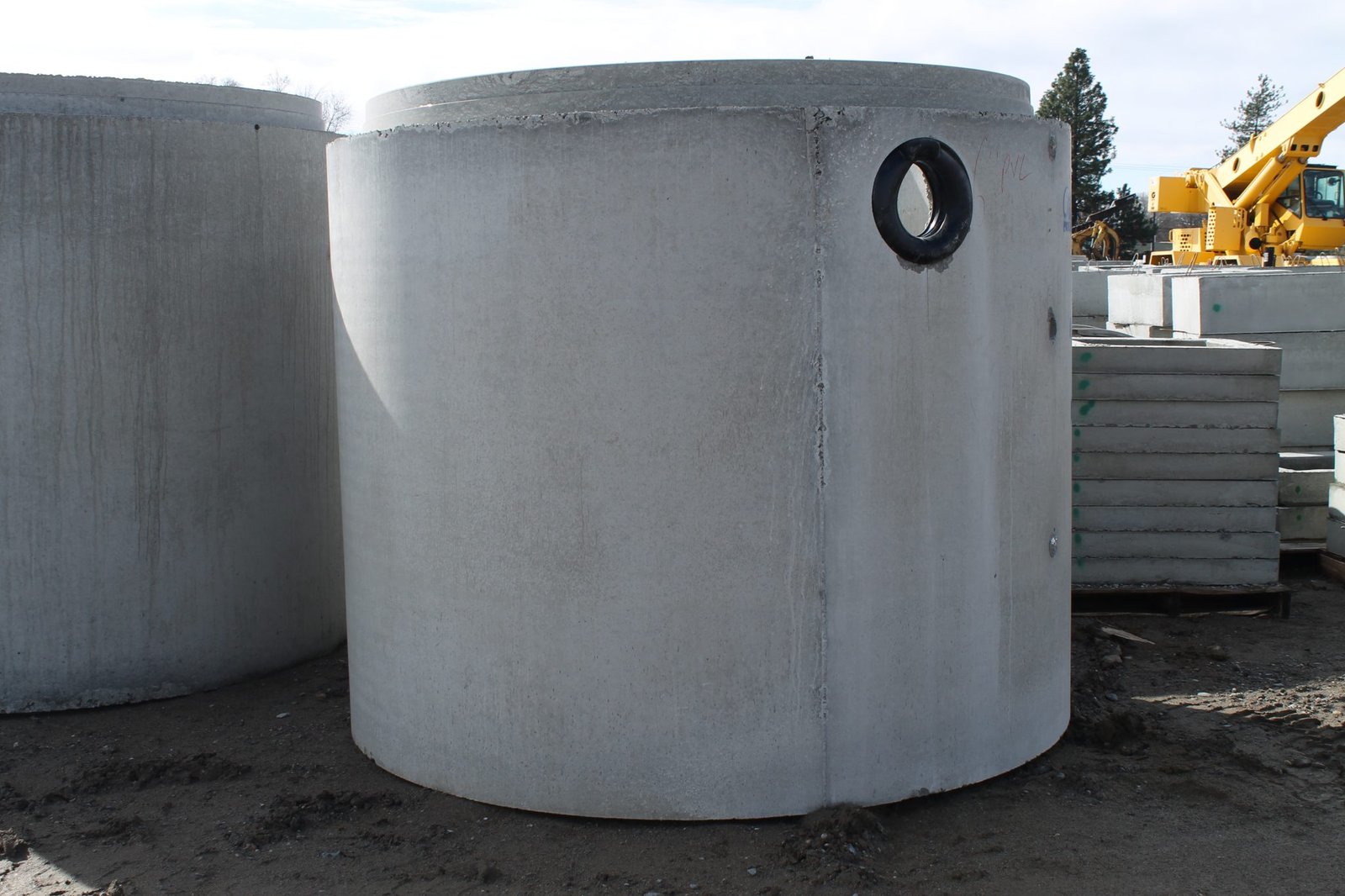
Groundwater pushes upward on a buried structure with a force equal to the weight of the water it displaces, and an empty manhole or vault in saturated soil behaves much like a boat. Precast structures that float a few inches during backfill can break pipe connections, tilt out of plumb and leave a rim that will never sit right in the pavement. That is the first reason structures are treated as a trade of their own and not as an afterthought to the pipe.
We set manholes, valve vaults, meter vaults, junction boxes, inlets and cast-in-place utility structures for sewer, storm, water and electrical systems. The work is deliberate and exacting: a base on a prepared bed, sections sealed and plumb, penetrations cored or cast to the pipe elevation, and a frame brought to the finished surface in a single adjustment. Done well, a structure disappears into the street. Done poorly, it announces itself every time a truck crosses it.
Most sanitary and storm manholes are precast concrete barrels with a cast base or a separate base slab, eccentric or concentric cones, grade rings and a cast iron frame and cover. Vaults for valves, meters and backflow assemblies are larger precast boxes with access hatches, and some structures are too large or irregular and are formed and poured in place. Inlets, junction boxes and drop structures sit between the two.
Connections are the detail that matters. Flexible boots or cast-in gaskets seal the pipe where it passes through the wall, inverts are formed with grout or precast channels to carry flow smoothly from inlet to outlet, and drop connections are built where the incoming line is much higher than the outgoing one. A structure that is built correctly serves a sanitary sewer without trapping solids and a storm drain without scouring the invert.
The South Platte River bounds the Greeley and Evans area on the south and the Cache la Poudre River runs through north Greeley, so structures in those corridors often sit in groundwater that rises and falls with the river. Where the water table reaches the base, we dewater before setting, place the structure on a stable gravel bed and backfill evenly on all sides so it cannot lift or shift. Some designs add a wider base or a concrete collar to resist flotation, and we build those to the detail.
Flood events remind owners why this matters. Four days of heavy rain in September 2013 flooded Loveland along the Big Thompson River, and a structure that leaks in a wet year lets groundwater into the system and sends it to a treatment plant. We test manholes by vacuum or exfiltration before the pavement is placed, because infiltration is much easier to fix when the structure can still be reached.
Structures in roadways are designed for highway wheel loads and set to the owner's standard details for cone height, step spacing, frame and cover weight, and joint sealant. Access openings and ladders must meet the safety requirements for confined spaces, and vaults that hold equipment need hatches sized to lift the largest piece that will ever be removed.
Old Town Fort Collins has a city-designated historic district dating to 1972 that overlaps the National Register district and imposes design standards. A utility structure set in a street or sidewalk near the Old Town district may need a cover, a frame color or a surface treatment that fits those standards, and approvals for such items take time. We ask early so that the right castings are ordered with the rest of the structures.
Depth, diameter, precast versus cast in place, number of penetrations and groundwater all move the price. A shallow standard manhole is a half-day operation, while a deep vault in wet ground takes shoring, dewatering, a wider excavation and careful lifting equipment. Special castings, corrosion-resistant liners and ladders add cost, but they pay back where the structure sees aggressive flows.
The cheapest structure is one that is built once. That means ordering from approved submittals, checking the elevation of every incoming and outgoing pipe against the structure schedule, and confirming with the engineer before cores are cut. We also recommend that owners of government and municipal facilities and public works departments specify a few standard structures, which reduces lead times and spare parts.
We set the base on a compacted bed, check it for level in both directions, and set each section on a continuous bed of sealant, taking care that the lift holes are filled and the barrel sections are aligned. Pipe penetrations are sealed and the invert is formed to the elevations on the profile. Before backfill, we check plumb, elevation and the clearance between each pipe and the wall.
The rim is set last. Grade rings and frames are adjusted to the finished pavement elevation, and the frame is set in a bed of mortar or a polymer sealant with a ring of concrete poured around it where traffic loads require. Setting the rim to match the base course and then readjusting after paving is a common source of rough manholes, so we coordinate with the paving crew and set once, to the final grade shown on the plans.
Send the structure schedule and the profile sheets and we will check pipe elevations, groundwater and lead times before anything is ordered.
Usually the backfill around the structure was not compacted in lifts, or the frame was set before the base course was finished. The fix is to compact evenly around the barrel, set the frame to the final grade and avoid heavy equipment next to a fresh structure. Settlement is a symptom of how the structure was backfilled, not of the structure itself.
Sewer manholes are typically tested by vacuum, where the structure is sealed and a vacuum is drawn and held for a set time, or by filling with water and measuring the drop. Storm structures are more often inspected visually. The test is performed before backfill is finished or before paving, depending on the owner's requirements.
Yes, but groundwater has to be controlled while it is set and the design must resist flotation once the excavation is backfilled. We use dewatering, a gravel base and uniform backfill, and some designs add ballast or a thickened base. The structure must be checked again after the water table returns.
They can be built to the exact size and shape of the site conditions, with pipe penetrations placed exactly where the lines arrive. They take longer than precast, since forms, rebar and curing add days, but for large or irregular structures they are often the better choice. We coordinate with the cast-in-place concrete trade crews.