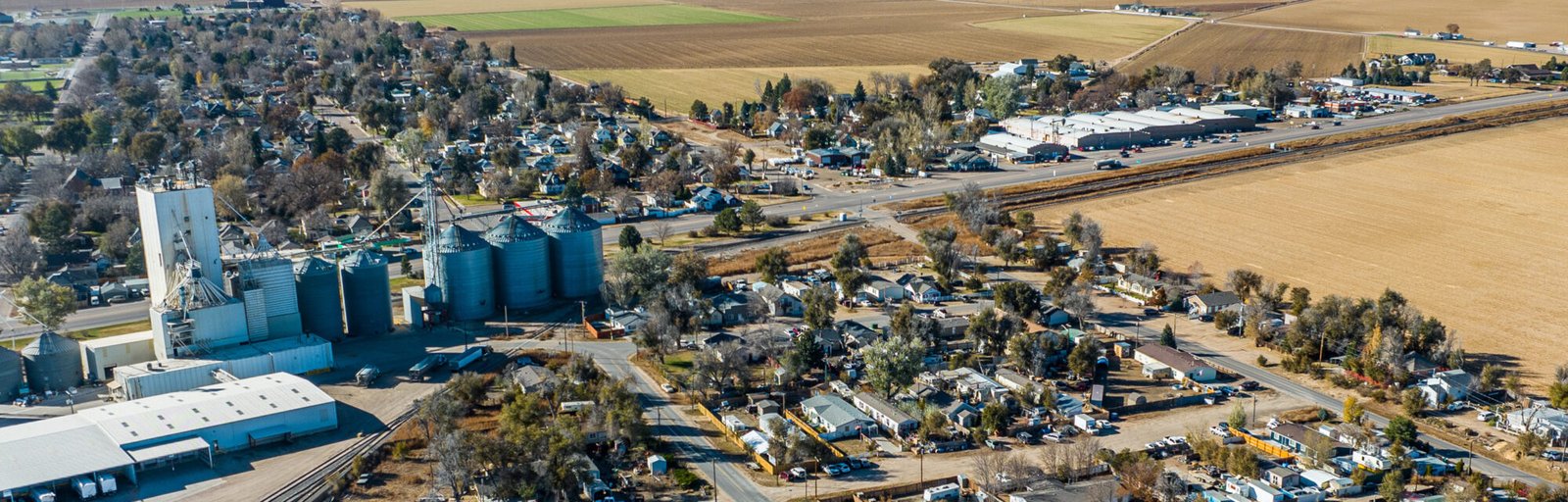
A rail-served industrial parcel needs three things before a tenant can use it: a graded pad, a track connection and a concrete surface that carries trucks, forklifts and rail-side loading. At Eaton, 160 acres of industrial ground zoned I-2 sit on the main rail line, and the site work that makes any one parcel usable is exactly what we do: earthwork, utilities, slabs and heavy pavement.
The Eaton Industrial Rail Parks (North and South) total 160 acres zoned I-2, with parcels divisible to a 1 acre minimum, unit train and manifest service available, and approval of a 10 percent design for new rail service. The park's owner also notes that the Denver metro is within an hour's drive and Denver International Airport within 50 miles. A buyer who can start at 1 acre and grow into a larger footprint has options, and the way the pad and utilities are laid out at the start decides how easily that growth happens.
We work with industrial owners, developers and general contractors who build here, and we plan the earthwork and concrete so each phase can stand alone while leaving room for the next.
The buyers on this kind of land are industrial and manufacturing owners who ship or receive by rail, and logistics and warehouse developers who build transload and warehouse buildings for tenants. Agricultural processors sit in the same group, since the surrounding farmland is the source of much of what moves.
These buyers share a priority: the site must work from day one. A tenant that cannot get a truck onto the pad or a car spotted at the siding has no use for a building. We schedule our work so that access and utilities come first, then slabs, then paving.
Industrial rail parcels generally need a prepared building pad, a slab built for forklift and truck traffic, concrete aprons at the doors, and a truck yard. Transload operations may add a loading platform or a pad for equipment. We build those with thicker sections, reinforcing and dowels at joints that carry wheel loads.
The track itself is built by rail specialists, but our work meets it: grading to the track elevations, drainage that does not undermine the ballast, and crossings where a truck route has to cross the siding. We coordinate with the railroad's design team so that our elevations and drainage match theirs.
The railroad's approval of a design for new rail service shapes the schedule. Earthwork and utilities can often go ahead before track is built, but the final grades near the siding cannot be fixed until the track plan is accepted. We rough-grade the pad, leave final grading near the track until the design is confirmed, and keep the utility and slab schedule moving in the meantime.
Slabs follow when the building design is final and the pad has been tested. Paving waits for the utilities underneath to be tested and backfilled. Our look-ahead schedule shows every one of these dependencies, so the owner can see where a delay in one approval will affect the next.
Unincorporated Weld County adopted the 2024 International Building Code effective June 15, 2026, with engineered foundation designs required for most new structures. Whether a parcel falls under the town or the county determines who reviews the permit. Either way, a foundation and slab design stamped by an engineer will be part of the package, and we build to those drawings.
Work near the right of way involves the railroad's own requirements, including insurance, flagging and limits on equipment. Our testing and quality control reports show that compaction and concrete strength meet the design, which is the proof both the building official and the railroad look for.
In a rural industrial park, travel affects trade pricing, so we coordinate mobilization and handovers before work starts. The trade crews handle mass grading, trenching, backfill, forming, reinforcing, placing and finishing. A single team accountable for the sequence makes it easier to solve problems on site.
Much of the surrounding farmland depends on irrigation systems. That means ditches, laterals and buried pipe may cross a parcel. Before grading we locate them, agree on a plan with the owners, and protect or relocate them as the design requires.
Eaton lies along US 85 about 7 miles north of Greeley, and US 85 meets SH 392 in Lucerne, passes through Eaton and meets SH 14 in Ault. The highway gives trucks a straight route to the park, and rail provides the second mode. Ault, just up the highway, has a similar combination of rail and road.
To the south, Greeley offers the larger employment and supplier base. We use that proximity to source ready-mix, pipe and aggregate from nearby plants, which keeps haul times short and the pour window workable.
Before buying a parcel, an owner should know the soils, the utilities available at the property line, the rail connection cost and the drainage route. We offer a short pre-purchase review: a look at the site, the geotechnical report and the utility plans, followed by a ballpark of site work and concrete. That prevents surprises after closing.
Parcels as small as 1 acre can fit a modest building, but access and truck turning space often drive the real footprint. We lay out the pad and yard with turning radii in mind, and we recommend a layout that can be extended as the tenant grows.
If you hold a parcel at Eaton or are weighing one, send us the plat and your intended use. We will outline the earthwork, utilities and concrete, and how they fit with the rail design.
It depends on the traffic. A yard with loaded trailers and lift trucks typically needs a thicker, reinforced slab with dowels at the joints, over a compacted base. The engineer sets the section, and we build it to the drawings with density and strength testing.
We locate them, talk with the ditch company and the owners, and plan a relocation or a pipe crossing that keeps water flowing. The design has to be approved by the ditch owner before we touch the facility.
Where grading affects the right of way or drainage toward it, yes. The railroad has its own review and standards. We coordinate through the owner and the engineer, and we do not finalize grades near the siding until the track design has been accepted.
Yes, though fixed costs such as mobilization are a larger share of a small job. We price the pad, utilities and slab clearly so the owner can see what is fixed and what scales with area.
We test compaction on the subgrade and base, and we cast cylinders at the pour to confirm strength. We can add flatness testing if the tenant needs it, and we share the reports with the engineer and owner.