
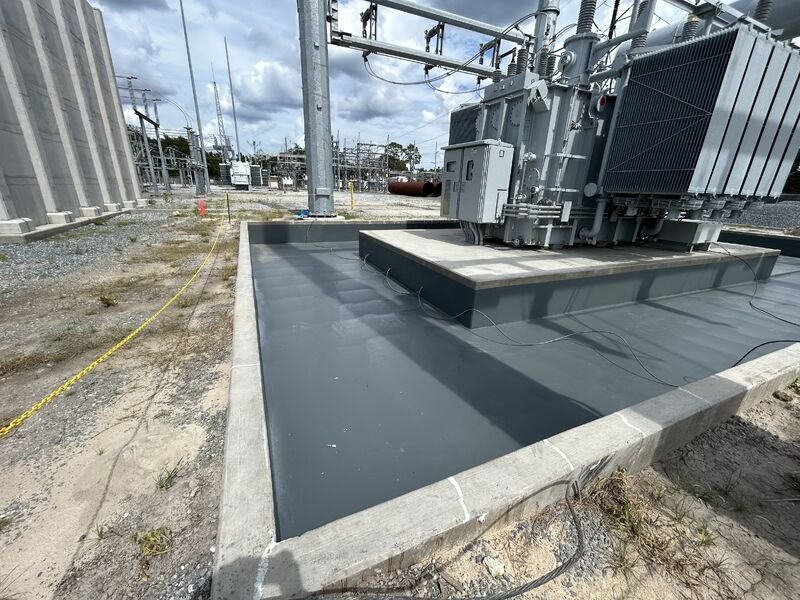
Sooner or later a containment pad is tested by something that was not supposed to happen: a hose lets go, a tank valve is left cracked, a storm arrives on top of a spill. The concrete either holds that liquid until someone can pump it out or it does not, and the difference lies in joints, curing and coatings far more than in thickness. We build containment pads and curbed basins for fuel, chemicals, wash water and process fluids on sites across the northern Front Range.
Typical scopes are tank farm basins, truck loadout pads, drum storage slabs, transformer containment and sloped aprons that drain to a sump. The concrete is a low-permeability mix with a controlled water-cement ratio, reinforced to limit crack widths rather than to carry load, and every construction joint is sealed with a waterstop or a compatible joint system. A basin is a bathtub, and a bathtub is only as good as its seams.
A cheese plant in Greeley was designed around more than 7 million pounds of milk per day, which gives a feel for the process volumes that this region handles. Washdown water, cleaning chemicals and product all need a place to go, and a pad that cannot contain them becomes the owner's problem within the first month of operation.
Northern Colorado mixes agricultural processing, energy services and manufacturing within a few miles of each other. Great Western Industrial Park in Windsor lists tenants from energy services to wind and composites manufacturing, and each of those uses fluids that need to be kept off the ground. The owners we work with are often asked by insurers or by the authority having jurisdiction to show how a release would be contained before a building is occupied.
The river corridors add a second layer. Evans sits along the South Platte, and a basin in a flood-prone bottom must stay sealed and also stay out of rising water, which affects both the elevation of the pad and the way stormwater is routed around it. Rainwater that accumulates in an open basin needs a controlled release path, and we design the sump and the valve arrangement with that in mind.
We prefer to pour floor and curb as a monolithic section when the geometry allows, which removes the most vulnerable joint. Where a cold joint is unavoidable, it gets a continuous waterstop, a keyway, and a surface prepared to receive the next placement. Penetrations are kept to a minimum, and the ones that remain are sleeved with link seals or cast-in fittings, never core-drilled after the fact through a finished basin.
The floor slopes toward the sump at a gradient the drawings give, usually a modest percentage that is still enough to move liquid reliably. We set screeds on that slope and finish with a steel trowel or a broom as the coating system requires. Related drainage components, from sump pits to trench drains, are built into the pour, and the outlets are coordinated with the site's storm drain installation so contaminated and clean water stay on separate paths.
Coatings and liners are only as good as the concrete beneath them. A pad that will receive an epoxy or other chemical-resistant coating must cure for the period the coating manufacturer requires, pass a moisture test and be profiled by shotblasting or grinding. We build the schedule around that wait rather than pretending it away, and we tell the owner when a coating can realistically start.
Before a basin goes into service, many owners and authorities require a hold test. The basin is filled with water to a stated level and observed over a set period, and any drop beyond evaporation means a leak to find. Cylinders and field tests documented through concrete testing and quality control back up the strength and air content records that regulators ask for.
Many containment projects are retrofits at operating facilities. We coordinate hot work, lockout and tagout, and confined-space entry for sumps with the owner's safety lead, and we plan deliveries so trucks do not cross live piping. A pour next to a fuel tank is scheduled with the operator, not around them.
Contaminated soil is another reality. If excavation for a new basin uncovers stained ground, work stops and the owner is told immediately, because handling and disposal are regulated. Owners in the energy sector, including oil, gas and midstream operators, usually have their own procedures, and we follow them while keeping the concrete schedule intact.
Pad area, wall height and joint count set the concrete and forming cost. Waterstops, sleeves and sump hardware add modest amounts, and coatings are often the largest single line after concrete. The decision to coat the entire basin or only the sump and perimeter is made on the owner's risk tolerance and on the chemistry of what will be stored.
Schedule is the other driver. A basin that must be complete before a tank set, or before a food and beverage processing line starts, has no float, so the curing and coating windows have to be inside the construction plan from the start. The trade crews work in both Greeley and Evans settings, where those pressures show up most.
Send the tank list and the site plan. We will price the basin, sequence the pour around your operations and set the curing and coating windows.
Reinforcement controls crack width, which matters because a crack in a basin is a leak path. The engineer sets the bar size and spacing, and the slab is generally thicker or more heavily reinforced than a plain floor of the same size. We follow the drawings and add the details that keep joints sealed.
It depends on the coating system and on the moisture level of the slab. Many manufacturers want the concrete cured for a period and then tested for moisture vapor emission. We plan that wait into the schedule and do not apply coatings over damp slabs.
It has to be released in a controlled way after it has been checked for contamination. Basins are usually provided with a sump and a normally closed valve or a pumped discharge. We build the sump and the sleeves to the drawing and coordinate the outlet with the site drainage.
Yes, with planning. We coordinate shutdown windows, protect piping, and often pour in sections with waterstops at the joints. The work is slower than new construction on an open site, and the pricing reflects the access and safety measures.
Testing is usually done by the owner or a third-party inspector, with the trade crews filling the basin and providing access. We document the fill level, time and observations, and we repair any leak found by methods the engineer approves.