A compressor, a generator or a test engine does not care how flat your slab is. It cares whether the foundation under it is stiffer and heavier than the machine's own dynamic forces. Equipment pads and machine foundations are the concrete that makes rotating and reciprocating equipment behave, and they are designed by a mechanical or structural engineer long before we see the drawings. Our work is to build exactly what the drawings and the vendor's foundation data call for, to the tolerances the vendor states.
The simplest scope is a housekeeping pad for a chiller, a transformer or a rooftop-sized unit set at grade: a few cubic yards, a mat of reinforcement and a trowelled or broomed top. The hardest is an inertia block or a heavy mat for an engine or compressor, where the mass is the design and a pour of 40 or 60 cubic yards must be placed continuously and cured with controlled temperatures. We price and sequence these as different jobs because they are.
Because the equipment arrives on the vendor's schedule, the pad is almost always on the critical path. We ask for the foundation drawing, the bolt template and the grouting requirement before we mobilize, and we do not pour until the template has been checked against the vendor's latest revision.
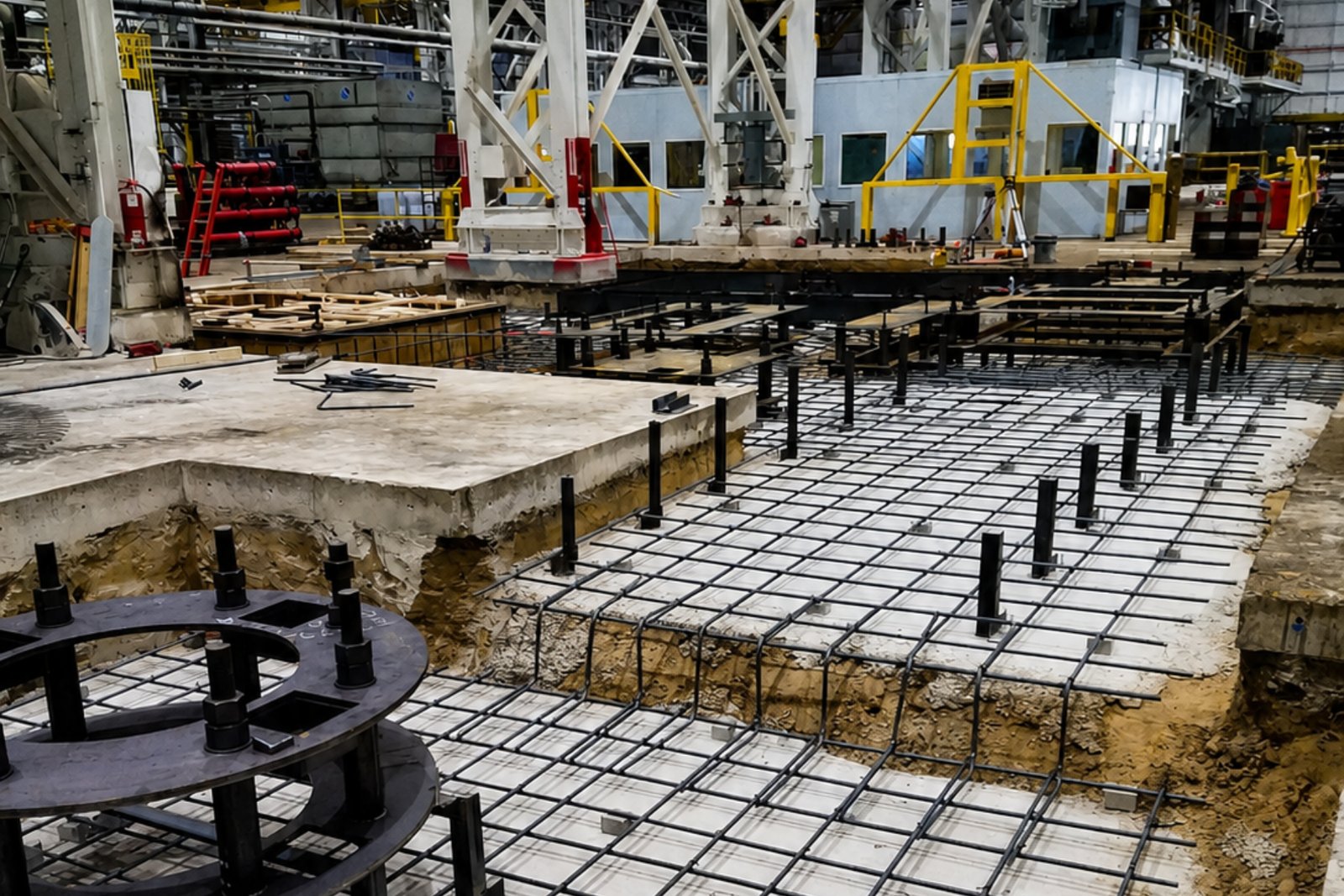
We form and place the pad, set and tie the reinforcement, install the anchor bolts or sleeve assemblies to template, finish the top and cure the concrete. Where the design calls for isolation joints, sleeves or embedded plates, the forming trade team installs them as part of the pour rather than leaving them to another trade. Embedded items are located by survey from fixed control, not tape measure from the edge of a form.
Beneath the pad, the earthwork trade team prepares the subgrade, whether that is compacted structural fill or an excavation to bearing, and verifies compaction with testing before steel goes in. Coordinating both ends of the job means the anchor bolt layout is checked against subgrade records and the vendor's alignment tolerances before placement.
A university energy campus hosting 26 labs and research groups, including large-scale engine testing and hydrogen and electric vehicle work, is an extreme example of the foundation demands in this market. A test facility like the one on North College Avenue needs foundations that isolate vibration from adjacent labs while allowing instruments to be relocated as the research changes. Plants that build vehicles ask for the same isolation and precision, as our page on automotive and EV plants describes.
On the manufacturing side, Windsor took over wind turbine blade production in 2021, adding an estimated 150 jobs. Blade molds and curing fixtures are heavy, precise and sensitive to settlement, which means floor slabs and pads that must hold elevation across seasons. Buyers planning equipment-intensive space can look at our work for manufacturing plants to see how the pads fit into the broader slab package.
Pads outdoors face frost. Fort Collins design criteria list a 30 inch frost depth, so an exterior pad that carries a vibrating machine is either set below that depth or insulated and detailed to avoid heave. We review the soils report for bearing and for expansive layers and ask the engineer to confirm whether over-excavation and structural fill are intended below the pad.
Grout is the last thing installed and the first thing that fails if it is rushed. Baseplates are leveled on shims or jackscrews, the pad surface is prepared and saturated or cleaned as the grout manufacturer requires, and the grout is placed from one side to avoid trapped air. We coordinate with the equipment vendor so the machine is not started until the grout has reached the strength the vendor specifies.
Thick pads also need a curing plan, not just a curing wish. We measure concrete temperature at the center and near the surface, keep the top moist or covered, and strip side forms on a schedule that avoids thermal shock. Cylinders from the pour are held for the 28 day result, and early breaks tell us when the vendor can begin loading the foundation with the machine's weight.
Anchor bolts are where machine foundations most often go wrong. We fabricate or receive the template from the vendor, set it on the forms with surveyed control and tie the bolts so they cannot move during the pour. A bolt that ends a half inch off is a drilled-and-epoxied bolt, and that is a repair that someone will have to explain to the owner.
Electrical connections to the equipment often run through conduit cast into or beside the pad. Our work with electrical duct banks keeps those runs coordinated with the pad pour. Larger mats are also a form of mass concrete pour, with their own heat-of-hydration controls.
The buyers are plant owners, general contractors building process space, utilities and energy operators. For the latter, our experience with utilities and energy companies covers transformer pads, generator pads and switchgear foundations where utility standards and owner standards both apply.
Heavy plant floors around the machine are covered by our industrial concrete floors work. We bid pads as part of the larger concrete package whenever possible. Splitting a machine foundation away from the surrounding floor usually creates two crews and two schedules, while a single scope lets us tune the pour order so the pad is complete in time for the vendor to set equipment.
Send the vendor foundation drawing and the geotechnical report. We will return a concrete order, a template plan and a pour schedule tied to equipment delivery.
Thickness comes from the equipment vendor and the structural engineer, based on machine weight, dynamic forces and soil bearing. A small chiller pad might be several inches thick with light reinforcement, while an engine or compressor block can be several feet. We do not choose the thickness, but we help check that the design is buildable.
A pad is a slab that supports static equipment. An inertia block is a deliberately heavy mass, often isolated from the surrounding floor, that damps vibration from rotating or reciprocating machines. Inertia blocks require larger pours, tighter tolerances on embedded items and more careful curing.
Yes. We set bolts to the vendor template or a template we build to the vendor drawing, tie them against movement and check them with survey control before the pour. If the vendor revises the drawing before pouring, we stop and confirm the revision.
Yes. We order heated mix, protect the subgrade from freezing, and cover the pour with insulated blankets or an enclosure. Heat of hydration in thick pads is often helpful in winter, but we monitor temperatures so differentials between core and surface stay within limits.