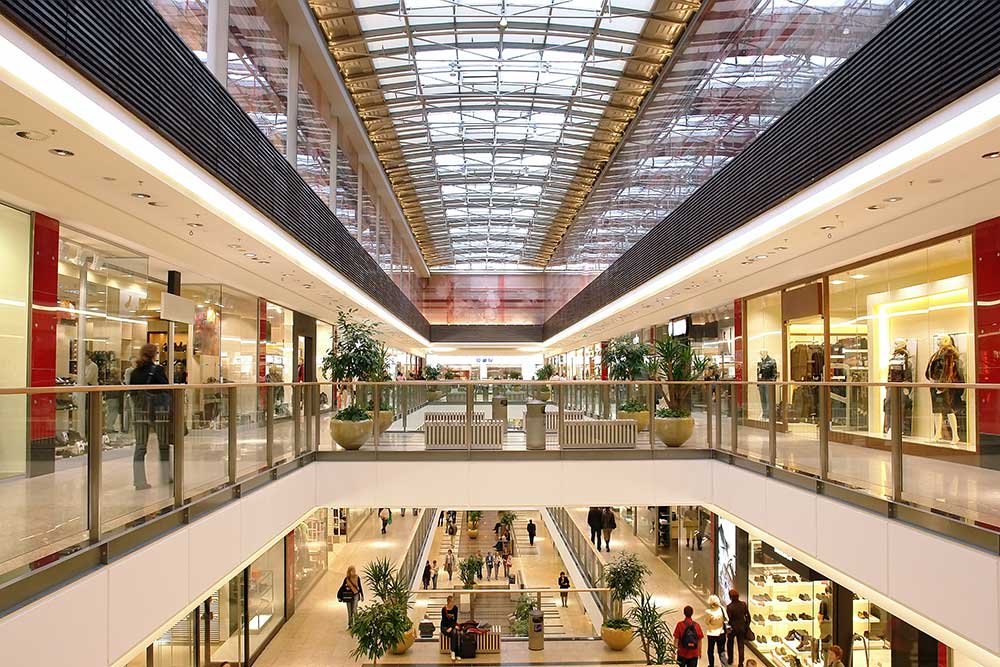
Most of a shopping center is parking lot. The inline shops, the junior boxes and the pad sites take the attention, but by area the largest concrete and earthwork scope is the paved field around them, the drive aisles that carry delivery trucks, and the curb, gutter and sidewalks that tie everything to the public street. Developers in Loveland, Johnstown, Timnath and Fort Collins have all learned that a retail project is won or lost in the site package.
We build that package. It starts with stripping and grading the pad, moves to utilities and detention, and continues through slabs for the buildings, concrete trash enclosures, dumpster pads, loading zones and the sidewalks that bring shoppers from stall to storefront. Each element has a different constructor, tolerance and inspection, but they all share one site and one drainage plan, so we sequence them as a single job.
Retail also has an unusual relationship with time. Tenants open on fixed dates, holiday sales windows do not move, and a center that is half open still needs working access, lighting and parking while the rest is under construction. A hotel or restaurant pad on the same parcel adds yet another schedule to coordinate.
A shopping center is built in phases. Pads are graded first so tenants can begin their shell work, then the site utilities, then paving and landscaping around the first buildings, and finally the last pad sites as leases close. We divide the work into logical packages: mass earthwork and utilities, building slabs, flatwork and paving. Each package has its own start and handover, and we say in advance which pieces can run in parallel and which must wait for another trade.
The site concrete itself includes curb and gutter that governs surface drainage, sidewalks and flatwork in front of storefronts, and heavy-duty slabs where trucks turn or dumpsters are emptied. Solid, reinforced pads at those points prevent the rutting and edge breakup that plague asphalt at turning areas, and they are one of the few items that a landlord notices ten years later.
Centerra, the commercial hub at the I-25 and US 34 interchange shared by Loveland and Johnstown, shows how a retail district grows: shopping centers, a mall, a medical center and an arena cluster around a freeway interchange, and the infrastructure follows. North in Johnstown, a 2022 report described a Highway 60 and I-25 project planned for more than 1,000 housing units and more than 1 million square feet of retail at an interchange passing more than 99,000 vehicles daily. Retail follows rooftops, and rooftops are arriving across the corridor.
In Timnath, a 39,000 square foot, two-building commercial condo project at Harmony Road and Signal Tree Drive, less than a mile from I-25, was announced as the town's first neighborhood commercial development, and a 240 acre mixed-use offering sits at the southeast corner of East Harmony Road and I-25. Different centers need different concrete: a neighborhood strip needs sidewalks and curb ramps for walkers, while an interchange center needs heavy truck pavement. Our notes on Timnath and Centerra describe the local work in more detail.
Retail contractors work on a sales calendar, and a Front Range winter reduces the number of days when concrete can be placed cleanly. We plan the lot and sidewalks in the warm months, protect any late-fall pours with blankets and heaters, and propose temporary paving where a center must open before the last concrete can be placed. A retail tenant will tolerate a gravel construction entrance for a few weeks but not for a season.
Holiday dates and tenant fixturing set the finish line, so we tie the delivery of curb ramps, striping-ready pavement and storefront slabs to those dates. The general contractors and construction managers who coordinate the whole center, along with tenant fit-out firms, rely on our look-ahead schedule to keep the site accessible while multiple trades work.
Retail owners are sensitive to cost per square foot of paved area, and small decisions add up across large fields. Pavement thickness is the major lever: a lot designed for passenger cars needs less than a truck court, and a mix of thicknesses can save material when a delivery route is isolated from the customer lot. Joint layout is the second lever, because longer panels with fewer sawcuts are cheaper to place but riskier to crack if the subgrade is soft.
Soil work is the third. Fill placed in lifts and compacted in a controlled way costs more than loose placement, but the lifts keep the lot from settling under traffic. When the geotechnical engineer calls for over-excavation or stabilization, engineered fill and soil stabilization are priced separately, so the cost of poor soil is visible and can be weighed against relocating a pad.
Our retail work spans the northern Front Range from Fort Collins through Loveland and Johnstown to Timnath and Windsor. Each town has its own review path and standards for sidewalks, curb cuts and stormwater, and we adapt the site package to the municipality that reviews the plans. In Fort Collins that includes the 2024 International Building Code with local amendments for permits submitted on or after April 1, 2026.
Freeway centers also coordinate with the state highway department when a new access or turn lane is needed, and we plan the shared work that connects a private site to the public right of way. Whether the job is a small pad site or a full center, the pieces we most often tie together are parking lot concrete, utility service, and the grading that makes water leave the lot instead of standing in it. Related work for neighboring uses is described under multifamily and mixed-use.
Send the site plan, the pad schedule and the opening dates, and we will return a phased price for grading, utilities, paving and storefront concrete.
Asphalt is cheaper to place and repair, but concrete lasts longer under heavy trucks and standing water. Many centers use asphalt in customer stalls and concrete at dumpsters, loading zones and drive-through lanes where traffic is concentrated. We can price both and show the lifecycle difference.
We phase the work so that entrances, accessible routes and emergency access stay open, and we place temporary walks and barricades where needed. Pour schedules are coordinated with tenant hours, and heavy truck deliveries are timed to avoid peak customer traffic.
Poor subgrade, missing joints and drying shrinkage are the common causes. We prepare and compact the base, place control joints at spacing suited to the slab thickness, and cure the concrete so the surface does not dry too quickly. Winter placements also need protection from freezing.
Yes. We often grade, compact and test each pad so it can be handed to a tenant's contractor, then build the surrounding paving later. A clear pad boundary and temporary drainage plan prevent damage while other work continues.
Most centers need a detention or water-quality facility, inlets sized to the lot, and erosion controls during construction. We build the basin early so that runoff can be controlled throughout the project, and we stabilize it before the paving crews arrive.