
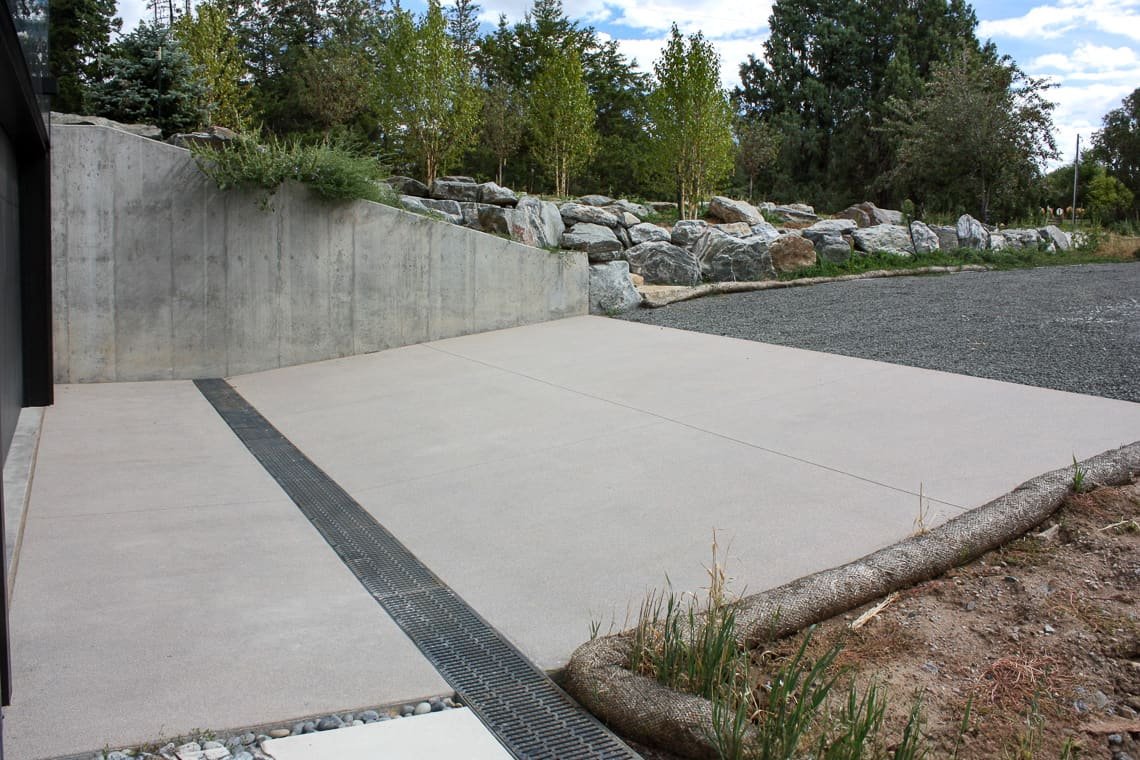
Water finds the low spot in a floor whether or not anyone planned one. A trench drain is how a plan puts the low spot where it belongs: in a straight channel across a dock apron, down the center of a wash bay, along a hangar door or through a processing room, with a grate that traffic can cross. We build trench drains and the sloped concrete that feeds them, and we treat the slope of the slab as part of the drain, not as a separate task.
Two types of systems are common. Precast or polymer channel sections are set to line and grade and encased in a concrete haunch, which suits most dock and parking applications. Cast-in-place channels are formed in the slab with steel frames and grates, and they suit special widths, depths and loading classes. Which one we recommend depends on the flow, the traffic and the chemicals in the water.
Drainage matters in this part of Colorado because of how water behaves. The Cache la Poudre River is subject to sudden floods, and the city still sees periodic flooding from it. Four days of heavy rain in September 2013 flooded Loveland along the Big Thompson River. Owners who have seen water move fast in these valleys specify surface drainage with more respect than owners elsewhere.
We set the slab slope before we set the channel. A typical floor drains at a fraction of a percent to a couple of percent toward the trench, and we run laser lines to hold it. The channel is set on a stable bed at the specified elevation, plumb and straight, with its top edge slightly below the finished floor so the grate sits flush, and it is braced against flotation so the pour does not lift it.
Concrete is placed on both sides of the channel at the same time, and vibrated to fill under the flanges without moving the unit. The haunch is reinforced and tied to the slab where the details call for it, and the surface is finished to the edge of the frame. After the pour, the grates are installed, checked for rock and rattle, and secured so a forklift cannot move them.
Joints deserve a plan. A saw-cut or construction joint that runs at a diagonal into the trench corner will crack, so control joints are laid out to meet the channel at the ends and at the frame breaks. Where the slab and the haunch meet dissimilar material, we use an isolation joint with a flexible sealant, because thermal movement at that seam is where a dock trench usually first leaks.
A trench drain is only half a system. The outlet connects to a pipe that must have enough slope and capacity, and to an interceptor, sump or storm connection that the project design provides. We coordinate with the underground crew on invert elevations, cleanouts and the sequencing that gets the pipe in before the slab, which is why storm drain installation is planned together with the floor.
Many trenches serve process floors where oil, grease or wash chemicals pass through, and the trap or separator downstream is specified for that. Where fluids must be contained rather than discharged, the trench drains to a sump inside a basin, built along the lines of our containment pads and secondary containment. We never connect a drain to the wrong system just because the pipe is near.
The grate load class matches the traffic. Pedestrian areas use light grates, dock aprons and truck courts need heavy-duty grates that can take loaded trucks, and aircraft areas use extra-heavy classes. A grate rated too low breaks under a forklift or turns into a trip hazard. We confirm the class with the engineer and with the manufacturer's data sheet before ordering.
In cold weather, frozen water in the channel can lift grates and crack haunches, so we pitch the channel to drain completely and avoid low spots that hold water. Maintenance access is built in: cleanouts at the ends, removable grates and a slope that flushes debris. Culverts and open channels that receive the drain flow, such as culverts and headwalls, are part of the same conversation about where the water goes after it leaves the building.
Food and dairy plants rely on washdown drainage, and the milk-processing facilities in the Greeley area are part of that. Owners in agriculture and dairy ask for stainless or polymer channels, sanitary details and slopes that leave no standing water. The same expectations carry to truck terminals and cross-docks, where drains keep dock aprons clear of ice and meltwater.
Northern Colorado Regional Airport lies on 1,065 acres at 5,020 feet near Loveland and Fort Collins, and hangar floors there, like those at other general aviation fields, need drains that manage melted snow dripping off aircraft and wash water. A project at the regional airport or a hangar floor elsewhere will use heavier grates and sloped aprons that tie into the apron drainage.
Site-wide drainage depends on where the water ends up. Detention and retention ponds receive flows from trench drains and from storm systems, and they are sized by the engineer to release at rates the jurisdiction allows. We coordinate with the grading and pond crews so inverts and outfalls line up.
Communities in flood-prone corridors, including Loveland along the Big Thompson, learned in 2013 how much work drainage does during extreme rain. A good floor drain does not prevent a flood, but it keeps ordinary storms from reaching equipment, inventory or people, and it sets up the site for the larger systems that handle the rest.
Send the floor plan and the loading. We will price channel and grate, set slopes and coordinate outlets with your underground package.
The floor slopes toward the trench, usually by a small percentage, and the channel itself may be pre-sloped or set level depending on the product. The engineer specifies the slopes. We hold them to the drawing with laser guides.
Precast and polymer systems are fast and consistent and work for most applications. Cast-in-place makes sense for custom widths, heavy loads or tight geometry. We recommend based on flows and loading.
Yes, with the right grate class and a properly reinforced haunch. Wheel loads on small wheels are severe, so we match the grate to the equipment on your floor and check the frame anchorage.
We pitch it to drain, avoid pockets that hold water and, where needed, specify heat tracing or covered locations. A frozen drain is a safety issue, so winter use is part of the design.