A road that crosses a ditch, a creek or a swale needs somewhere for the water to go, and the culvert that carries it is one of the cheapest structures on a site to build and one of the most expensive to get wrong. A pipe set a few inches high will hold water in the channel upstream, a pipe set low will scour its own outlet, and a pipe without a proper inlet will clog the first time a storm carries debris. Failures of this kind rarely happen the week after construction. They happen in the first big runoff, when the owner can least afford them.
We install culverts of all common materials, concrete headwalls and wingwalls, flared end sections and the channel protection that goes with them. The projects include access drives into industrial sites, farm and ditch crossings, road improvements and the outfalls of storm systems. The work blends pipe-laying with concrete work, and we do both with the coordinated trade crews so that the inlet and outlet details are built to the pipe, not to a rough approximation of it.
The barrel is reinforced concrete pipe, concrete box, corrugated metal or HDPE, chosen for the cover, the load and the flow. Reinforced concrete pipe handles heavy loads under shallow cover and has the longest life; boxes are used for wide, shallow channels; flexible pipe is lighter and quicker to place but depends on well-compacted backfill for its strength. Each type has a bedding detail that must be followed, because the pipe carries its load through the soil around it. Where the culvert takes the outfall of a storm drain, the two profiles are drawn together so the invert elevations agree.
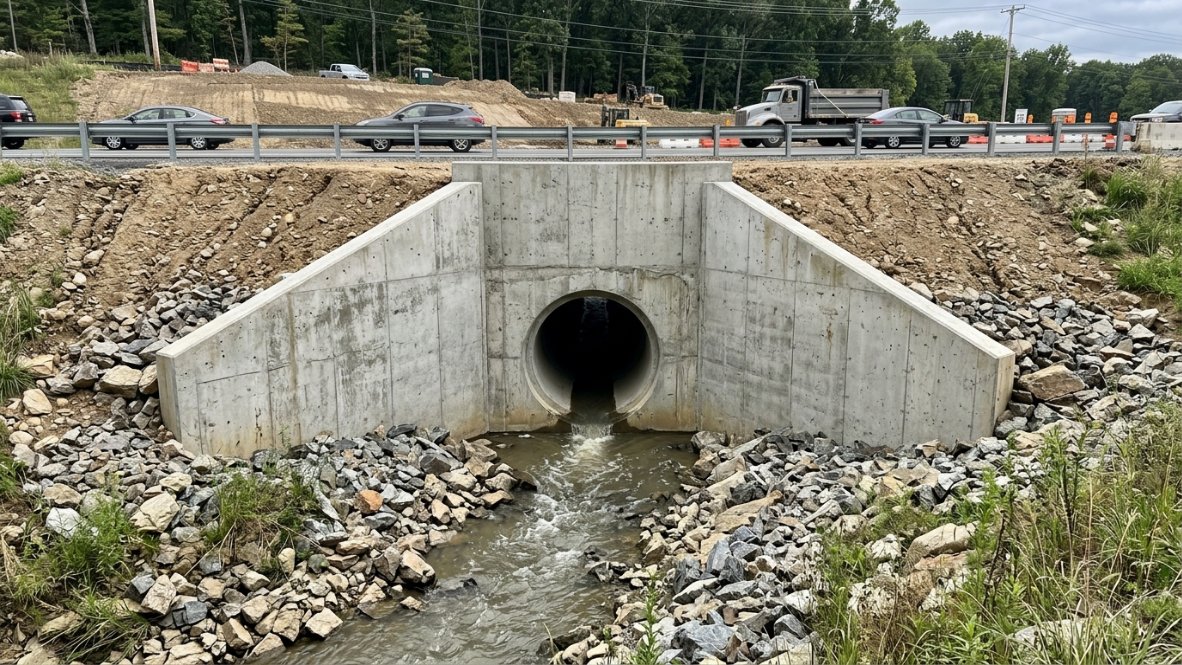
At the ends we build cast-in-place or precast headwalls with wingwalls, aprons and cutoff walls that keep the water from undermining the structure. Reinforcement, forms and cure are the same as in any other structural concrete, and the formwork trade crews build the walls true to the pipe. Riprap with filter fabric protects the channel past the apron, sized to the velocity at the outlet.
Much of the farmland around Eaton depends on irrigation systems that were engineered long ago, and the ditches and laterals they created cross every road and driveway in the area. Severance has a similar history, where agriculture remains the town's primary industry despite recent residential construction and where the Great Western Bike and Pedestrian Trail follows the former rail route. A crossing in this landscape is a joint project with the ditch owner, whose consent and standards control the culvert size, the invert and the dates when the ditch can be interrupted.
The mountains show the other extreme. In the September 2013 flood, Highway 34 in Big Thompson Canyon, Estes Park's main route in and out, was washed away. Culverts and headwalls there and elsewhere on the Front Range are now sized and protected with floods in mind, with debris racks, oversized outlets and heavier riprap.
We set the pipe from the downstream end, on a bed shaped to the pipe with the invert elevation verified by level or laser. Joints are sealed with gaskets or wrapped and grouted according to the pipe type, and the pipe is checked for alignment before backfilling. Backfill goes in lifts on both sides of the pipe, compacted to the specified density, and the cover over the top is built up before heavy equipment crosses.
The outlet gets as much attention as the pipe. A headwall poured with a toe wall at the right depth, an apron at the invert and riprap tied into the bank will outlast one that was cast in a hurry. If the flow cannot be diverted, we work in the dry using bypass pumping or a temporary flume, and we control erosion in the channel as the work proceeds. A culvert that carries a perennial stream needs additional measures to protect fish and water quality, and we follow the permit conditions closely.
Culvert work often takes place with a live channel beside the excavation and, on public roads, with traffic close by. Trench protection is required wherever workers enter an excavation, flow must be controlled before anyone works in the channel, and the weather forecast is checked daily because a thunderstorm upstream can send a surge through a work zone in minutes.
When a road is cut, the traffic control plan, detours and plates are in place before the saw cut. We schedule the cut for the shortest practical window, backfill and compact quickly, and restore the pavement or temporary surface the same day where we can. Neighbors and emergency services are notified of any closure in advance.
The main variables are pipe size and length, material, depth of cover, whether the channel has to be diverted, the headwall type and the riprap quantity. A small driveway culvert with a flared end section is a day's work. A large box culvert under a road, with headwalls, wingwalls and aprons, can occupy a crew for weeks and involve formwork, rebar, concrete testing and curing.
Permit and ownership issues also drive cost. A crossing of a ditch company's facility may carry fees and conditions, and an outfall to a regulated stream requires environmental review. We recommend that owners of government and municipal sites and agriculture and dairy operations start these conversations early, and we can price the concrete and pipe so the budget has a number to work with.
Send the crossing details and the owner contacts and we will price the pipe, the headwalls and the channel protection together.
The engineer sizes the culvert from the design storm, the watershed and the allowable headwater. We build to that size and verify the installed slope and invert. If the field conditions differ, such as a ditch that has been regraded, we raise the issue before ordering pipe.
Almost always. Ditch companies and irrigation districts own the water right and the facility, and they set the culvert standards, the timing and the repair responsibilities. Their approval is often the longest part of the process, so we start early.
It can, with a temporary flume or bypass pump, but it is slower and more expensive. When the schedule allows, we install the pipe when the ditch is dry. Coordination with the ditch rider or manager avoids surprises.
The most common causes are undersizing, poor bedding, inadequate cover, scour at the outlet and debris blocking the inlet. Most of these are construction issues that can be avoided with proper compaction, headwalls with cutoff walls and well-placed riprap.