
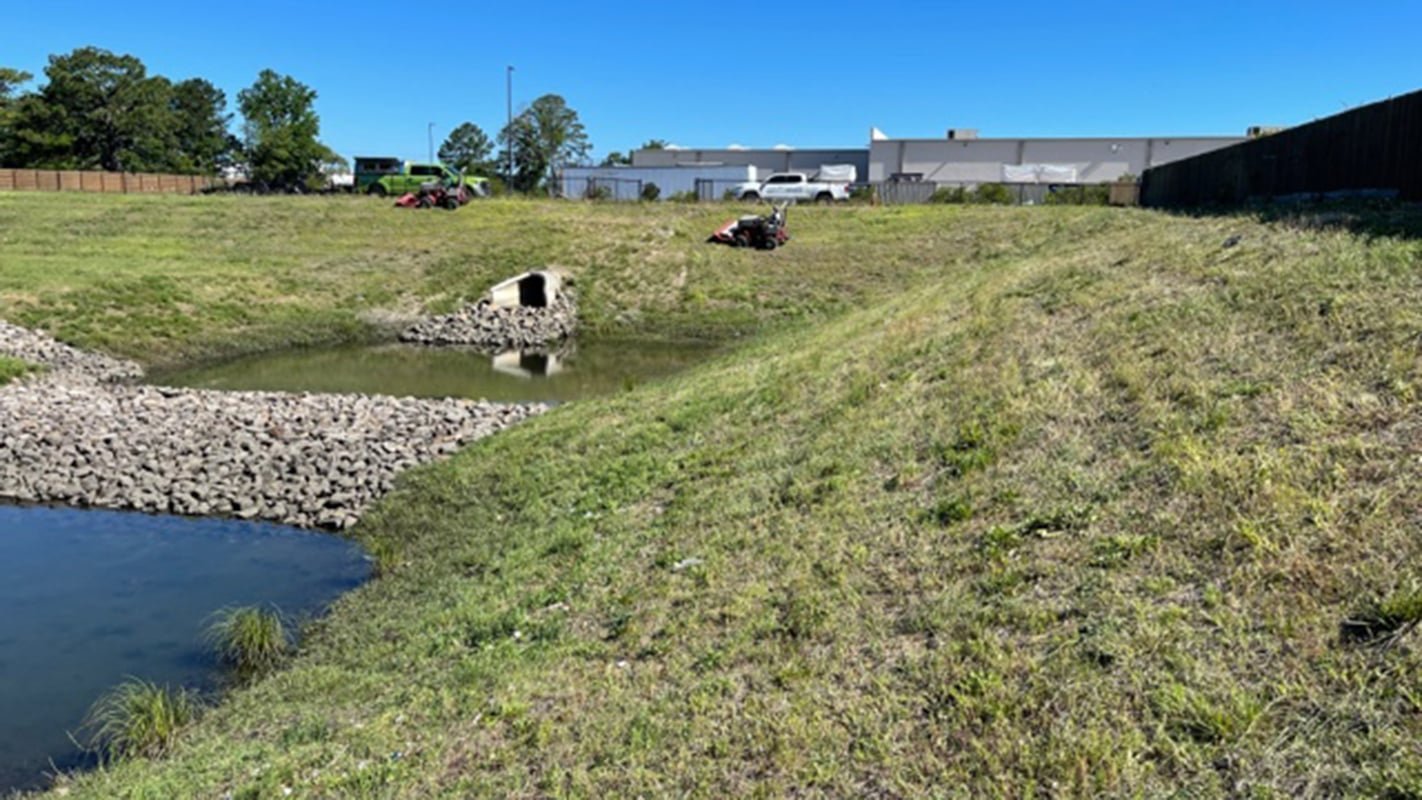
Four earthen dams hold back Horsetooth Reservoir just west of Fort Collins, 156,735 acre-feet of water retained by compacted soil and a few concrete structures, and the dams were seismically retrofitted between 2000 and 2004. A detention pond on a commercial site is a very small relative of that engineering. It is an embankment, a spillway and an outlet, built to hold stormwater back and release it slowly, and it relies on the same principles of clean foundation, compacted fill and a carefully built outlet that keeps the water from finding its own way out.
We build detention and retention ponds, water quality basins and the control structures that go with them for commercial parks, industrial sites and the subdivisions of homebuilders and multifamily developers. Most of these ponds are required by the drainage report before a building permit can be released, so they are often the first major earthwork on the site and the first facility that must be inspected. The pond also doubles as the sediment trap during construction, which affects how and when it is built.
A pond is made of several parts that each have their own tolerance. The bottom is graded to the design contour, often with a low-flow channel that carries small storms to the outlet. The side slopes are shaped to the ratio on the plan, usually flat enough to be mowed or vegetated. The embankment, where the pond is formed above natural grade, is built of compacted fill placed in lifts, with a key trench into the foundation soil to cut off seepage.
The outlet is a concrete structure with an orifice plate, a weir or a perforated riser that controls the release rate. It connects to a storm drain pipe, usually reinforced concrete, with anti-seep collars or a filter diaphragm to keep water from tracking along the outside of the barrel. An emergency spillway, lined with riprap or concrete, protects the embankment if the pond is overtopped. We coordinate forming and pouring of the structures with concrete formwork trade partners.
The basin is excavated using the same equipment as pond and basin excavation projects, with the material hauled to the embankment, to other fill areas or off site according to the earthwork balance. Topsoil is stripped and stockpiled, the foundation is proof-rolled and any soft or organic material is removed. The first lift of the embankment is keyed into the prepared foundation and moisture-conditioned to the range the geotechnical report specifies.
Lifts are placed thin enough for the roller to achieve density through the whole thickness, and testing confirms each one before the next is placed. Where native soils are too wet, too dry or too sandy to hold water, we use engineered fill and soil stabilization methods, including a clay liner when the design demands one. The finished pond is checked by survey against the design contours and the outlet invert.
Four days of heavy rain in September 2013 flooded Loveland along the Big Thompson River, and the lesson for a pond contractor is that the first storm after construction may be the hardest. We stabilize slopes and outlet protection before the pond is allowed to fill, keep the control structure free of debris, and seed or blanket the slopes quickly. Large warehouse sites, with acres of roof and truck court, shed the most runoff and so need the biggest ponds.
Retention ponds, which hold water permanently, have a different set of constraints. They need a liner or a high water table, an inlet and outlet that prevent short-circuiting, and a safety bench. Where Timnath's growth management area borders open space near the Poudre River and Timnath Reservoir, ponds are often shaped to fit the surrounding landscape and to handle groundwater that rises in the irrigation season. We design the dewatering and the sequencing.
The drainage report defines the volume, the release rate, the water surface elevations and the outlet type, and the grading plan translates them into elevations on the ground. Some ponds fall under rules for small dams if the embankment height or stored volume exceeds a threshold, and the jurisdiction will tell the owner whether that applies. Construction of any pond also falls under the stormwater permit for the site, since it is a major soil disturbance.
We read the drainage report along with the geotechnical report and ask about conflicts early. A common one is a pipe that enters the pond below the design water surface or an outlet that is set too high to drain the pond. Another is an underdrain that has no downstream connection. Fixing these on paper costs nothing, and fixing them in concrete costs a great deal.
Ponds are built early because the site drains to them and because they serve as the sediment basin until the site is stabilized. That means the outlet structure and the pipe from the street must be in place before the first heavy rain. We order the precast or schedule the cast-in-place work before mobilizing, and we install the temporary outlet protection while the permanent work is underway.
Weather decides the earthwork window. Fill cannot be placed or compacted in frozen or saturated conditions, so the embankment is planned for the dry months, with the outlet pipes laid in advance. On sites in Timnath and near Bellvue, where irrigation season brings seepage and ditch flows, we coordinate with the ditch owner to avoid interference. After paving, the pond is cleaned out, the sediment removed and the final grading completed before turnover.
Send the drainage report and the grading sheets and we will review the embankment, outlet and sequence with you before the earthwork bid.
A detention pond holds water temporarily and empties between storms, so it is normally dry. A retention pond holds a permanent pool and releases only the water above a set level. Both are built from similar earthwork, but retention ponds need liners or a high water table and have additional safety features.
The key trench cuts into the foundation soil and ties the fill to it, which prevents water from seeping along the contact. Without it, the embankment can erode from below. The trench is excavated below any topsoil and loose material and is filled with compacted soil.
Yes, and it often is. The outlet is protected with a temporary riser or filter, and sediment is cleaned out before the pond is finalized. It's important to confirm with the engineer how much storage the sediment will take and when the final grade will be set.
Embankment fill is tested for density and moisture by the testing agency, outlet pipes are checked for line and grade and the structures are inspected for dimensions and reinforcement. When a liner is required, it is tested for permeability. The pond is surveyed as a final check.
Cost depends on the volume of earth moved, the depth of cut, the need for imported fill or liner and the complexity of the outlet. On many commercial sites the pond is one of the larger earthwork items, and a balanced cut and fill within the site helps control the price.