
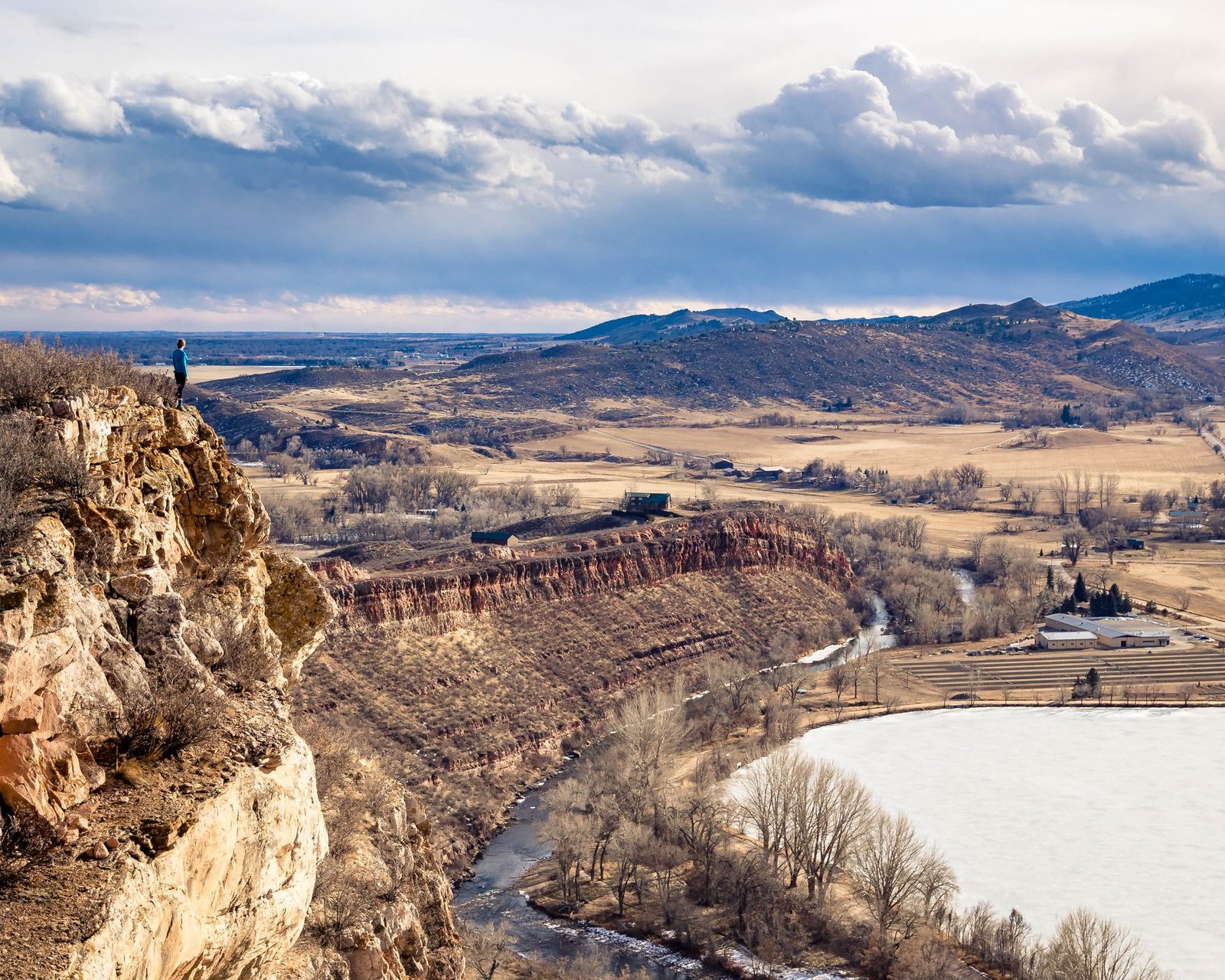
A narrow valley with a canyon at one end and a reservoir at the other leaves a builder with very little room to maneuver. In Bellvue, a concrete truck, a pipe delivery or a loaded dump truck has few ways in and out, and the ground it has to work on slopes, shifts from soil to rock, and drains toward the river. We build here by solving access and drainage first, then foundations and utilities.
Bellvue is an unincorporated community of Pleasant Valley, a narrow valley just northwest of Fort Collins on the south side of the Cache la Poudre River at the mouth of Rist Canyon, at 5,131 feet elevation. The southern portion of the valley is now inundated by Horsetooth Reservoir. A site in a valley this tight is bounded by water and canyon walls on more than one side, so lots are small, drives are steep and the options for staging equipment are limited.
Property owners, small developers and the general contractors working for them call us when a foundation, a driveway apron or a service line has to be built on a lot that does not behave like a flat subdivision pad. We explain the conditions, the sequence and the price in terms an owner can follow.
Slopes change how we set up. We bench the work area before heavy equipment arrives, check that the excavator and trucks sit on stable, level ground, and never leave a fresh cut unsupported above a workspace. Trench walls are sloped or shored to the depth, and for deep or wet excavations a competent person inspects daily. These steps are routine for us, not special.
Canyon roads add traffic risk. A loaded concrete truck on a winding road needs a spotter at blind corners, and a neighbor's driveway should never be blocked for long. We coordinate delivery times with the supplier, post a contact number for residents and keep a flagger or a signed detour when a lane has to close.
Hillside and valley-edge lots often need stepped footings, deepened stem walls or drilled pier foundations that reach stable material below the surface. The geotechnical report tells us which, and we build to the engineer's design with inspection at the open excavation, before the concrete arrives.
Where excavation meets bedrock or large boulders, the rock and hard ground excavation trade crews use hydraulic breakers or other methods to reach the design depth. Utilities are installed in the same excavation when possible, which reduces disturbance on a small lot. Driveway aprons, flatwork around the house, and patios are poured to a grade that sheds water away from the foundation.
Horsetooth Reservoir holds 156,735 acre-feet behind four earthen dams (Horsetooth, Soldier Canyon, Dixon Canyon and Spring Canyon) completed in 1949 and seismically retrofitted in 2000 to 2004, as part of the Colorado-Big Thompson Project. For builders, the reservoir is a reminder that water management shapes every site nearby, from groundwater levels to the rules about what can be built near the shore and the dams.
The Cache la Poudre River drops about 6,155 feet from Rocky Mountain National Park to its mouth, and was designated a National Wild and Scenic River on October 30, 1986 for 76 miles. That designation affects how agencies look at work near the river, so owners should expect extra review and a premium on careful erosion control. Neighboring Laporte shares many of these river conditions.
We reduce the footprint of our work. Smaller equipment, compact loaders and short-reach pumps let us pour where a full-size boom truck cannot go, and we measure the swing radius of every machine against the overhead lines and the canyon wall before it is unloaded. We stage materials off the road, use temporary fencing to keep a clean boundary, and plan each day's work so the site is safe overnight.
Spoil is a real issue on a small lot. When there is nowhere to stockpile, we plan export and haul-off in advance and bring in clean backfill as needed. We protect the river and reservoir side with silt fence and wattles, and we keep concrete washout in a lined container that is hauled away, never dumped on the ground.
Mountain-edge weather changes quickly. A morning that begins clear can end in rain or snow, and a concrete pour can run into that change. We watch the forecast, book the pump and the trucks for the early hours and hold a plan for covering and curing. In cold months we use heated mix, blankets and insulated forms, and we place only when the subgrade is thawed.
Access can be the bottleneck. Narrow roads limit truck size, so a pour may require smaller loads over a longer period, or two trucks working in sequence. We discuss this during pricing because it affects both the schedule and the cost. Owners who need a utility corridor or a driveway crossing can also coordinate with the county road authority for permits.
If your lot is on a slope, near the river or at the end of a narrow road, send us the survey and the soils report. We will give you an access plan and a price before you commit to the design.
Often yes, but we check the route in advance. Narrow roads, tight turns and weight limits may require smaller trucks or a pump setup. We walk the route with the supplier, plan the delivery sequence and have a spotter on site.
We use breakers or other rock-handling methods to reach the design depth, and we price rock as a unit-cost allowance when the geotechnical report suggests it. If the rock is unexpected, we document it and give the owner a change order before proceeding.
We install silt fence, wattles and stabilized entrances, keep concrete washout contained, and avoid stockpiling near the water. Disturbed ground is stabilized as soon as the work allows, and the controls are checked after storms.
Where the engineer specifies them, yes. Drilled piers reach stable soil or bedrock below weak surface material, and they work well on sloped lots with limited access. We coordinate with the driller, place reinforcement and concrete under inspection and keep a log of each pier.
Yes. We coordinate foundation, flatwork, driveway-apron and drainage trades against common levels and joint details, with mobilizations planned together where practical on a hard-to-reach lot.