
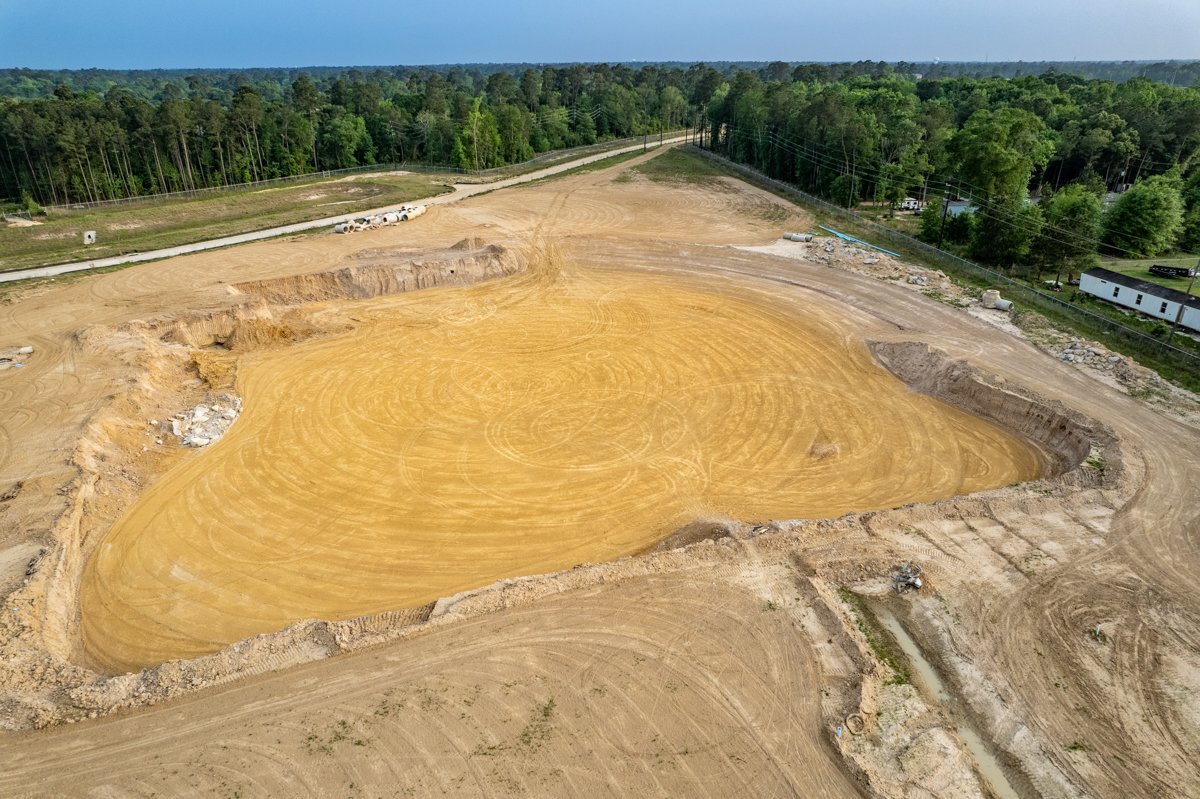
Horsetooth Reservoir, just west of Fort Collins, holds 156,735 acre-feet behind four earthen dams. A stormwater pond on a commercial site is a very different thing in scale, but it is built from the same ideas: excavate a basin, place compacted soil in a controlled way, control the outlet and keep the water in the places it is supposed to be.
We excavate and shape detention ponds, retention basins, water quality ponds, irrigation storage and similar earthen facilities. The work includes cutting the basin to design, building embankments, setting outlet structures, installing liners where required and stabilizing the slopes and bottom with vegetation. Done well, the pond works for decades with routine maintenance; done poorly, it leaks, erodes or fails in the first storm.
Developers, public agencies and owners of industrial and commercial sites use us when they want the pond built in the right place, at the right size and with the right soils, and handed over with documentation the inspector will accept.
Excavation is staged so that the best material goes where it is needed, and the pond is built as part of the larger detention and retention pond system the site depends on. Suitable clay may be set aside for embankment cores and liners, and topsoil is stripped and stockpiled for final seeding. Embankments are built in thin lifts, keyed into undisturbed ground and compacted at controlled moisture, with testing at specified frequency. A cutoff trench beneath the embankment is common where soils are permeable.
Once the basin is shaped, outlet structures, trickle channels, forebays and emergency spillways are set to the grades shown on the plans. Slopes are trimmed to a gentle ratio that can be mowed and planted, and the bottom is graded so water drains as designed. Finally, we seed and blanket the slopes and install riprap at inlets and outfalls so that the first storm does not carve the pond up.
Ponds follow the stormwater criteria of the jurisdiction and the design in the drainage report, which defines volume, release rate, outlet configuration and maintenance access. Larger embankments may trigger dam safety review under state rules, and any pond that connects to a waterway or wetland may need permits from other agencies. We read the drainage report and the permits together, and we build to both.
Horsetooth's dams were completed in 1949 and seismically retrofitted between 2000 and 2004, a reminder that earthen embankments are living structures that get inspected and improved. For smaller ponds the lesson is simpler: documentation matters. We keep density tests, material sources and as-built surveys so that the owner and the jurisdiction can confirm the pond matches its design, and so that a maintenance crew knows what is under the grass.
Pond excavation involves some of the softest, wettest ground on a site. Equipment can bog down in saturated soils, and operators need stable working platforms, mats or tracked equipment suited to the conditions. We plan access routes ahead of time, keep spoil away from the edge and avoid undercutting slopes that people or machines will use.
Water adds another hazard. A basin that fills during construction becomes a drowning risk and a stability problem, so we pump it down, fence it when needed and keep ladders and rescue equipment on site. After construction, the pond is a permanent feature that the public may see, and its slopes, fences and warning signs should be designed with that in mind. Dewatering during construction ties to the methods described under dewatering methods.
On most developments the pond is built early, because it doubles as a sediment basin during construction and the outlet needs to work when the first storm hits. That approach has a trade-off: the basin collects silt and has to be cleaned out and finished at the end of the project, with final grading, outlet adjustment and stabilization. We plan both phases, the rough pond and the finished pond, and price them separately.
Wet seasons delay embankment work, since clay placed too wet cannot be compacted, and cold weather affects seeding and the establishment of grass. We try to complete embankments in dry months and time seeding to the windows when grass will root, and we use temporary stabilization when the calendar does not cooperate. Outfall pipes and culverts and headwalls go in with the embankment, not after it, so the fill never has to be cut open. The wait is cheaper than a failed slope.
Ponds on the northern Front Range sit in varied settings. In Timnath, the growth management area is mostly low-density residential or agricultural with open space near the Poudre River and Timnath Reservoir, and ponds there are often part of a larger system of open space and drainage. Near Bellvue, where Pleasant Valley sits at the mouth of Rist Canyon and its southern portion is inundated by Horsetooth Reservoir, water storage shapes the land.
East of Fort Collins the plains flatten, and Greeley is served by US 34 and US 85, with the South Platte River bounding the Greeley and Evans area on the south and the Cache la Poudre River running through north Greeley. Ponds there contend with high groundwater and floodplain constraints, and we plan liners, underdrains and outlet protection accordingly. Owners of distribution center sites and other commercial developments planning a pond near a river should expect an early conversation about groundwater and floodplain limits, along with the culvert work that connects the pond to its receiving channel.
Send the drainage report, grading plan and geotechnical report. We will review soils, groundwater and outlet design and price the excavation, embankment and finishing in phases that fit the site schedule.
A detention pond holds stormwater temporarily and releases it at a controlled rate, normally draining dry between storms. A retention pond keeps a permanent pool of water. The drainage report determines which type a site needs, and the excavation, outlet and liner differ.
Only if the soils are permeable and the design requires a permanent pool or the jurisdiction requires it. Clay soils may seal themselves when compacted, and others need a clay blanket or synthetic liner. The geotechnical report and design drawings control.
We place suitable soil in thin lifts, key it into the foundation, compact it at controlled moisture and test it at set frequencies. Where the embankment holds water, we also build a cutoff to limit seepage.
Yes, and it often should. We build it early with a temporary outlet, maintain it during construction and clean it out and finish it at the end. That sequence is common and should be shown on the erosion control plan.
Routine mowing, sediment removal, outlet cleaning and inspection of embankments and spillways. We provide as-builts and a handover so that the owner knows where the outlet, forebay and access are located.