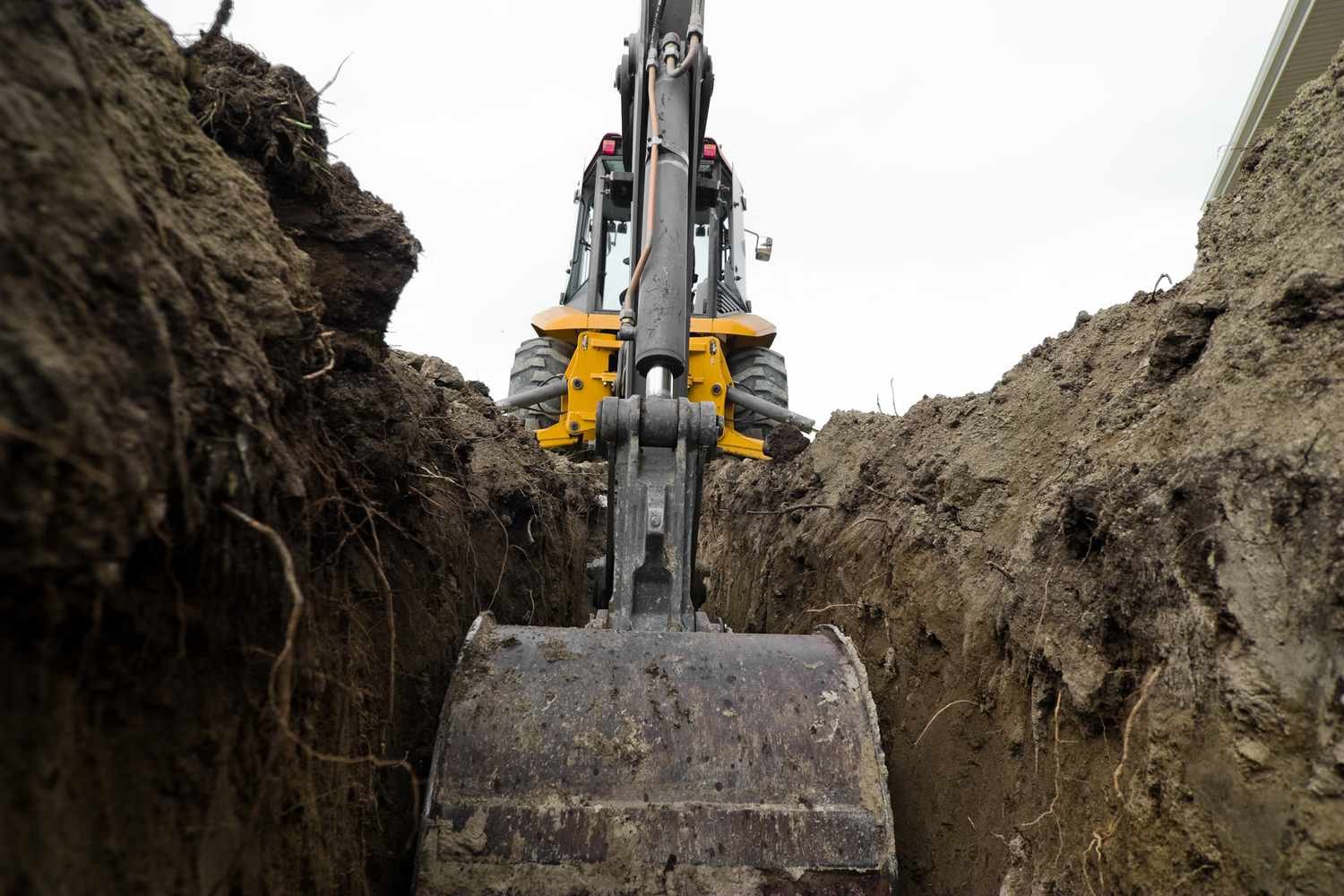
A trench is dug once and judged for decades by what happens on top of it. If the backfill settles, the pavement above it ripples; if the bedding is wrong, the pipe below it deflects; if the cover is shallow, the first hard freeze finds the line. We think about the finished surface and the buried pipe at the same time, and dig the trench to serve both.
We trench for water mains and services, sanitary and storm sewer, fire lines, electrical duct banks and conduit and fiber runs across Fort Collins and the towns that have grown up around it. The work involves cutting pavement, sloping or shoring the walls, setting bedding, placing pipe or conduit, and bringing the backfill up in compacted lifts to the surface or the pavement subgrade.
Owners and general contractors hire us when they want one crew responsible for the trench from the first cut to the density test, instead of splitting the excavation, the pipe and the compaction among three parties who each assume the others are watching.
The first step is alignment and depth. We verify the line from the plans, mark it, expose crossing utilities by hand or vacuum, and then cut. Trench width is kept as narrow as the pipe and the working room allow, because a wider trench means more backfill and more settlement. Bedding material is placed and shaped to support the pipe barrel evenly, and the pipe zone is filled by hand-directed placement to a depth above the crown before heavy equipment goes near it.
Above the pipe zone, backfill goes in lifts that match the compaction equipment, moisture conditioned and tested. Under pavements the specification is strict and the lifts are thinner; in landscape areas the density target is lower and the lifts can be thicker. Tracer wire, warning tape and detectable markers go in on the schedule the utility owner requires, and dry utilities follow the same discipline described in conduit and fiber trenching, and the trench is restored to its original surface condition or to the subgrade the paving contractor expects.
A trench is the most hazardous excavation on a job site because the walls can fail without warning. Rules require protective systems for trenches five feet deep or more, and for shallower trenches whenever the soil or conditions suggest a hazard. We use trench boxes, shoring or sloped walls depending on soil and space, keep spoil at least the required distance back from the edge, and provide a ladder or ramp within a short walk of every worker.
A competent person inspects the trench before work starts each day and after any rain, thaw or vibration event. Open trenches near traffic are fenced, plated or backfilled before the end of the day. Atmospheric testing is added when the trench passes through potentially contaminated ground or enters an existing structure. We train the trade crews to treat the trench like an entry point to a confined space, because in practice that is how it behaves.
Fort Collins building design criteria list a frost depth of 30 inches, and buried water lines are set deep enough to stay below it, which is why cover, not diameter, often controls how deep a water trench has to be. We plan the trench from the invert and the pipe schedule up, so cover, bedding and grade are all checked before the machine starts. Gravity lines, which have to hold a precise slope, are laid with laser control and checked at every joint.
Backfill selection is another decision made before digging. Native material is used where the specification allows and where moisture can be controlled; select material is imported where it does not. We keep stockpiles separate, cover them in wet weather and add water to dry material on the trench side, not at the pile. Our approach to the pipe itself is covered in water main installation and sanitary sewer installation.
Trench work serves utilities first. Electric, gas, communications and water providers work in corridors that change as development grows, and utilities and energy companies need crews that can restore the surface and satisfy inspectors without callbacks. Developers also order trench work in volume: Wellington's Sage Farms is a roughly 300 acre community with neighborhood commercial in its first phase, and a project of that size is mostly trench, pipe and backfill before it becomes anything else.
Agriculture shapes the work too. Much of the farmland around Eaton depends on irrigation systems built long ago, and a trench in that area may cross ditches, laterals or buried pipe whose owners expect notice and a clean restoration. We schedule those crossings for the off-season when we can and coordinate with the ditch company on timing, protection and the quality of the backfill under a waterway. If your project is in Wellington or the Weld County farm towns, we can walk the alignment with you before pricing.
Production in a trench depends on depth, soil, congestion and groundwater. A shallow, straight run through open ground can move quickly, while a deep run in a street with a dozen crossings may advance a few dozen feet per day. Dewatering, rock, imported bedding and pavement restoration are all separate cost items that can change a unit price by a wide margin, and they are the areas where early investigation pays off.
Testing and rework matter just as much. A failed compaction test means digging out and redoing a lift, sometimes at depth, so it is cheaper to place and test carefully the first time. Where trenches serve multifamily and mixed-use projects, utility connections to many buildings multiply the number of short trenches and crossings, which often costs more per foot than the main line and should be priced accordingly.
Send the utility plans, the alignment and the restoration requirements. We will check depths, crossings and soil conditions and give you a trenching plan and a price you can compare with confidence.
Water lines are typically set below the 30 inch frost depth that the city lists in its building criteria, plus whatever cover the utility provider requires. Sewer and storm depths follow the design grade. The plans and utility standards control; our job is to excavate to the invert with the right bedding and width.
The testing firm checks density and moisture in each lift against a laboratory standard, at intervals set by the specification. Under pavements the target is high and tests are frequent. We keep lifts thin enough to hit the target and re-compact when a test fails.
We contact the ditch owner, schedule the crossing for when the ditch is dry if possible, and use flow diversion or a temporary bypass when it is not. The pipe is set at the depth the owner requires, and the ditch bottom and banks are restored to their original shape.
Yes, with planning. Frozen ground slows excavation, and frozen material cannot be used as backfill, so we cover open trenches, thaw where needed and protect stockpiles. Backfill placed in cold weather is tested for density just like summer work.
We cut and patch pavement to the municipality's or owner's standard, or we prepare the trench surface for the paving contractor. The restoration detail is confirmed before we cut, since requirements for base thickness, tack and patch size vary.