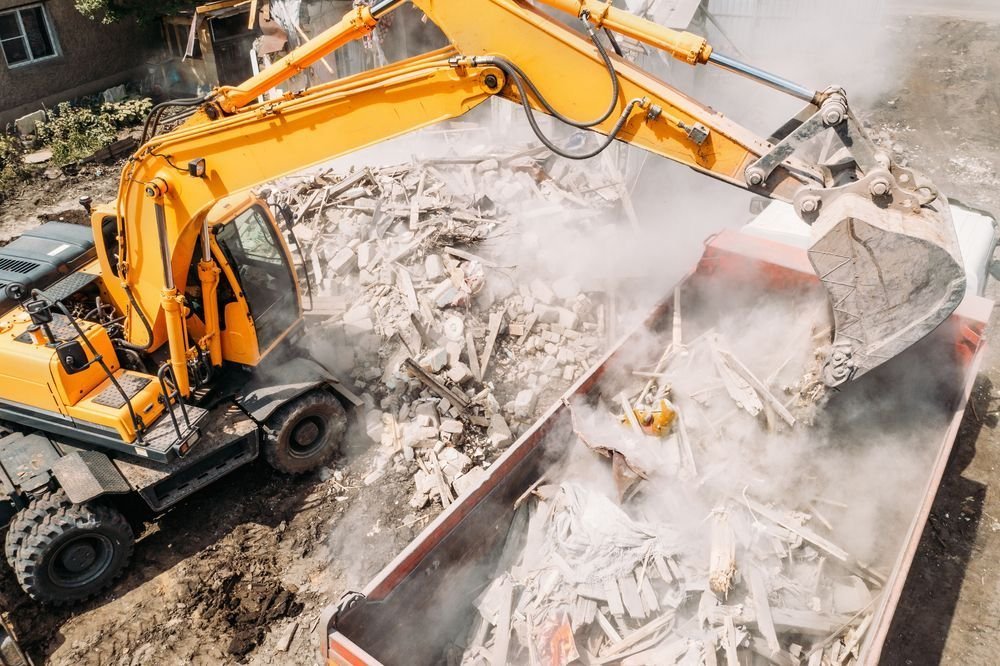
Every redevelopment on the northern Front Range starts with something coming out. A 1980s business park that no longer suits its tenants, a 1990s office building on a corridor that has outgrown it, a parking field that will become a pad site: each leaves tons of concrete that must be broken, sorted, hauled or reused before anything new can be formed. We take out slabs, footings, foundation walls, pavement, curbs and structural concrete, and we plan the removal as carefully as the pour that follows it.
The first number we want is tonnage. A 6 inch slab covers a square foot with roughly 0.5 cubic foot of concrete, and a few acres of pavement turn quickly into thousands of tons that need trucks, a crusher or a landfill tipping fee. Knowing the quantity and the thickness lets us decide whether to crush on site, haul to a recycler or do both, and it lets the buyer see which choice is cheaper before a single piece is moved.
We sort and stage by material. Plain concrete goes to the crusher, rebar is pulled out and sent to a metal recycler, and any asphalt, soil, wire mesh or other debris is kept apart so it does not contaminate the crushed product. Clean, sorted concrete is worth more as aggregate than mixed rubble is worth as fill.
Buildings change hands on the northern Front Range, and their use changes with them. A 179,688 square foot office building in the Harmony Road tech corridor, built in 1997, changed hands in 2019, and in March 2024 a large technology facility on the same corridor was put up for sale while its owner sought smaller space. Buildings of that age, with floors, footings and parking designed for another era, are the stock that tenants and developers renovate or replace.
In southeast Fort Collins, business parks built in the 1980s sit near newer industrial buildings along Prospect Road, Timberline Road and Highway 14. Whenever a site like that is cleared for a new use, demolition scope depends on what is underneath: deep footings, thickened slabs, underslab utilities or old foundations from earlier uses. We ask for as-builts, scan the site and probe where records are missing.
Before heavy equipment is started, the structure is surveyed for hazardous materials as required, utilities are disconnected and verified dead, and the demolition plan is reviewed. Older buildings may have materials in coatings, mastics or insulation that require abatement before concrete work begins, and we coordinate the order of operations with the abatement contractor so we are not waiting on each other.
Dust, noise and vibration are managed as part of the work. We keep surfaces wet during breaking and crushing, set crusher placement away from neighbors, watch vibration near sensitive structures, and schedule noisy operations to fit the hours allowed. Utility conflicts are a standing risk: we pothole before we dig and mark every line we find, and the demolition and site preparation trade crews follow the same rule.
Slabs on grade are saw cut into panels, broken with hydraulic hammers or pulverizers and loaded out. We rely on concrete sawing, cutting and coring to isolate sections next to buildings or utilities that must remain. Footings and foundation walls require more breaking, and where the structure is thick a pulverizer is far faster than a hammer and strips rebar as it goes.
Pavement comes out in larger pieces, often with an excavator and a breaker, and the crushed product is a good candidate for recycled base. Elevated slabs and structural frames are taken apart in a sequence that follows the engineer's plan, with shoring where needed. Each element has its own safe procedure, and we plan the removal order to keep the remaining structure stable.
Crushed product is only worth reusing if it is clean. We screen the output to the gradation the specification asks for, pull out stray wire and plastic, and keep it separate from soil and asphalt millings. A sample goes to the testing lab before the material is placed as base or backfill, and the reuse decision is recorded so the owner can show where every load went.
Reinforcement density and thickness set productivity. Heavily reinforced concrete is slow to break and slow to load, and thick foundation walls cost more per cubic yard than thin slabs. The distance to the recycler or landfill, the tipping fees and the number of truck trips determine the rest. We show how those pieces add up, and where on-site crushing and reuse changes the picture.
Reuse is a real lever. Crushed concrete can become structural fill, base course or backfill on the same project, which removes both a disposal cost and an import cost. We work with the earthwork crew on import, export and haul-off so the numbers balance across the site.
A haul route has to be chosen before mobilization. Interstate 25 runs along the east side of Fort Collins and US 287 becomes College Avenue through the city, so trucks leaving a corridor site usually reach one of those two roads. We plan routes that avoid school zones, schedule loads outside peak hours and keep trucks clean as they leave.
For office buildings being replaced, the order is utilities, interior, slabs and footings, and we coordinate with commercial developers who want a clean pad by a specific date.
Redevelopment around the Timberline and Prospect industrial area or the center of Fort Collins usually involves staged removal to keep neighboring tenants operating.
Closeout matters as much as startup. When the last piece is hauled, we grade the pad to the drainage the next contractor needs, fill open excavations with compacted material, and leave the site fenced and free of loose steel. A walk with the owner and the incoming builder confirms what remains underground, such as retained utilities or capped lines, and the record goes into the turnover package.
Send the plans and photos. We will estimate tonnage, recommend a crush-or-haul plan and give a schedule that fits your redevelopment timeline.
Often yes. Clean, crushed concrete works well as base or backfill if it meets the specification. It reduces hauling and import costs, but the geotechnical engineer or the owner must approve reuse. We keep the crushed product clean and test it as required.
Rebar is pulled from the broken concrete, stacked and sent to a metal recycler. Heavier reinforcement slows the work, which is why we ask for as-builts or scan the slab before pricing. The scrap value offsets some of the cost.
We stop and report. Abandoned tanks, old utilities, unmarked footings or contaminated soil are handled according to the contract and the law. Having a contingency and an agreed process in advance keeps surprises from stalling the project.
Most jurisdictions require a demolition permit, and some require notice for utility disconnects or hazardous material surveys. We help owners understand the sequence and work with their permit consultant. The local building department confirms the requirements.