Before a blade touches slab, we scan it. Post-tension tendons, electrical conduit, rebar mats and embedded plumbing do not announce themselves, and a core bit that hits a cable can injure a person and end a project. Concrete sawing, cutting and coring is the discipline of removing exactly the concrete the plan calls for and nothing else, and that begins with locating what is inside the slab.
We cut control joints in new flatwork, saw openings for doors and utilities in floors and walls, core holes for pipes, conduit and fasteners, and slice slabs into pieces that can be lifted out. Wet cutting keeps dust down and extends blade life, and we capture slurry with vacuums and berms so it does not flow to a storm inlet. It is a precise trade, and the precision shows up as clean edges that patch well.
Cutting a clean line at the edge of a panel, a median or a sidewalk keeps the adjacent concrete intact, and a straight sawcut is what lets a patch look intentional rather than improvised. Depth matters as much as line: we set blade depth to the slab thickness or to the dowel and bar layout, so a cut stops where the plan says it should.
Every cut starts with ground-penetrating radar or a rebar scanner on slabs, and with a review of the drawings. Locations of conduit and tendons are marked on the surface in a color the whole crew recognizes, and a cut line is moved if it conflicts. Wall saws and wire saws are used when the cut is too deep or too long for a handheld saw, and we set them with guide tracks surveyed to the line.
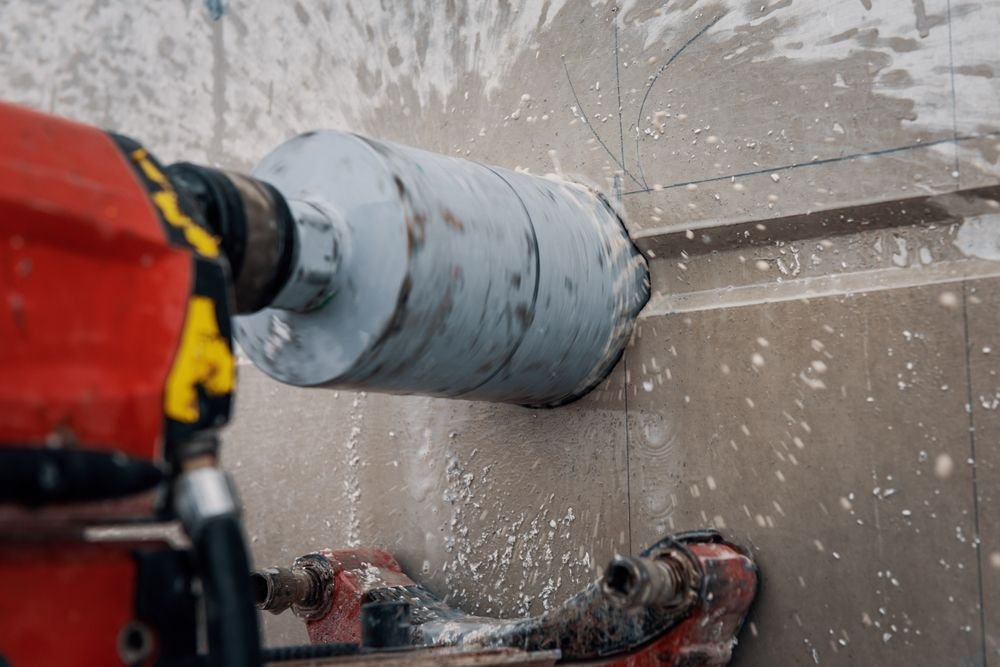
Slurry is contained. We use vacuum collection on wet cuts, filter the water as required and dispose of it properly instead of letting it follow the grade. In occupied buildings, we add dust barriers and negative air where the work touches finished spaces. Cores are drilled with a rig bolted or vacuumed to the slab so the hole is square and the bit does not wander.
Cutting concrete releases respirable crystalline silica, and the controls are water at the blade, local exhaust or vacuum, and respiratory protection when conditions call for it. We keep exposure plans, set up work zones that keep other trades out of the cutting area and monitor conditions throughout the shift. Dry cutting is reserved for places where water is not an option, and it is paired with extraction.
Tendon-bearing slabs are handled as hazards. Post-tensioned floors are never cut or cored until the tendon layout is confirmed from drawings and scanning, and we coordinate with the original engineer on any opening. A mistake with a stressed tendon can launch steel across a room, which is why this scope involves concrete demolition and removal planning rather than a casual saw rental.
Road and roadway work calls for sawcuts at the edges of removal areas and for joint cutting in new paving. The Harmony Road corridor, where a city study contemplated widening four-lane sections, raised medians and continuous sidewalks, is an example of a corridor where saws make every curb, median and ramp tie cleanly into what remains. The Harmony Road corridor is typical of urban work where clean edges matter.
Interchange and bridge work around the I-25 and Mulberry interchange shows another side: the state's project cites bridge replacement, aging infrastructure and flood mitigation among its goals, and saws and core rigs are used for deck removal, barrier cuts and utility penetrations in that kind of work. We bring the same discipline to private jobs that need a clean line for a new concrete paving tie-in.
Coring is the quieter half of the trade. Plumbers need 4 inch holes for drains, electricians need sleeves for feeders, and mechanical trades need openings for ducts and piping that were not in the first set of drawings. We core to the marked diameter, hold the bit square, clear the debris and leave a hole that the trade can sleeve and firestop. Cores taken for testing are labeled and delivered to the lab, so the strength numbers can be tied to a location.
Sawing is usually a short operation in a long schedule, so it is easy to lose time waiting for a cutter. We book cuts around the demolition and utility crews that depend on them, and we sequence so that cutting and removal happen together, with one hauler and one patching crew behind. For joint cutting in new slabs, timing is critical: we saw as soon as the concrete will take a blade without raveling, often within hours.
Night work is common on public corridors and in occupied buildings. We staff for it, light the work zone, and plan noise levels with the owner. General contractors who need a dependable cutting subcontractor can read more about our work with general contractors and construction managers.
A cut is usually step one. After it come removal, utility trenching, new reinforcement and replacement concrete, and we price the sequence as one package when asked. For work on school campuses and transit corridors, such as the area served by the MAX bus rapid transit line that runs south toward a transit center near Harmony Road, cut-and-patch tolerances are tight and the public is close by.
Owners of schools often schedule such work in summer breaks, when floors can be opened, new utilities installed and the slab restored before students return. We plan the cutting layout and the patch pour together so there is no gap between them.
Send the plan and the slab thickness. We will scan, price the cuts and schedule them around your trades.
Only after the tendons are located and the engineer has approved the opening. We scan, mark and often hand-expose tendons where needed. Never assume a safe path without confirming it.
We use vacuum collection, berms and filtration so cutting water does not flow to inlets or the street. Waste water is disposed of in line with local requirements. Wet cutting is cleaner than dry cutting but requires planning.
As early as the concrete can take the blade without raveling, usually within several hours after finishing, depending on mix and weather. Late cuts risk random cracking. We use early-entry saws when timing is tight.
Wall saws and wire saws can cut through very thick concrete. The limiting factors are access, water and safety. We choose the saw based on thickness, reach and the debris that will fall when the cut is complete.
Yes. Public corridors and occupied buildings often require it. We staff nights and weekends and control noise, dust and lighting.