Old Town sets the bar for how a Fort Collins sidewalk should look. The district covers roughly 26 acres and includes 38 contributing buildings, and a city-designated historic district with design standards overlaps it. Anyone who pours a plaza, entry or walk near that area is held to a higher standard than a plain broom finish, and the same expectation is spreading to hotels, restaurants, breweries and campus-style business parks across the northern Front Range.
Decorative concrete answers that expectation without giving up the durability of a structural slab. Integral color, stamped patterns, exposed aggregate, saw-cut scoring and stained or sealed surfaces all begin with the same base: well-compacted subgrade, proper thickness, sound reinforcement and a mix that can handle freeze-thaw cycles.
We build decorative flatwork for commercial owners who want a surface that looks designed and still performs after many winters of plowing and deicers.
The region sees real winter. Freeze-thaw cycles, plow blades and deicing chemicals attack decorative surfaces harder than they attack a plain slab. Estes Park, at 7,743 feet on the Big Thompson River at the eastern entrance to Rocky Mountain National Park, shows the high end of that exposure, with a visitor economy that wants stamped and colored paving in the center of town, and a climate that tests every joint and sealer.
Design standards also shape the work. The Old Town historic district's overlay means that new walks, plazas and entries often have to respect existing materials, patterns and details. Owners and architects working near it may specify brick-pattern stamps, saw-cut grids or exposed aggregate that references historic paving. We read the standards early so that the pattern, color and joint plan can be approved before the pour. Review cycles for historic-district work can add weeks, so we build that time into the schedule and keep the mock-up available for the reviewer to see.
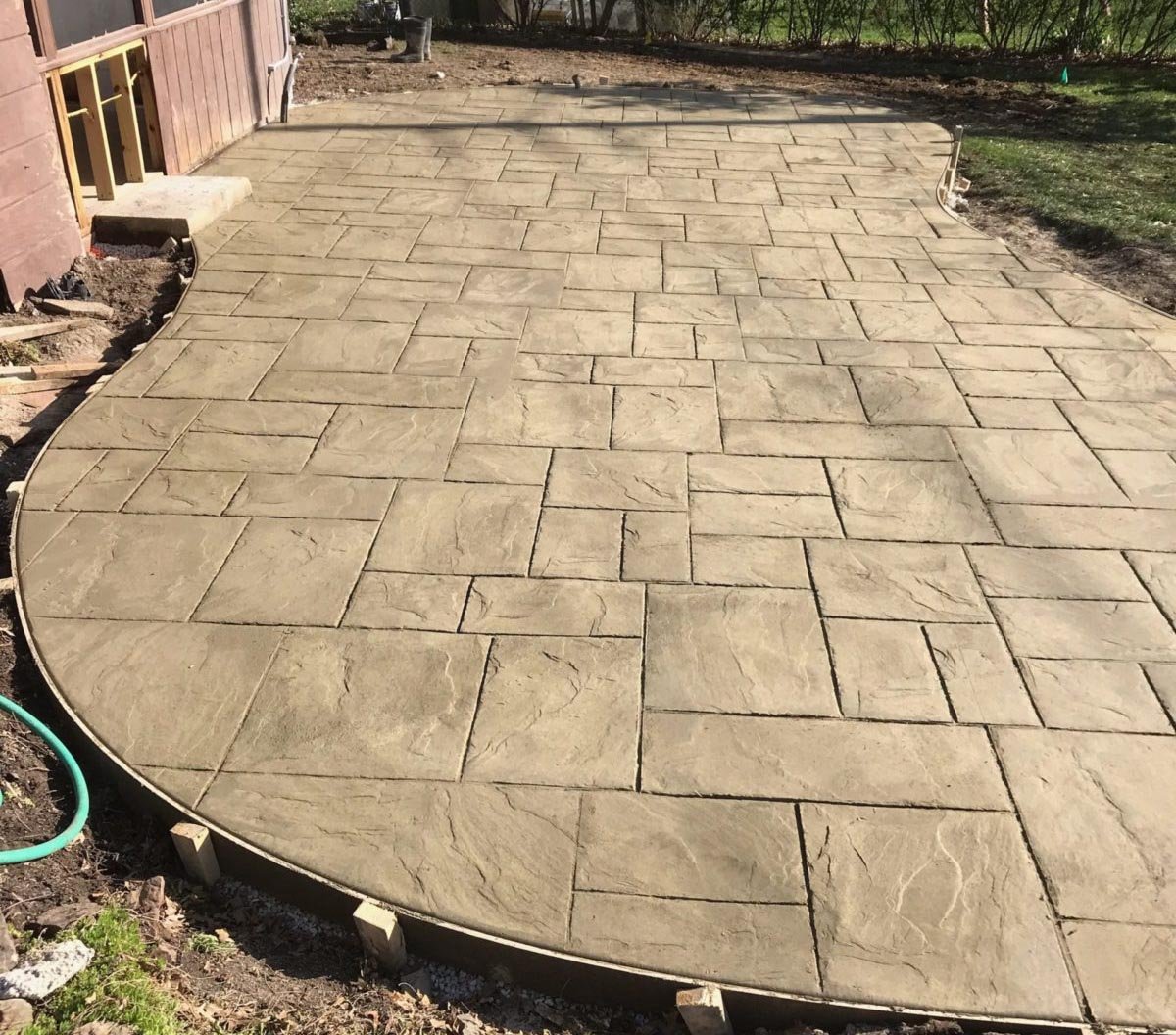
Stamped concrete is placed, finished, colored with release agent and impressed with mats while it is still plastic. Integral color is mixed into the concrete at the plant and gives a consistent base hue. Color hardener, broadcast on the surface, adds both color and wear resistance. Exposed aggregate is made by retarding the surface paste and washing it away to reveal stone, producing a slip-resistant, durable finish. Saw-cut patterns and scored lines give clean geometric designs, and stains or dyes add depth.
Each method has its own limits. Stamping requires speed and a timed sequence. Exposed aggregate requires careful washing. Stains need clean, sound surfaces. We discuss performance, maintenance and cost with the owner, including how sidewalks and flatwork will tie into decorative areas at the building entrance.
We build a mock-up panel for any large decorative area so the owner and architect can approve color, pattern and texture under real light. The mock-up also tells the trade team how the mix behaves on the day, how much release is needed, and when to stamp. We confirm the base is stable, the thickness is correct and the reinforcement is in place before any decorative work starts.
On pour day we plan the sequence so finishers do not run out of time. Stamping has a narrow window, and the crew needs enough hands for the area. Control joints are cut or tooled to follow the pattern, so the cracks the concrete is going to make follow lines the design can hide. After curing, we clean and apply a sealer chosen for outdoor wear and for the slip resistance the site needs.
Decorative concrete placed outdoors in Colorado needs air entrainment in the mix, a properly sloped surface, and joints sealed and maintained. Deicing salts are damaging to young concrete, and we advise owners to avoid using them during the first winter and to choose appropriate products afterward. Sealers help but need to be reapplied every few years.
Slip resistance is a design issue and a safety issue. Smooth stamped surfaces, polished stone-like patterns and glossy sealers can become slick when wet or icy. Texture additives, matte sealers and exposed aggregate help. Accessible routes have their own rules for slope and surface, which we address with the architect so that the design looks good and complies. ADA-compliant details matter at ramps and curb cuts, which we cover under ADA ramps and accessible routes.
Decorative areas rarely stand alone. They tie into concrete paving at drive aisles and fire lanes, to curb and gutter along the street, and to entries that meet polished interior floors. Plazas often need drainage, planters, bollards and seat walls, all of which we coordinate with the landscape and utility trades.
For the hospitality and hotel market, entry courts, pool decks and outdoor dining all use decorative concrete. Municipal and public works buyers use it for streetscapes and trailheads. We build the same way for each: plan the base, protect the finish, and maintain the joints. Where a plaza sits above a basement or a utility vault, we coordinate the structural slab with the decorative topping so that waterproofing, drains and expansion joints line up and no pattern is cut across a joint that has to move.
Share the design intent and the site plan. We will propose a mock-up, a pattern and joint plan and a price for the finish you want.
With air-entrained concrete, good drainage, sealing and joint maintenance, stamped surfaces last many years. The sealer typically needs reapplication every two to three years, and joints need re-caulking. Using deicing salts and abusive plowing shorten life.
Yes, with care. Color, release and stamping work all depend on temperature and set time, so we use warm mix, blankets and a longer finishing plan. We will not stamp on frozen subgrade, and some projects wait for spring.
Integral color is controlled by the plant, but variations occur with water, cement and weather. Color hardener and stain bring more control at the surface. A mock-up and a single plant supply help keep the match tight.
Clean the surface regularly, reseal on schedule, repair joint sealant, and avoid harsh chemicals and metal blades on plows where possible. Rust-prone items like metal planters can stain, so we recommend protective pads.
Stamped concrete is a monolithic slab, with no joints that can shift or weeds that can grow, and it is typically faster to install. Pavers can be repaired in pieces and may feel more traditional. The right choice depends on budget, design and maintenance expectations.