
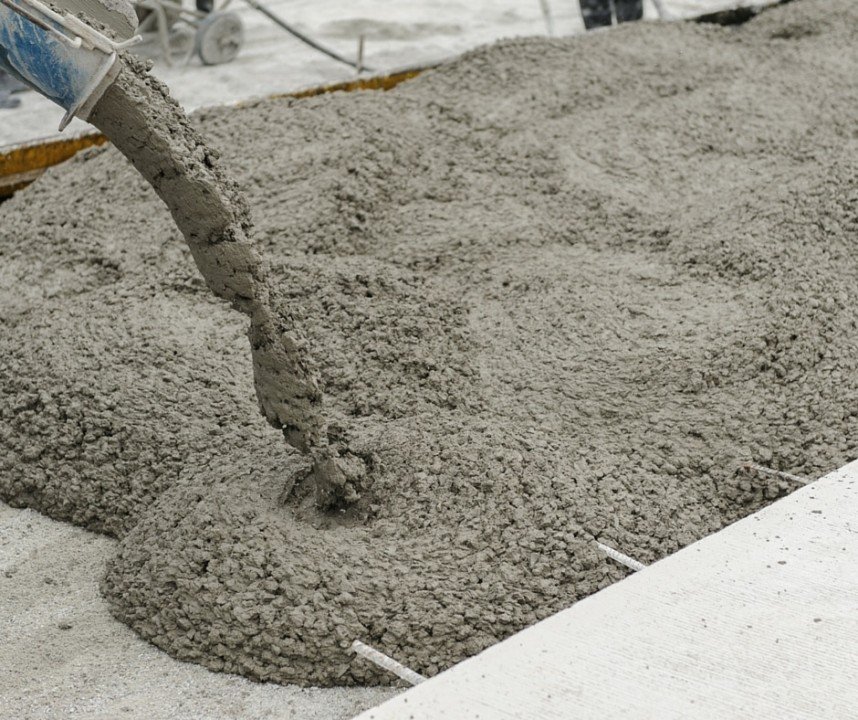
Anything thick enough to hold its own heat is mass concrete, and a pour that large is planned like a small operation, not a big slab. A mat 40 feet by 40 feet and 4 feet thick holds about 237 cubic yards, and the same footprint at 10 feet takes close to 600. At those volumes the delivery rate, the cooling plan and the temperature record matter more than the finishing. We plan and place thick mats, pedestals, heavy pile caps and equipment foundations for buyers who cannot afford a cold joint or a thermal crack.
Cement releases heat as it hydrates, and in a thick section the core stays hot while the surface cools. The gap between them, the temperature differential, creates tension at the surface, and the surface cracks. Specifications limit that differential and also cap the peak temperature in the core, and the pour is designed to stay inside both limits. We work to the numbers the engineer states, and we do not assume that a mix that worked in a thin slab will work in a block.
The project drivers on the northern Front Range are often industrial. A research and manufacturing campus of 101 acres, buildings taking up hundreds of thousands of square feet, and rail-served parks with heavy loading all bring foundations that want to be thick. We read the structural drawings for any section that crosses the mass concrete threshold in the specification and treat it as its own package.
The mix is built with the supplier for low heat: moderate cement content, supplementary cementitious materials such as fly ash or slag, and sometimes chilled water or ice in hot weather. Trial batches or past data confirm that strength is reached at the age the engineer needs, which is often 56 days rather than 28 for mass sections. Aggregate size, slump and set time are agreed before any pour is scheduled.
Placement is continuous in layers, each placed before the last begins to set, so the concrete stays monolithic. That requires a steady truck rhythm, often several trucks in the line at all times, and a standby plan for any equipment breakdown. We set up two pumps or a pump and a crane and bucket when one failure would otherwise stop the pour. The line, the booms and the washout are laid out the way we plan any large concrete pumping and placement job.
Thermocouples are cast into the core, mid-depth and near the surface, and read continuously by a logger. We watch the numbers in real time, and if the differential approaches the limit we add insulation, blankets or a temporary enclosure. In winter the surface is protected so it does not lose heat too fast, and in summer it is shaded and wetted so it does not gain heat from the sun.
Forms and insulation stay on until the temperature differential shrinks to what the engineer accepts, which may be days or more than a week. Stripping early is the common error, and it can crack a large block on its first cold night. The same discipline applies to a heavy block in the middle of a floor, such as the equipment pads and machine foundations we build for process lines.
The extras are real but predictable. Low-heat mixes cost more than standard mixes, thermocouples and loggers add equipment, insulation and curing materials add labor, and the pour crew is larger and stays longer. Standby equipment is cheap insurance against a cold joint, and we price it as a line item rather than hiding it.
Quantities drive the rest. A pour over several hundred cubic yards may need a night start to avoid traffic and heat, or a split into two placements with a designed joint. We offer alternatives, such as thinner sections with more reinforcement or a staged pour, and we share the cost and schedule difference so the owner chooses with numbers.
Industrial owners with heavy process equipment, rail-served distribution sites and buildings with large pedestals are the typical buyers. A railroad's industrial rail parks near Eaton total 160 acres zoned for heavy industrial use with parcels divisible to a one acre minimum, and the foundations that serve rail loadouts and process lines are often thick. We talk with industrial and manufacturing owners about these sections early, because the concrete supplier needs lead time.
Data and technology buildings also bring mass sections. Generators, switchgear and chillers on a data center site rest on heavy pads, and a cold storage facility has dense foundations for its refrigeration equipment.
Sites near Eaton or in other Weld County towns illustrate how quickly these sections can show up in rural-industrial settings.
The record of a mass pour includes mix submittals, batch tickets, placement start and finish times, thermocouple logs, cylinder breaks and a photo set of the formwork and reinforcement before and after. We assemble it as the pour proceeds, not afterward, and hand it to the inspector within days. Testing frequency is set by the specification and often exceeds the standard rate; our concrete testing and quality control practice covers the sampling and curing of the cylinders.
Weather affects every one of these steps. A hot afternoon speeds hydration; a windy day dries surface layers, and we have separate plans in hot and windy weather concrete when conditions turn. The pour date is a window, and we keep the delivery plan flexible enough to take advantage of the best part of the day.
Send the structural drawings and the specification. We will return a pour plan, a delivery rate and a temperature control approach.
There is no single thickness. Specifications often define it by the dimensions where heat buildup is a concern, such as sections thicker than a few feet. The engineer will state whether temperature limits apply. If they do, we plan for them.
Mass mixes use slower cement chemistry to limit heat, so strength gain is slower. A 56 day test reflects when the structure will actually carry its design load. Early breaks are still taken to track progress.
Yes. Winter can actually help by limiting peak temperatures, but surface protection is needed so the exterior does not cool too fast. We use blankets and enclosures and watch the thermocouples throughout.
We plan with margin: extra trucks in the line, a second pump and a communication line with the plant. If a gap does occur, we keep the placed concrete alive by vibration and follow the rule that each layer must be placed before the prior one sets.