
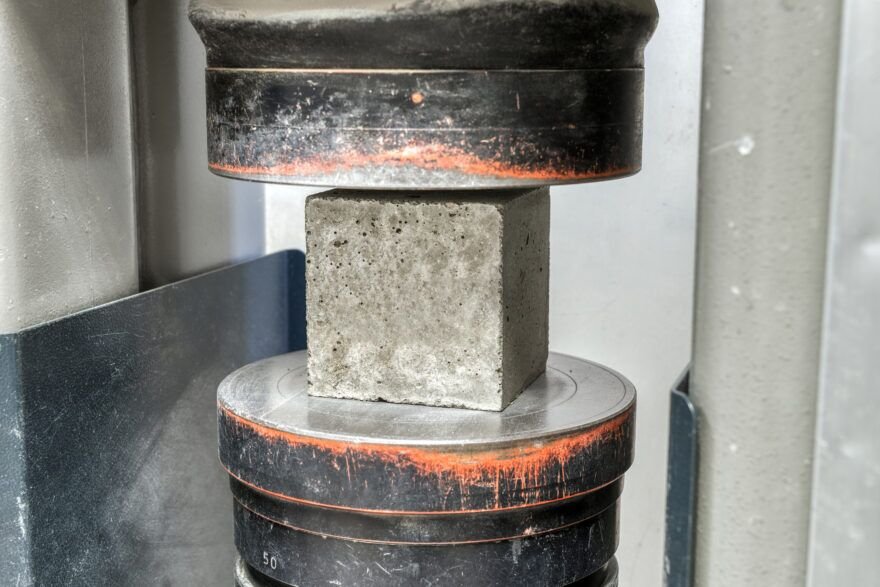
Twenty-eight days after a pour, a cylinder is crushed in a laboratory and a number decides whether a floor was built correctly, which is a long time to wait for an answer about something already covered with a slab, racking and equipment. That delay is the reason quality control on a concrete job has to be a set of checks made during the work and not a report assembled after it. Subgrade density, reinforcing placement, slump, air content, temperature and curing each get tested or inspected at the moment they can still be corrected.
We approach testing as part of the construction sequence. The testing agency is on site when the subgrade is proof-rolled, when the rebar is inspected, and when the first truck discharges, and the results go straight into a log that the superintendent, the engineer and the owner can read. When a number is off, we want to know while the concrete is still plastic. When it passes, we want a clean record that supports the certificate of occupancy and the warranty file years later.
Fort Collins treats the 2024 International Building Code with local amendments as the current code for permits submitted on or after April 1, 2026, and keeps the 2021 codes available for reference until October 1, 2026. Because commercial codes in Colorado are adopted city by city and county by county, the edition that governs a concrete job depends on the jurisdiction and the submittal date, so we confirm the governing edition and the special inspection schedule before the first footing is cast.
The structural drawings and the specification carry the real acceptance criteria: design compressive strength at 28 days, maximum water-cement ratio, air content for exterior exposure, slump limits and curing requirements. Fort Collins design criteria also list a 30 inch frost depth, which controls footing bearing elevations and which inspectors check before any concrete is placed. We build the test plan from those documents, not from a generic template, and we flag early any requirement that does not match what the mix supplier can deliver.
On the earthwork side the agency runs compaction tests with a nuclear density gauge or sand cone against the maximum dry density from a Proctor curve, and observes the proof-roll for pumping or rutting. Before the pour, an inspector checks the rebar placement, meaning bar size, spacing, cover, laps and chairs, against the drawings. At the truck, the technician measures slump, air content by the pressure method, unit weight and concrete temperature, then casts cylinders or beams for strength and flexural testing.
Those cylinders are cured under controlled conditions for lab breaks and, where early loading matters, kept in the field alongside the slab. Post-tensioning, anchor bolts and embedded plates get their own inspection sign-off. Floor flatness and levelness are measured within the hours the specification allows, because it is too late to dispute them after the curing compound has dried. Every sheet is tied to a specific placement by location, time and truck ticket.
Not every test passes, and a good quality program is judged by what happens next. A low slump on a pump load might mean the concrete is rejected, retempered with a documented admixture or placed in a non-critical area, and the choice belongs to the engineer, not the foreman. A cylinder that breaks low is checked against the companion set, the curing records and the batch ticket before anyone concludes the structure is deficient. Cores and nondestructive tests are used when the question remains.
We keep the paper trail tight so those decisions are quick. Truck tickets, batch times, water added at the site and field temperatures are reconciled the same day. When the same mix is used across a project, we trend the strength results and talk with the plant if the average drifts toward the minimum. This is dull work, and it is exactly what protects an owner from a dispute in year three.
Testing runs on the schedule of the concrete, which means the agency must be booked days ahead and confirmed again the afternoon before. A missed rebar inspection can hold a pour for a day; a missed truck sampler can mean the cylinders for a whole bay are unrepresentative. We build the testing sequence into the three-week lookahead alongside forming, inspections and the pumping and placement plan, so the technician arrives before the first truck and not after the second.
Break results drive release decisions as well. Formwork stripping, post-tensioning stressing, saw cutting and the first loads on a slab all depend on early strength, and cold weather slows that gain. In winter we use field-cured cylinders and maturity data to decide when a deck can be stripped, instead of guessing from the calendar.
Testing is a modest line item with an outsized effect. The cost drivers are the number of placements, the volume per placement, the frequency set by the specification (commonly a set of cylinders for each fixed volume or each day, whichever is stricter), special inspection hours and the lab work for mix design review. Owners who add pours without adding sampling plans often discover that the agency bills by the trip, so a pour that is split into three small days costs more in testing than one well-planned day.
We help avoid unnecessary spend by combining placements where the design allows and by aligning pours with the agency's calendar. We do not cut tests to save money. A short program that misses a deficient batch can cost far more in core drilling and repairs than the testing would have, and the owner is the one who pays for it.
Testing begins well before concrete arrives, with building pad preparation and the compaction records that support a floor. It continues through every slab on grade, where it verifies thickness, strength and curing, and through every elevated or wall pour where early strength governs when forms can come off.
We prepare quality records for owners of manufacturing plants, for schools and healthcare owners who must close out special inspections before occupancy, and for any project whose permit file expects a complete record. Building packages that carry that full record are described under our commercial concrete contractor scope.
Share the specification and the placement schedule and we will lay out where each test, hold point and record falls before the first truck arrives.
Slump, air content and temperature are known at the truck within minutes. Seven-day breaks give an early indication, and the 28-day break is the formal acceptance number for most mixes. If an early result worries the engineer, we can use field-cured cylinders, maturity data or cores to confirm strength without waiting.
Special inspection and acceptance testing are normally hired by the owner so the results are independent, while contractors often hire a separate agency for their own quality control. We work with either arrangement. What matters is that each agency has a copy of the specification and the pour schedule and that results go to the engineer of record without delay.
We review the batch tickets, the curing history of the cylinders and the companion set, and we ask the engineer to evaluate the structure with cores or nondestructive tests if the concern stands. A low cylinder does not automatically mean a bad slab, but it does mean a documented answer is required before the work is accepted.
Yes, compaction and moisture testing of the subgrade and base are part of the program because a slab can only be as stable as what is under it. The geotechnical report sets the density target, and the agency checks each lift against it before we cover it.