Once a mixer truck backs up to the form, the clock on that load is already running, and the whole pour now depends on how quickly the concrete can travel from the chute to the place where it will stay. Placement is the one stage of a concrete job that cannot be corrected the next morning. A cold joint, a segregated load or a crew that runs out of reach shows up in the finished floor for the life of the building, so we settle the method well before the first truck is dispatched.
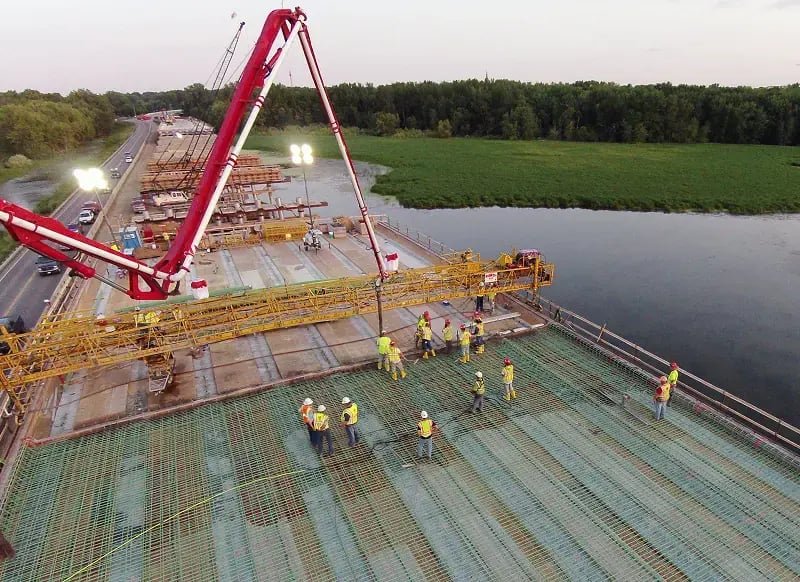
That decision comes down to reach, ground, mix and finishing capacity. A boom pump earns its mobilization on a large slab, a deck or a tall panel where the boom can swing over the work without a single line being moved. A line pump suits tight courtyards, basement walls and interior bays where a truck cannot get close. A direct chute pour is still the cheapest way to place a footing or a thickened edge when the mixer can reach it, and we say so when it applies. We also check the pour against the people who will finish it, because a pump that delivers more yardage per hour than the finishers can strike off simply moves the problem to the surface.
A pump is only as productive as the supply behind it. Before a large placement we work out the pump rate in cubic yards per hour, the haul time from the plant to the site and the unloading time per truck, and we turn that into a truck interval the dispatcher can hold. If the interval stretches, the pump idles, the concrete in the hose stiffens and the finishers wait with a half-set edge behind them. If it bunches up, trucks queue on the street and the concrete in the drum ages. We would rather agree the interval with the batch plant the day before than discover it at the first load.
Pour windows on the northern Front Range are set as much by weather as by the calendar. Summer afternoons can turn windy and hot enough that a slab loses surface moisture faster than it can be finished, so large flatwork is scheduled to start early. In the cold season the same pour moves to the warm part of the day, with the heated mix, blankets and enclosures of cold-weather concrete practice ready before the pump arrives. Fort Collins design criteria list a 30 inch frost depth, which means footings and slabs poured near freezing need the subgrade thawed and protected before any concrete goes in, and the pump line itself needs to be kept from freezing between loads.
The scope we pump covers slabs on grade, footings, grade beams, stem walls, tilt panels, elevated decks, columns, equipment pads and wall pours. Each has a different tolerance for slump and a different way of being fed. Slab concrete is placed in strips with the pump moving backward so no one walks on fresh work. Walls and columns need lifts the form can carry, delivered through a hose with a rubber end so the concrete does not free-fall and segregate. Tilt panels are cast flat on the slab, so the pump has to reach the whole casting bed from the edge of the building without driving across it.
We confirm the pump mix with the supplier rather than adding water at the site. Pumpable concrete needs enough paste and the right gradation to slide through a 5 inch line, and a plasticizer lets the finishing crew keep a slump they can work. Priming the line with a grout slug, discarding the first few feet of discharge, and washing out in a designated pit are routine parts of a placement here, and each is written into the plan so the washout never ends up in a ditch or a storm inlet.
A boom truck needs more room than most owners expect. The outriggers spread to a footprint that can run to twenty feet or more across, and each pad carries a point load that a freshly backfilled trench, a buried vault or a soft shoulder will not take. We walk the setup location with the superintendent, mark known utilities, and plan cribbing or steel plates where the ground has not been proven. Overhead lines are the other early check. A boom that clears a power line on paper can swing into it with a hose full of concrete, so the setup point is chosen with the lines in mind, and the owner of the line is called when the clearance is not generous.
Large industrial pads change the picture. Great Western Industrial Park in Windsor is a 3,000-acre master-planned park with sites from 5 to 200 acres and buildings from 60,000 to 1,000,000 sq ft, and a building that size is poured in bays that stretch across hundreds of feet. There the pump moves on a planned route around the perimeter while trucks stage on a gravel haul road, and the pour sequence is drawn so that every joint is placed where the designer expected it.
On the morning of a major pour the crew arrives before the first truck. The forms and rebar have been inspected, the subgrade is damp but not ponded, the vapor barrier and edge details are checked and the testing agency is on site with its equipment. We confirm that the pump has been set, that the finishers have the screed, the bull floats and the power trowels they need, and that the cure method is staged and ready to apply. Only then does the first truck discharge.
The first load tells us everything. We look at the slump and temperature, watch how the concrete moves through the line and how it responds to the screed, and adjust the next load with the plant if the mix needs a change. Our testing and quality control program runs alongside the pour so the cylinders, air readings and temperature logs are captured while the concrete is still in the truck, not reconstructed afterward.
A pump is rarely the point of a job; it is the way a floor or a structure gets built. Large slab on grade placements rely on it, as do tilt-up panels that must be cast before the crane arrives, and the pump is often the only practical way to lift concrete to a suspended floor.
We place concrete for general contractors and construction managers who need a placement partner that can hold a schedule, and we regularly prepare pour plans for warehouse buildings, where long bays and many trucks make the placement plan the most important page in the submittal.
Send us the plans, the pour volume and the target dates, and we will return a placement plan with pump type, truck interval and weather contingency.
Use the chute when the mixer can reach the form and the pour is small, such as a strip footing or a thickened slab edge. A boom pump is worth it when the concrete has to travel more than a chute length, over obstacles or up to a deck, or when the placement rate has to match a large finishing crew. The setup cost is usually repaid on slabs and panels where holding a steady rate matters more than the hourly pump charge.
We ask for the lowest slump that the pump and the finishers can live with, and we get there with a mid-range water reducer instead of added water. Pumping typically wants a little more workability than a chute pour, but extra water costs strength and invites surface cracking. The slump and the water-cement ratio are logged on the first load of every pour.
We confirm that a backup pump or a second boom truck is available from the supplier before a critical pour, and we plan where the cold joint would be placed if the pour has to stop. A planned stopping point with a bulkhead and dowels is far better than an improvised one. The testing agency documents the time the joint was formed so the engineer can review it.
Yes, with preparation. The mix is heated, the subgrade must be free of frost, the line is insulated or kept moving and the placed concrete is covered immediately. The concrete leaving the hose has to meet a minimum temperature set in the specification, and we check it at the discharge, not at the plant.