
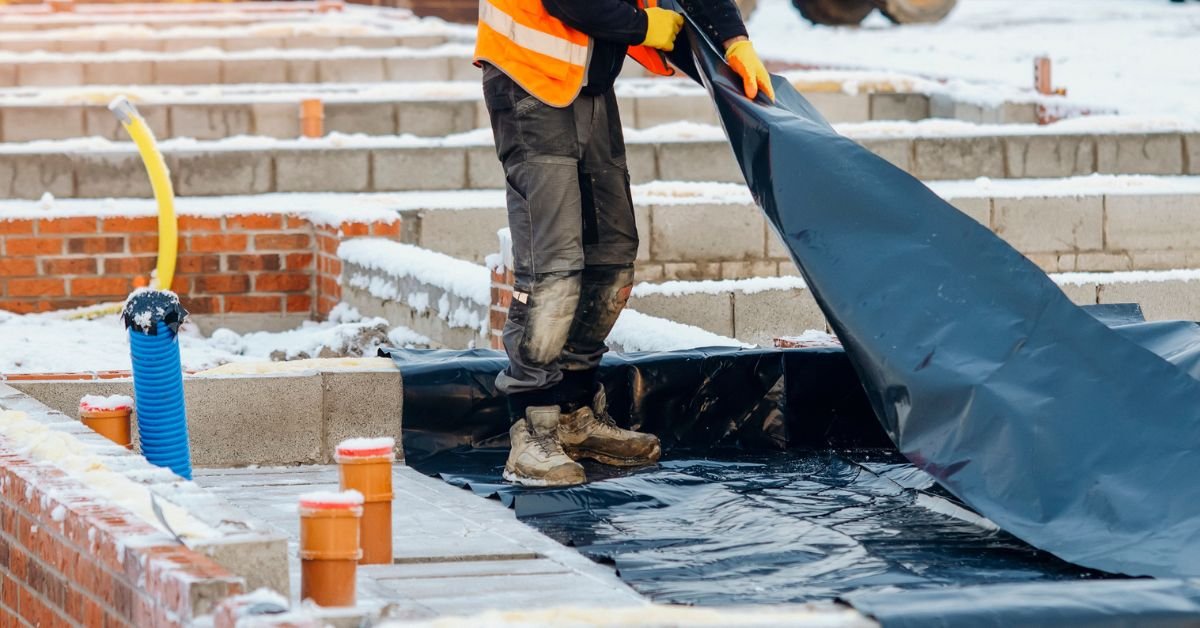
The first night is the dangerous one. Concrete that freezes before it gains about 500 psi can be permanently damaged, and a pour that looks fine at five in the afternoon can be ruined by a clear sky at four in the morning. Cold-weather concrete on the northern Front Range is less about heroic measures than about arithmetic: how warm the mix leaves the plant, how much heat it loses on the way, how long it has to be protected, and how we will know it is strong enough to be left alone.
The practical job begins well before the pour. We confirm the forecast, look at the overnight low rather than the daytime high, and decide whether blankets will do or whether a heated enclosure is needed. The subgrade is checked for frost, because placing concrete on frozen ground leads to settlement when it thaws, and forms and reinforcement are cleared of snow and ice. If the ground cannot be thawed and protected, the pour moves.
Fort Collins building design criteria list a 30 inch frost depth, and Estes Park sits at 7,743 feet, so the region includes places where winter lasts well beyond the calendar. Wellington, the northernmost town on I-25 in Colorado at 5,194 feet, sees the same pattern at a lower elevation. Our winter plan changes with the elevation of the job.
We aim for the warmest part of the day for placement and finishing, and for a start time that leaves the finishers daylight. A slab started in the afternoon ends in the dark, with bleed water still rising while temperatures fall, and that combination causes dusting and scaling. Early starts, a trusted batch plant and a fast crew shorten the exposure.
We also plan the number of cold days, because protection lasts for a set number of days that depend on the exposure and the mix. If the engineer wants three days of protection at 50 degrees and the forecast shows a week of single digits, the heating budget is part of the project. The same plan covers footings and stem walls that must be backfilled before the ground freezes deeper.
Ready-mix logistics tighten in the cold. Plants heat water and sometimes aggregate, trucks are loaded with a margin of temperature, and a long haul or a waiting truck loses heat. We confirm the mix temperature on the ticket, take it again at the discharge, and reject a load that arrives outside the range rather than hoping the blankets will compensate.
The usual approach follows ACI 306. The mix is ordered at a temperature that suits the section thickness, with heated water and, where needed, heated aggregate. Non-chloride accelerators speed set and strength gain when the specification allows them, and air entrainment is maintained for any exposed surface that will see freeze-thaw cycles and deicing salts.
Things we avoid are as important as things we use. We do not add water to a stiff mix, we do not use salt to lower the freezing point, and we do not cover a fresh slab with plastic that traps water on the surface. Unvented fuel-fired heaters release carbon dioxide that can leave a soft, chalky skin on the surface, so we use indirect-fired heaters or ventilate enclosures properly.
Slabs are the hardest to protect because they lose heat from the top. We use insulated blankets laid directly on the finished surface once it can take them, or a hoarded enclosure with heaters when the forecast is severe. Thin sections such as sidewalks and curbs need extra care, since they have little mass to hold heat. The opposite end of the year brings the dry, drying-wind problems we handle under hot and windy weather concrete.
Walls and columns retain more heat inside insulated forms, and we use insulating form liners where they pay. Footings and pier tops are covered with blankets and straw bales. For all elements, we place thermometers or maturity sensors in the concrete so the record shows what the concrete experienced, not what the air did. This data supports the decision to strip forms and ends arguments about whether a slab can carry load.
Curing does not stop when the heaters go off. Taking protection away all at once can shock the surface, so we step the temperature down gradually and keep the concrete from drying out in dry winter air. A slab that has been kept warm and then moist for the required period will resist scaling from deicing salts, which is the damage owners usually see first and blame on the mix.
Heated materials, accelerators, blankets, enclosures, fuel and extra labor add up. The additions depend on the temperature, the size of the pour and the duration of protection. We show them as a separate line, so owners can compare a winter price with a spring price and decide whether the schedule benefit justifies it.
Delay has a cost too. Pushing a pour to spring may hold up framing or enclosure, and that can cost more than protection. Developers and contractors weighing that tradeoff, including general contractors and construction managers, find that early winter planning is the cheapest form of protection, and concrete testing and quality control supplies the strength record that proves it worked.
A winter crew works differently from a summer crew. Finishers work with windbreaks, tools stay warm, and a person is assigned to watch the blankets and heaters through the night. We build that watch into the plan and not into an hourly emergency call.
Floors in a warehouse building benefit most from a protected, enclosed pour, since an enclosure also keeps trades working.
In Wellington, where commercial space is growing near the I-25 exit, winter schedules for pad sites are tightly managed, and our work in Wellington and Estes Park shows the range of conditions we plan for.
Send the pour schedule and the element list. We will return a mix temperature, a protection plan and a heating budget.
There is no single number. The decision rests on the forecast low, the mix temperature, the protection and the section thickness. We have procedures for very cold days, but we also postpone when the risk is too high.
We use field-cured cylinders or maturity sensors to measure strength gain and compare it to the specification. The decision is based on measured strength, not on a calendar count.
Not if it is protected and cured properly. Concrete placed in cold weather gains strength more slowly, but it can reach the same ultimate strength. Problems come from freezing early, from poor curing or from adding water.
No, not without thawing. Frozen subgrade settles when it thaws and can crack the slab. We thaw with blankets or heaters, verify the ground temperature and place on thawed, firm material.