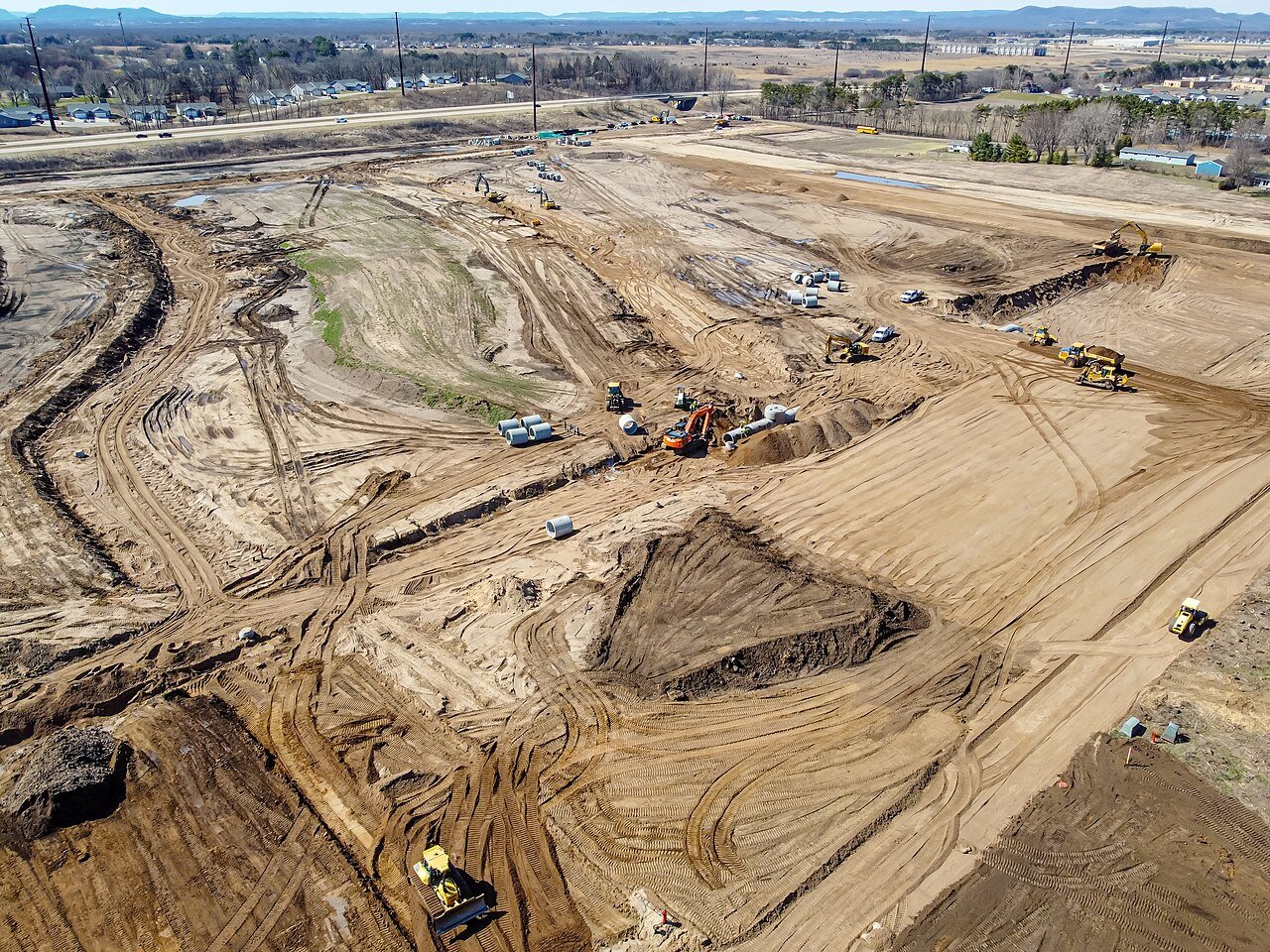
A parcel becomes a neighborhood or a business park in a sequence that most buyers never see. Before anyone pours a footing, someone has to grade the land, lay the water and sewer, build the streets, shape the ponds and hand all of it to a town or district that will own it afterward. That sequence is called land development infrastructure, or horizontal construction, and it is where a project's schedule and budget are won or lost.
We perform the earthwork, underground utilities, concrete flatwork and subgrade preparation that make up horizontal development, from clearing and mass grading through curb, gutter and street subgrade. The work is phased, so that finished lots or pads can be turned over to builders while later phases are still under construction.
Developers, master-planned community teams and general contractors use us when they want coordinated trade partners working to one sequence, with each phase and handoff defined.
The scale of recent projects shows what horizontal work looks like here. The Ridge at Johnstown is a 265-acre master-planned mixed-use site with 90 acres of I-25 frontage, and 122 acres of it had been sold to residential developers. Ladera, a 240 acre mixed-use offering at the southeast corner of East Harmony Road and I-25 in Timnath, is marketed with interstate frontage, and Sage Farms in Wellington is a roughly 300 acre community with neighborhood commercial in its first phase.
Population growth explains the demand: Johnstown's population grew from 9,887 in 2010 to 17,303 in 2020, and Timnath grew from 625 residents to 6,487 over the same decade. Each new resident needs a street, a water line and a sewer, and land development infrastructure is the work that provides them. We watch the pace of these projects so that we can plan crews and equipment for the phases ahead.
A typical package begins with clearing, topsoil stripping and mass grading, then adds storm drainage, sanitary sewer and water mains, with services stubbed to each lot. Streets follow, with subgrade preparation, curb and gutter, base and paving, and detention ponds are built early so that they can handle construction runoff. Dry utility trenches are cut in joint trenches or separate corridors, depending on the utility providers.
We coordinate the trade packages for mass grading, water main installation and storm drain installation, with responsibilities assigned to the relevant trade partners. The advantage of this arrangement is that one team plans the whole sequence and one team answers for how the pieces fit together.
The first target in a land development schedule is finished lots. Builders cannot start until the streets, utilities and lot grades are in and accepted, so the sequence runs backward from the date of the first closing. We lay out phases that let finished lots be handed over while the next phase is under construction, with temporary access and erosion control to keep the two apart.
Weather and inspections control the pace. Utilities must be inspected and tested before backfill is paved, streets must pass density and proof-roll tests, and the town or district has to accept each phase before building permits are issued. Winter slows earthwork and paving, so we plan to complete critical underground work before the ground freezes and leave surface work for spring when conditions allow.
Commercial developers are the main clients for horizontal work, and they often hold the land and phase the investment. They want predictable costs, clear milestones and a contractor who communicates early about changes in conditions. Metropolitan districts and special districts that will own the infrastructure are the other party at the table, and they care about standards and as-builts.
A Highway 60 and I-25 project in Johnstown described in 2022 was planned for more than 1,000 housing units and more than 1 million square feet of retail, at an interchange that passes more than 99,000 vehicles daily. Projects like that combine residential, retail and highway elements, and the infrastructure has to serve all three. We bring experience in coordinating these layers, and we are comfortable working alongside state, town and utility representatives.
Land development leans on several services we describe separately: detention and retention ponds for stormwater, erosion control and SWPPP compliance throughout, and pond and basin excavation for the shaping of the basins. Each has its own sequence, and together they determine whether a development holds water in the right places.
Commercial pads in a development often include hotels and other interstate-frontage uses, and those buyers want pads delivered with a documented subgrade and utility stubs in place. We prepare them as part of the infrastructure package so that the first vertical builder does not have to redo the ground.
Cost drivers include soil conditions, the balance of cut and fill, the length and depth of utilities, the number of lots and the standards of the receiving jurisdiction. Rock, groundwater and unsuitable soil are the usual surprises, and an early geotechnical investigation reduces them. Phasing affects cost, since mobilizing for many small phases costs more than moving through a few large ones.
We help developers build a budget that matches the phasing plan, with unit prices and quantities they can track and update as design changes. Value engineering conversations, such as adjusting pond locations to improve cut and fill balance or relocating a street to avoid a deep utility, often produce larger savings than line-item pricing alone.
Send the plat, grading and utility plans and your target phasing. We will review the sequence, identify risks and price the infrastructure in phases that match your sales and building schedule.
We coordinate trade partners for earthwork, many underground utilities, curb and gutter and subgrade, and we coordinate paving, dry utilities and other trades. Owners choose how much of the package to place with us, and we price each piece separately.
We plan backward from the date the first lots must be finished. Streets, utilities and lot grades in the first phase are built and tested first, with temporary erosion control and access so that later phases proceed without interfering.
The town, district or utility that will own it inspects the work, usually in stages. We schedule inspections, keep test records and provide as-builts so that acceptance and warranty periods can begin.
Weather, unexpected soil conditions, utility conflicts and approval timing. We build float into the schedule, investigate conditions early and keep inspectors informed to reduce each of them.