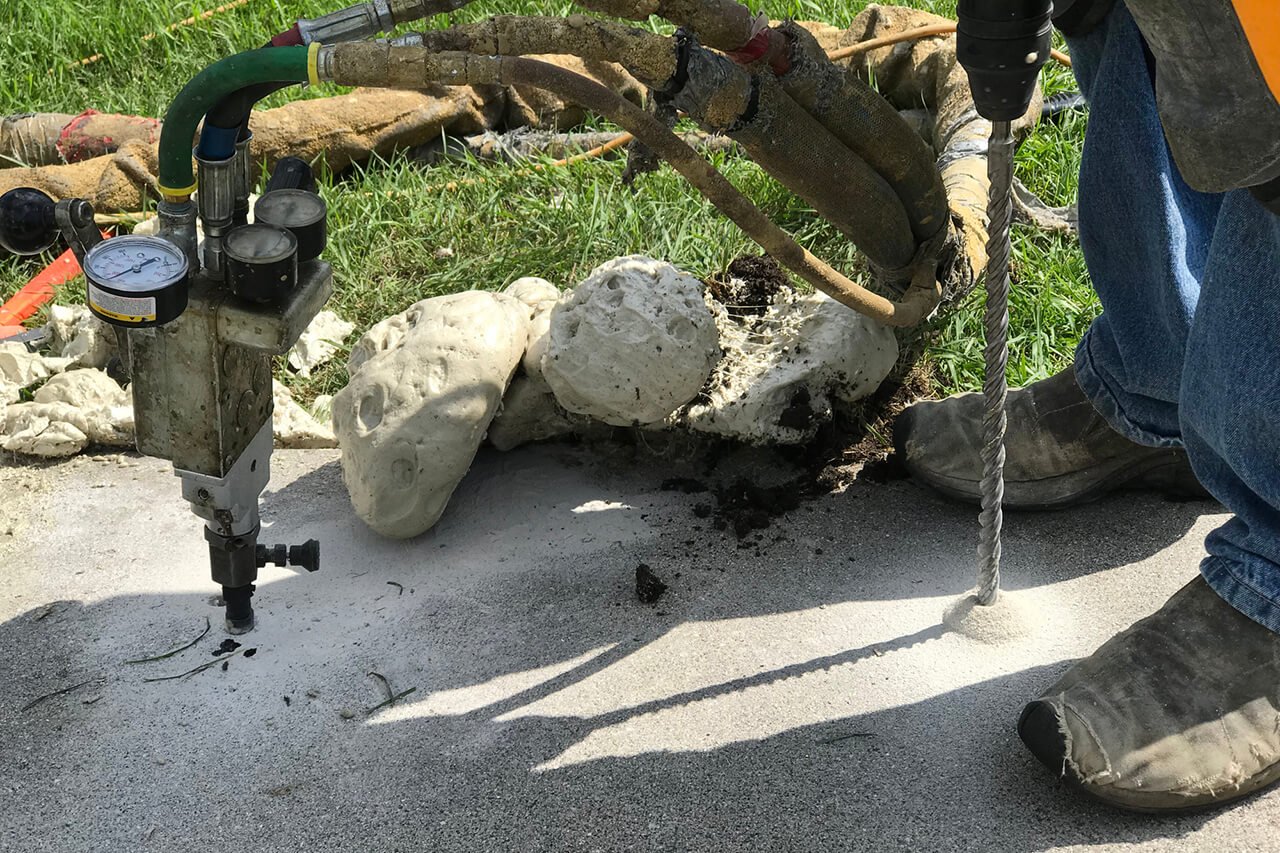
A sunken sidewalk panel is a trip hazard today and a claim tomorrow. A dock apron that has dropped an inch away from the building lets water under the slab and into the next problem. Concrete leveling and slab lifting restore those slabs without tearing them out, by injecting material beneath them through small holes and raising them back to grade. We do this work when the slab is sound and the void or soft zone underneath is the real defect.
Two families of material do the lifting. Polyurethane foam is light, cures quickly and goes in through holes about the size of a coin, so a crew can often treat a panel in minutes and reopen it to traffic nearly at once. Cementitious slurry, the mudjacking approach, is heavier and uses larger holes, but it fills big voids economically and suits thick slabs. We recommend one or the other after probing the void, and we explain why in terms of weight and volume.
The first question is always cause. Lifting a slab without stopping the water or the compaction problem that sank it is a temporary fix. We look for downspouts discharging onto the slab, irrigation spray, broken pipes and poorly compacted trench backfill before quoting, because the cheapest lift in the world still fails if the next storm washes the support out again.
Northern Colorado has farmland and irrigation woven through the same areas that are now being developed. Farmland around Eaton depends on irrigation systems engineered long ago, and Berthoud's early economy grew alfalfa, sugar beets and wheat. Seepage from ditches and fields can keep subsoil wet, and when subdivisions and warehouses are built over such ground, any weak compaction gets exposed by moisture over time.
Growth adds its own pressure. Johnstown grew from 9,887 residents in 2010 to 17,303 in 2020, and fast-built neighborhoods and commercial pads settle as trench backfill consolidates. Expansive clays swell when wet and shrink when dry, and the seasonal movement can lift one side of a slab while the other drops. Sorting out which of these is at work decides whether lifting, soil stabilization or replacement is the right answer.
We start by probing the void with a rod through a small test hole to see how deep the gap is and how soft the soil below is. The injection pattern is laid out on the slab in a grid sized to the panel, holes are drilled, and the material is introduced in small increments while a laser or level watches the slab rise. We stop when the panel meets the adjoining one, not when the pump runs out of material.
Holes are patched with a color-matched material and the surface is cleaned. For joints that open after lifting, we sealant them so water does not find the new crack. A lifted slab that is still cracking across its width may be a candidate for concrete repair and restoration as well, and we flag it rather than lifting something that should be replaced.
Every lift is measured. We record elevations at panel corners before we start and again when the pump stops, so the owner has numbers instead of impressions. On accessible routes, we aim for the cross slope and joint offsets that keep the path usable, not simply flush, and we re-check after the material has cured because some products continue to rise slightly in the first minutes.
Sidewalk panels, curb ramps and driveways are the common calls. In commercial settings the list extends to loading dock approaches, parking lot panels, pool decks, warehouse floors that have dropped at columns and equipment pads where settlement has begun. On industrial floors, a tight tolerance on slope and flatness means a measured plan with before and after elevations.
Foam is particularly useful inside operating buildings. A retail center or a self-storage facility cannot close for a week, and foam lifting is quick, quiet and dust-light. We work on slab on grade floors during off hours and leave aisles open to the extent possible.
Warehouses show a different pattern. Settlement near column lines, trench backfill and dock pits shows up as a step at a joint that forklift wheels hit every day. Lifting those panels back into plane, then sealing the joint, can restore a floor in a single weekend, and it is cheaper than the production loss from a damaged aisle.
Lifting is among the faster concrete repairs. A crew can raise a run of sidewalk panels in a day, and foam reaches usable strength within minutes. Slurry takes somewhat longer to set, but still shorter than the days required to replace and cure a new slab. We state a reopening time for each material and each area so facility managers can schedule around it.
Cold weather limits foam more than slurry, because the chemical reaction depends on temperature of the product and the substrate. On a freezing morning we may switch to slurry or wait for the afternoon. We also avoid injecting into frozen ground, where the material cannot flow into the voids, and where a thaw would re-open the gap beneath the lifted slab.
Lifting costs less than replacing in most cases, often by a wide margin once demolition, haul-off, new subgrade, forms, concrete and curing are counted. It does not cost less when the slab is badly cracked, when the subgrade has failed across a large area or when the existing concrete is thin and deteriorated. We give both numbers when the choice is close, and we say which one we would choose.
Farm and ranch operators who ask about floors and aprons in feed and equipment buildings get the same service as other agriculture and dairy owners, and we regularly look at settlement in subdivisions near Berthoud and Johnstown.
Send photos and the address. We will probe the void, tell you what is causing it and price lifting against replacement.
If the cause of settlement is addressed, a lift can last for many years. If water keeps washing out the support or the soil keeps consolidating, the slab can settle again. We look at drainage and compaction before quoting so you know the risk.
Foam is lighter and faster and suits most residential and many commercial slabs. Slurry fills large voids at lower material cost and suits thick or heavily loaded slabs. We choose based on void size, weight and your downtime window.
Often, as long as the pieces remain structurally intact and the cracks are not progressing. Lifting a cracked slab can improve drainage and remove a trip hazard even if the cracks remain. If cracking is severe, we recommend replacement.
Yes, with care. We locate utilities first, limit injection depth and pressure near them, and avoid sealing off drains. For sensitive locations, we coordinate with the utility owner before drilling.