Some soils improve when they are mixed with something that changes them chemically, not just with something that holds them in place. Lime reacts with clay and reduces its plasticity, so that a sticky, swelling subgrade turns into a crumbly, workable one. Cement binds sandy and low-plasticity soils into a stiff, weakly cemented layer. Both are old techniques, and both work well when someone pays attention to the details.
We treat subgrades beneath pavements, working platforms for buildings, haul roads and truck yards across the northern Front Range. The process involves testing the soil, choosing a binder and a dose, spreading it, mixing it in, letting it react, compacting it and curing it. Each step has a timing window, and skipping one is a common reason treated soil underperforms.
The usual reason an owner calls us is a plan that has a stretch of pavement, a pad or a yard over poor ground, a tight budget and a deadline that rules out a deep removal and replacement.
Treatment helps when the soil has a high plasticity index, when it stays too wet to compact, or when the pavement section would otherwise be much thicker. It is less useful where soil contains certain sulfates, because the reaction between lime, clay and sulfate can form minerals that swell after the work is done. A laboratory test for soluble sulfates and a mix design with strength and plasticity targets should come before any binder is ordered.
Site conditions matter too. Treatment needs room to spread, mix and let the material sit, it generates dust that has to be controlled, and it should not be done where nearby utilities or trees would be affected by a pH change. We also consider the future: if the owner expects to dig utility trenches through the treated layer, the effect on later backfill should be understood before the decision is made.
The work begins with a field and laboratory program. Samples from the planned depth are tested for plasticity, gradation and sulfate content, and trial mixes with several binder doses show the engineer what each dose achieves. Once the dose is chosen, the subgrade is shaped and the binder is spread by a calibrated spreader, with the quantity checked by weighing trays on the ground or by counting bags per area.
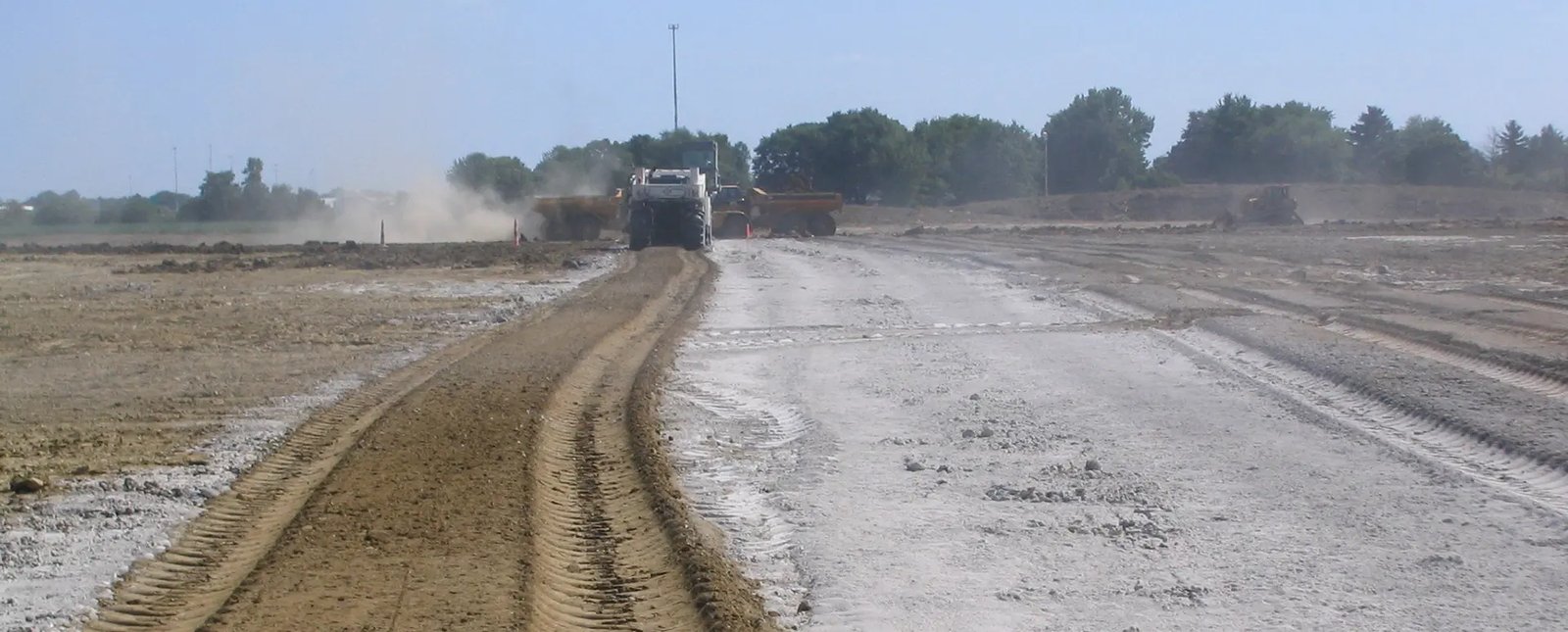
A reclaimer or mixer works the binder through the full treated depth, adding water to reach the moisture the mix design calls for. Lime-treated clay is usually allowed to mellow for a day or more, then remixed and compacted; cement-treated material must be compacted quickly, before it begins to set. The surface is then kept moist or sealed and protected from traffic through the curing period. This is a specialized form of the work we describe under engineered fill and soil stabilization.
Chemical treatment is sensitive to weather. Lime reactions slow in cold ground, and cement hydration is hindered by frost, so most treatment specifications set a minimum air and ground temperature, and an end-of-season cutoff. Wind on the Front Range can carry lime dust off the site in seconds, so we watch forecasts, wet the surface and sometimes postpone spreading on a gusty day.
Treated layers also cannot be left unprotected for long. A rain on freshly spread binder can wash it away, and a hard freeze on an unfinished layer can damage it. We plan spreading, mixing and compaction so that the area treated in a shift can be finished that shift, and we keep a plan for covering or sealing the surface when weather turns. On roads and yards the paving crew follows after the layer has cured, as covered in asphalt paving base preparation.
Treatment is an engineered activity. Unincorporated Weld County has adopted the 2024 International Building Code with engineered foundation designs required for most new structures, which reflects how closely foundation performance is tied to the soil beneath it, and public road and pavement projects typically carry their own treatment specifications. We work from the project specification and the geotechnical report and do not substitute binders or doses without engineer approval.
Quality control includes calibration of the spreader, depth checks of the treated layer, moisture and density tests after compaction and strength tests on cured samples where specified. Dust control and worker protection follow the safety data for the chosen binder, including eye and skin protection, since quicklime in particular is caustic. At completion we provide dose records, test results and a plan of the treated area so that future designers know where it is.
The demand for treatment comes largely from public and logistics work. Municipal and public works owners treat road subgrades to avoid thick pavement sections and to give contractors a stable surface in wet spells. Truck terminals and cross-docks, such as those described in truck terminal and cross-dock work, use treated subgrades beneath heavily loaded yards.
Town road networks that have grown quickly feel the pressure most. Milliken sits about two miles east of I-25 and, as a 2006 article recorded, its mayor said the town lacked a major roadway close enough to encourage commercial and industrial growth, a gap that new roads must fill. State Highway 56, a 9.5 mile route that runs from US 287 in Berthoud to I-25 exit 250 in Johnstown, is the kind of link that connects those towns to the interstate. We work in Milliken and Johnstown where road improvements and new yards often need a subgrade that is stronger than the native soil.
Send the geotechnical report and pavement section, plus the area to be treated. We will outline a testing program, a likely dose range and a price for treatment, mixing, compaction and curing.
Lime generally suits clay with high plasticity, while cement suits sandy or low-plasticity soils. Laboratory testing decides, because some soils respond to neither or need both. We recommend the test program before the binder is chosen.
The depth comes from the pavement design or the engineer, commonly in the range of 6 to 12 inches. Greater depths are possible in multiple passes. We verify depth in the field with probes or excavated test sections.
Lime in sulfate-bearing clay can produce expansive minerals, so we require a sulfate test first. If sulfate levels are elevated, the engineer may call for another method, such as cement, a different binder or replacement of the soil.
Lime-treated layers usually need a curing period measured in days, while cement-treated layers gain strength within days. The specification sets the minimum, and we work with the paving schedule to avoid delays.
We wet the surface, spread in calm conditions and use equipment with enclosed delivery. When wind is too strong we stop. Our goal is to keep binder on the ground and off the neighbors.